
Where Crystals Come From: The Origins Map
An evidence-graded map of representative mineral occurrences and product source claims, with clear limits on provenance, quality, value and ethics.
In this field note
“Where is this stone from?” can ask six different questions. It may mean where the mineral has been recorded, where commercial material is produced, what a supplier says about a parcel, whether a product has documented provenance, how far records trace the material, or whether custody remained controlled between each transfer. Those answers are not interchangeable.
This origins map is therefore an evidence index, not a quality heatmap. It gives representative, source-linked entry points for materials used across the BE. Journal and leaves gaps visible where suitable evidence was not found.
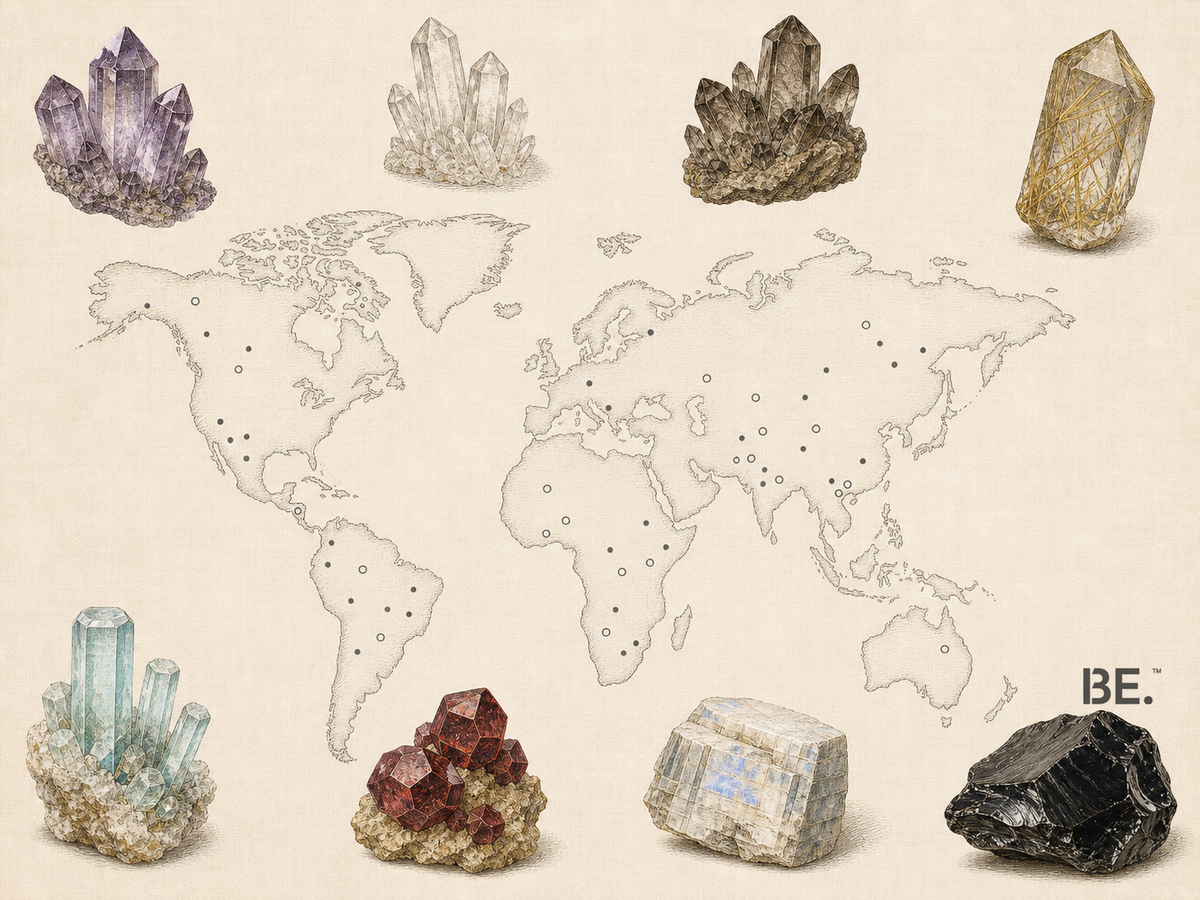
How to read this map
The map uses four evidence levels. They describe the strength and scope of a location claim, not a ranking of countries or stones. This local review found no current product mapping that qualifies for L1.
| Level | Meaning | Acceptable wording | Still not established |
|---|---|---|---|
| L1 | An upstream record was inspected and exact-lot continuity to the current object was verified. | “Documents reviewed for this exact lot through the stated chain segment.” | Ethical performance, quality or value without separate evidence. |
| L2 | A current brand- or supplier-documented product, lot, country or region claim that was not independently audited. | “Seller-declared region: India; independent verification not available.” | Mine-level origin, uninterrupted custody or ethical status. |
| L3 | An authoritative source documents the material at a representative locality. | “Documented occurrence in Bahia, Brazil.” | That a BE. product or any unlinked parcel came from there. |
| L4 | Suitable location evidence for the claim in question is unavailable. | “Origin unknown at this evidence level.” | No map point should be added by guessing from a product or trade name. |
Six origin terms that should not collapse into one
- Occurrence: a place where a material has been observed or collected. It need not be a present commercial source.
- Deposit or production region: a geological body or broader area associated with extraction. Production scale and dates still matter.
- Source claim: what a seller, supplier or other entity states about a parcel or product.
- Provenance: a documented claim about origin or history whose scope and verification method must be stated.
- Traceability: the ability to follow material through specified records and chain segments.
- Chain of custody: controlled records of transfers through a defined chain. The RJC’s current CoC standard covers gold, silver and platinum-group metals; it must not be presented as a coloured-gemstone or crystal CoC certification.
GIA notes that geographic-origin conclusions can be complex opinions built from reference samples, inclusions, chemistry and instrumentation. Deposits follow geology rather than political borders. Even when a laboratory can address origin for a suitable gem, that does not mean every bead can be assigned visually or economically.
Geology comes before borders
Quartz can crystallise in igneous, hydrothermal, metamorphic and sedimentary contexts; garnet species form under different conditions; feldspar moonstone can occur in several geological provinces. Political boundaries were drawn long after those rocks formed. One mineral can therefore occur across many countries, and one country can host many unrelated deposits.
For the formation settings themselves, use the four geological formation paths. For mineral identity and comparison, use the BE. Stone Library and Quartz Family Tree. Those pages own formation and taxonomy depth; this page owns the scale of location evidence.
Origin entry points for 17 BE. materials
Every row below is deliberately narrow. L3 rows are representative documented occurrences, not exhaustive world lists or product provenance. L4 rows stay blank on the map.
| Material | Representative location evidence | Level | Boundary and owner |
|---|---|---|---|
| Amethyst | GIA documents major or prominent sources in Rio Grande do Sul, Brazil; the Anahí mine in Bolivia; Zambia’s Kariba area; and Four Peaks, Arizona. | L3 | Representative sources, not a SKU claim. GIA source · material guide |
| Citrine | GIA lists Bolivia, Spain, Madagascar, Mexico and Uruguay among leading natural-citrine sources and separates this from amethyst commonly heated to citrine colour. | L3 | Do not map treated inventory back to a natural-citrine locality. GIA source · material guide |
| Smoky quartz | Mindat records smoky quartz across many regions worldwide. | L3 | Occurrence is not current production or product provenance. Mindat source · material guide |
| Rose quartz | GIA records massive rose quartz from countries including Brazil, India, Madagascar and Sri Lanka. | L3 | Keep massive rose quartz distinct from rare transparent euhedral pink quartz. GIA source · material guide |
| Clear quartz | Quartz has documented worldwide distribution. | L3 | Worldwide occurrence creates no origin hierarchy. Mindat source · material guide |
| Rutilated quartz | GIA documents golden rutilated quartz mining around Remédios in Bahia, Brazil. | L3 | One locality case, not the source of every rutilated-quartz lot. GIA source · material guide |
| Hematoid quartz | The reviewed GIA record supports hematite-in-quartz identity, but its dealer context does not establish locality for this map. | L4 · no point | Identity evidence is not origin evidence. GIA source · material guide |
| Blue Smoky quartz | No suitable authoritative location source was found for this market label in the reviewed evidence. | L4 · no point | Do not infer a deposit from the product name. material guide |
| Emerald Phantom quartz | A GIA chlorite-phantom case documents a specific analysed sample and locality context. | L3 case | Do not turn one case into a fixed global origin for a trade name. GIA source · material guide |
| Green Phantom quartz | A peer-reviewed study records chlorite phantom growth in rock crystal from the Fiescheralp area of Switzerland. | L3 case | One study site does not prove a commercial product’s origin. study · material guide |
| Super Seven | The reviewed authoritative sources did not provide a stable location definition for this trade-name scope. | L4 · no point | Unverified trade-name scope; use the Stone Library for navigation, not origin proof. |
| Aquamarine | GIA identifies Minas Gerais in Brazil, Pakistan’s Karakoram foothills and sources in Kenya, Madagascar, Nigeria, Zambia and Mozambique. | L3 | Representative sources, not a production ranking. GIA source · Stone Library |
| Garnet group | Garnet is a mineral group. GIA records species-dependent sources—for example, tsavorite in East Africa and spessartine in Namibia and Tanzania. | L3 | Name the garnet species before generalising a source. GIA source · full Garnet Guide |
| Moonstone | GIA identifies India and Sri Lanka as important sources and also lists Brazil, Madagascar, Myanmar and Tanzania. | L3 | General occurrence does not verify a product’s India claim. GIA source · material guide |
| Prehnite | GIA Gem Project records include specimens from Australia, South Africa and the United States. | L3 specimen | Specimen localities are not a ranking of commercial sources. GIA source · prehnite material guide |
| Kyanite | A 2014 GIA report lists gem-quality kyanite from Nepal, Brazil, Kenya, Tanzania and Madagascar and describes Indian material while saying production and supply were then unknown. | L3 · time-bounded | Historical locality note, not a current output ranking. GIA source · material guide |
| Obsidian | USGS documents obsidian-bearing lava flows at Yellowstone. | L3 | Obsidian is volcanic glass, not a crystal species; one occurrence does not prove product origin. USGS source · material guide |
Why origin is not grade, rarity or value
A country can contain several deposits, and one deposit can yield material across a wide quality range. Colour, transparency, inclusions, structural soundness, treatment, cutting, matching, disclosure and demand remain separate variables. GIA states this plainly for amethyst: origin alone does not add value; quality, especially colour, drives value regardless of country.
Origin can be relevant to geology, research, history or traceability. It becomes misleading when used as a shortcut—“best,” “rare,” “premium” or “ethical”—without evidence for that separate proposition. A more precise disclosure tells the reader who made the claim, what object or lot it covers, the geographic resolution, how it was verified and what remains unknown.
How far current product evidence reaches
Two current product pages offer L2 examples. The Bolivian Amethyst 6mm Strand Bracelet carries a seller-declared Bolivian/Andes context. The Moonstone Strand Bracelet carries a seller-declared India origin. These are current brand statements—not independently audited mine-level provenance, exact-lot continuity, quality evidence or ethical proof.
Five questions to ask about origin
- Who made the claim? Brand, immediate supplier, exporter, miner, laboratory or auditor?
- What does it cover? A material type, supplier parcel, exact lot, finished product or representative sample?
- What geographic resolution is supported? Country, region, mine, deposit or only a documented occurrence?
- What maintains continuity? Invoice, lot ID, transfer record, sealed parcel, testing or an audited control system?
- What remains unknown? Treatment, exact mine, intermediate stages, labour, environment or governance?
An unknown field is not automatically evidence of wrongdoing. It is a boundary on what can be claimed. Ethical due diligence has its own questions about people, environment and governance; an origin label is only one input and does not answer them.
Frequently asked questions
Q1.Does a point on this map prove where my bracelet came from?
No. An L3 point shows a documented occurrence for the material. Product provenance requires records that connect the relevant parcel or exact lot to the finished object.
Q2.Does a country of origin determine crystal quality?
No. Deposits and material vary within countries, and quality also depends on the individual material, treatment, cutting, matching and condition. Origin and quality need separate evidence.
Q3.Why can the same mineral occur in many countries?
Minerals form where the necessary chemistry, temperature, pressure, fluids and geological processes occur. Those settings can repeat across tectonic regions and do not follow modern political borders.
Q4.Is an origin report the same as chain of custody?
No. A laboratory origin opinion addresses geographic origin within its method and limits. Chain of custody records controlled transfers through a defined supply chain. Neither should be substituted for the other.
Q5.How should a seller-declared region be verified?
Ask who supplied the claim, which product or lot it covers, what dated records support it, whether continuity was checked and whether any independent laboratory or audit was involved.
Q6.Is an unknown origin automatically bad?
No. Unknown means the available evidence does not support a narrower claim. It should remain visible so the seller does not convert uncertainty into invented provenance, quality or ethical assurance.
References
- CIBJO — The Gemstone Book
- Gems & Gemology — The geographic origin dilemma
- GIA — What country do my gemstones come from?
- USGS — Mineral Commodity Summaries 2026: Gemstones
- Responsible Jewellery Council — Glossary
- Responsible Jewellery Council — 2024 Code of Practices guidance
- Responsible Jewellery Council — 2024 Chain of Custody guidance
- GIA — Does it matter where an amethyst is mined?
- GIA — Amethyst sources
- GIA — Aquamarine sources
- GIA — Garnet sources
- USGS — Yellowstone’s obsidian-bearing lava flows
Field Notes.
One stone at a time: its geology, and how to read quality. The Stone Buying Checklist comes with your first email.
By subscribing you agree to receive emails from BE. Unsubscribe anytime.
Sent. Check your inbox.