
Hematoid Quartz Guide: Iron Oxide Inclusions, Red Phantoms & Grading
Hematoid quartz explained — how hematite creates red phantoms in quartz, origin differences, name decoder, and a 5-point grading guide.
In this field note
Cut open a piece of hematoid quartz and the story of its formation is right there on the cross-section: translucent quartz interrupted by clouds, wisps, and phantom layers of red to brown pigment. That pigment is iron oxide, the most abundant colouring agent in the Earth’s crust, trapped inside one of the most common minerals on the planet. The combination should feel ordinary. It does not.
The grading notes further down come from the lot records BE. Crystal Jewellery keeps for its own hematoid material.Hematoid quartz is common. What makes it interesting is legibility. Every strand is a frozen geological process you can read with the naked eye: where the iron entered, when it stopped, and how the quartz lattice grew around it. The sections below cover the chemistry, the naming mess, major sources, and a practical grading framework for buyers.
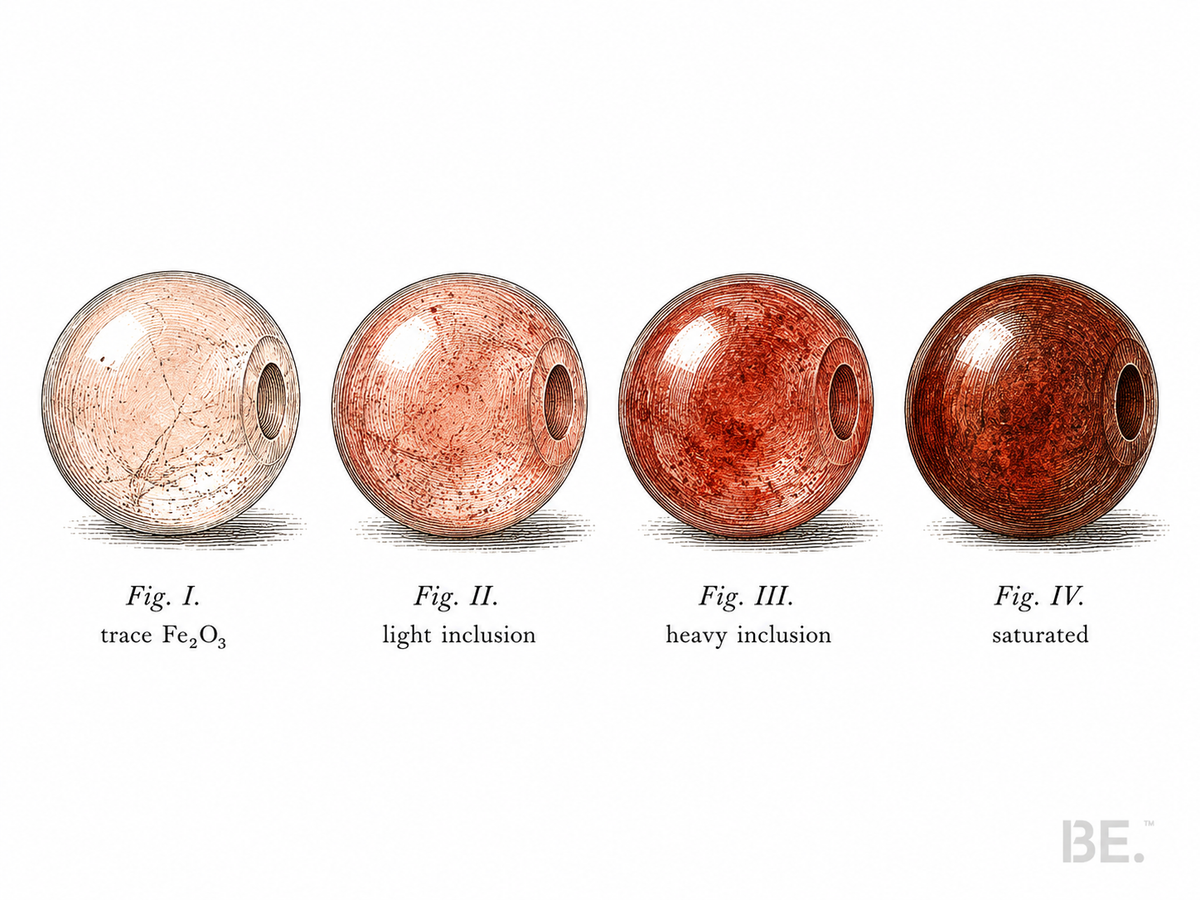
What makes hematoid quartz red
The red to brown colouration in hematoid quartz comes from microscopic particles of iron oxide included within the SiO₂ crystal lattice. “Iron oxide” is a family of compounds, and the specific species present determines the exact hue.
| Iron oxide species | Chemical formula | Colour contribution | Common occurrence in quartz |
|---|---|---|---|
| Hematite | Fe₂O₃ | Red to reddish brown | Primary colourant in hematoid quartz; finely dispersed platelets or phantom layers |
| Magnetite | Fe₃O₄ | Black to dark grey | Less common in quartz; occasionally found as discrete micro-inclusions |
| Goethite | FeOOH | Yellow to brownish orange | Often accompanies hematite; responsible for warmer, golden-brown tones |
| Lepidocrocite | γ-FeOOH | Reddish orange to orange | Found as thin platelets inside quartz; sometimes called “strawberry” inclusions |
In most hematoid quartz, hematite dominates. The particles are typically sub-micrometre in size. Individually they are too small to see. Together they scatter enough light to produce visible colour. When these particles accumulate along growth surfaces of the quartz crystal, they create phantom layers: ghost outlines of an earlier crystal shape preserved inside the larger crystal that grew around them. Phantoms occur in many quartz varieties. The high contrast between transparent quartz and opaque red hematite makes them unusually photogenic here.
The iron itself originates from iron-bearing fluids circulating through the host rock during or between growth phases. A crystal with multiple phantom layers records multiple pulses of iron-rich solution, sometimes spanning thousands of years. For a broader discussion of why iron produces different colours in different mineral hosts, see our guide to why iron looks different colours in crystals.
Hematoid vs strawberry vs fire quartz: the name decoder
Few gemstones suffer from as much naming confusion as this one. The same stone, or closely related stones, circulate under multiple trade names. Some overlap. Some contradict each other. Here is what each name typically refers to and where the boundaries blur.
| Trade name | Typical inclusion | Appearance | Notes |
|---|---|---|---|
| Hematoid quartz | Hematite (Fe₂O₃) | Red to brown clouds, wisps, or phantoms in clear-to-milky quartz | The most mineralogically precise name; directly references the hematite content |
| Fire quartz | Hematite | Same as hematoid quartz | A marketing synonym; “fire” references the red colour, not any optical effect |
| Strawberry quartz | Lepidocrocite or goethite, sometimes hematite | Pink to pinkish red, often more uniformly distributed than hematoid | Loosely applied; some vendors use it for any pinkish quartz with inclusions |
| Red phantom quartz | Hematite along growth surfaces | Distinct red “ghost” outline visible inside the quartz crystal | Describes a growth feature (phantom) rather than the mineral species |
| Ferruginous quartz | Any iron oxide / hydroxide | Variable: red, brown or yellow depending on iron species | A catch-all geological term; technically the broadest category |
The practical takeaway: hematoid quartz and fire quartz are the same thing. Strawberry quartz may or may not be the same thing depending on the vendor and the actual inclusion species present. If you care about precision, ask for the inclusion mineral rather than relying on the commercial name. For a broader look at iron-bearing red and orange gemstones, our guide to red and orange crystals covers the spectrum.
Origin fingerprints
Hematoid quartz is found worldwide, but three sources dominate the bead market. Each tends to produce material with recognisable characteristics, though significant overlap exists within any single locality.
| Source | Typical character | Common inclusion pattern | Market availability |
|---|---|---|---|
| Brazil (Minas Gerais | )High-clarity quartz with vivid red hematite phantoms; often shows well-defined growth layers | Sharp phantom layers, sometimes multiple concentric phantoms in a single crystal | The benchmark origin; steady supply, widest quality range |
| Madagascar | Warmer, more orange-toned hue; sometimes includes goethite alongside hematite | Diffuse, cloud-like distribution rather than sharp phantoms | Moderate supply; well-regarded for deeply saturated pieces |
| China (various provinces | )Variable; ranges from very pale blush to heavily included dark red-brown | Mixed; both phantom-style and dispersed inclusion patterns | Large volume; quality varies significantly between mines and parcels |
Origin alone does not determine quality. A well-selected parcel from any of these sources can produce exceptional beads, and a poorly sorted parcel from even the most celebrated mine will disappoint. What origin does influence is the general character of the inclusions. Sharp red phantoms are more common in Brazilian material, a softer, warmer diffusion in Malagasy material. Choosing between them is a matter of taste. Neither reads as the better material.
Reading a hematoid quartz strand
Evaluating a hematoid quartz bracelet requires looking at both the quartz host and the iron oxide inclusions. Neither component tells the full story on its own. Five criteria, taken together, separate ordinary strands from well-sorted ones.
- Inclusion visibility. The hematite should be clearly visible: clouds, wisps, or phantom layers that give each bead obvious internal character. Beads where the inclusion is so faint it could be mistaken for slight cloudiness are graded lower. You should be able to see the iron oxide without holding the bead against a light source.
- Colour saturation. Richer, more vivid reds and red-browns indicate a higher density of finely dispersed hematite. Pale, washed-out pink suggests either very low iron content or a different inclusion species entirely. The most desirable strands show a confident, unambiguous red.
- Quartz clarity. The quartz between the inclusions should be transparent to translucent. Chalky or opaque material fails here. High clarity creates contrast, so the red inclusions stand out against a clean background. When the quartz itself is milky, the inclusions lose definition and the bead looks muddy.
- Phantom definition. If phantoms are present, they should be reasonably sharp: a distinct outline, readable at arm's length. Well-defined phantoms are rarer because they require an abrupt change in growth conditions, and they are the feature most likely to draw a second look.
- Strand consistency. All beads on a strand should be visibly from the same family: similar inclusion density, similar hue, similar clarity. A strand where one bead is deep red and the next is nearly clear reads as poorly sorted.
Care, durability, and grading
Hardness and wear
Hematoid quartz inherits the durability of its host mineral. Quartz sits at Mohs 7, which places it comfortably above most everyday abrasives. Your strand can handle daily wear without significant risk of scratching. The hematite inclusions, being fully enclosed within the quartz lattice, are protected from the environment. They will not oxidise further, fade, or leach out.
- Water exposure. Brief contact with water during hand-washing is harmless. Prolonged submersion is unnecessary but unlikely to cause damage. The elastic cord, however, degrades faster when repeatedly saturated. Remove the bracelet before swimming or showering. The cord is what suffers.
- Sunlight. Hematite’s red pigment is photostable. Unlike some organic dyes, Fe₂O₃ does not fade in UV light. You can wear a hematoid quartz bracelet outdoors without concern for colour loss.
- Cleaning. Warm water with a drop of mild soap and a soft brush is sufficient. Rinse thoroughly, pat dry. Ultrasonic cleaners are generally safe for quartz but unnecessary for routine maintenance.
How BE. grades hematoid quartz
Each parcel is assessed for inclusion visibility, colour saturation, quartz clarity, and bead-to-bead consistency. Beads are sorted under standardised lighting and grouped by visual grade before stringing. The Lot ID printed on your strand’s tag traces back to the specific sorted parcel, meaning two strands from the same lot will show closely matched character. The same criteria apply to every parcel, so the sort can be repeated.
Each hematoid strand in the BE. Crystal Jewellery collection ships with a Stone Origin Record. Where that record does not fix the inclusion species, it says so instead of choosing the more saleable name.
Frequently asked questions
Q1. What is hematoid quartz?
Hematoid quartz is macrocrystalline quartz (SiO₂) that contains inclusions of hematite (Fe₂O₃), an iron oxide mineral. The hematite gives the quartz a red to reddish-brown colour, often appearing as clouds, wisps, or phantom growth layers inside the crystal. It is a naturally occurring variety found in multiple localities worldwide.
Q2. Is hematoid quartz the same as fire quartz?
Yes. Fire quartz is a trade synonym for hematoid quartz. Both names refer to quartz coloured by hematite inclusions. The name “fire quartz” refers to the red colour. There is no optical fire effect in this material. The two terms are interchangeable, though hematoid quartz is the more mineralogically precise name.
Q3. What makes hematoid quartz red?
The red colour comes from sub-micrometre particles of hematite (Fe₂O₃) dispersed within the quartz crystal lattice. Hematite is the same iron oxide responsible for the red colour of rust, red soil, and ochre pigment. The denser and more finely dispersed the hematite particles, the deeper and more vivid the red.
Q4. Is hematoid quartz natural or treated?
Hematoid quartz is natural. The iron oxide inclusions form during the crystal’s growth, when iron-bearing fluids enter the crystallisation environment. There is no commercial treatment that replicates the characteristic phantom layers and dispersed clouds of natural hematoid quartz. Some dyed quartz exists on the market, but it produces a uniform, surface-concentrated colour that looks distinctly different from natural hematite inclusions under magnification.
Q5. What is the difference between hematoid quartz and strawberry quartz?
The distinction is blurred in the trade. Strictly, strawberry quartz contains lepidocrocite (γ-FeOOH) or goethite (FeOOH) inclusions rather than hematite, producing a pinker, more uniformly distributed colour. In practice, many vendors use “strawberry quartz” loosely for any pinkish or reddish included quartz regardless of the actual inclusion species. If precision matters, ask the seller to specify the inclusion mineral.
References
Field Notes.
One stone at a time: its geology, and how to read quality. The Stone Buying Checklist comes with your first email.
By subscribing you agree to receive emails from BE. Unsubscribe anytime.
Sent. Check your inbox.