
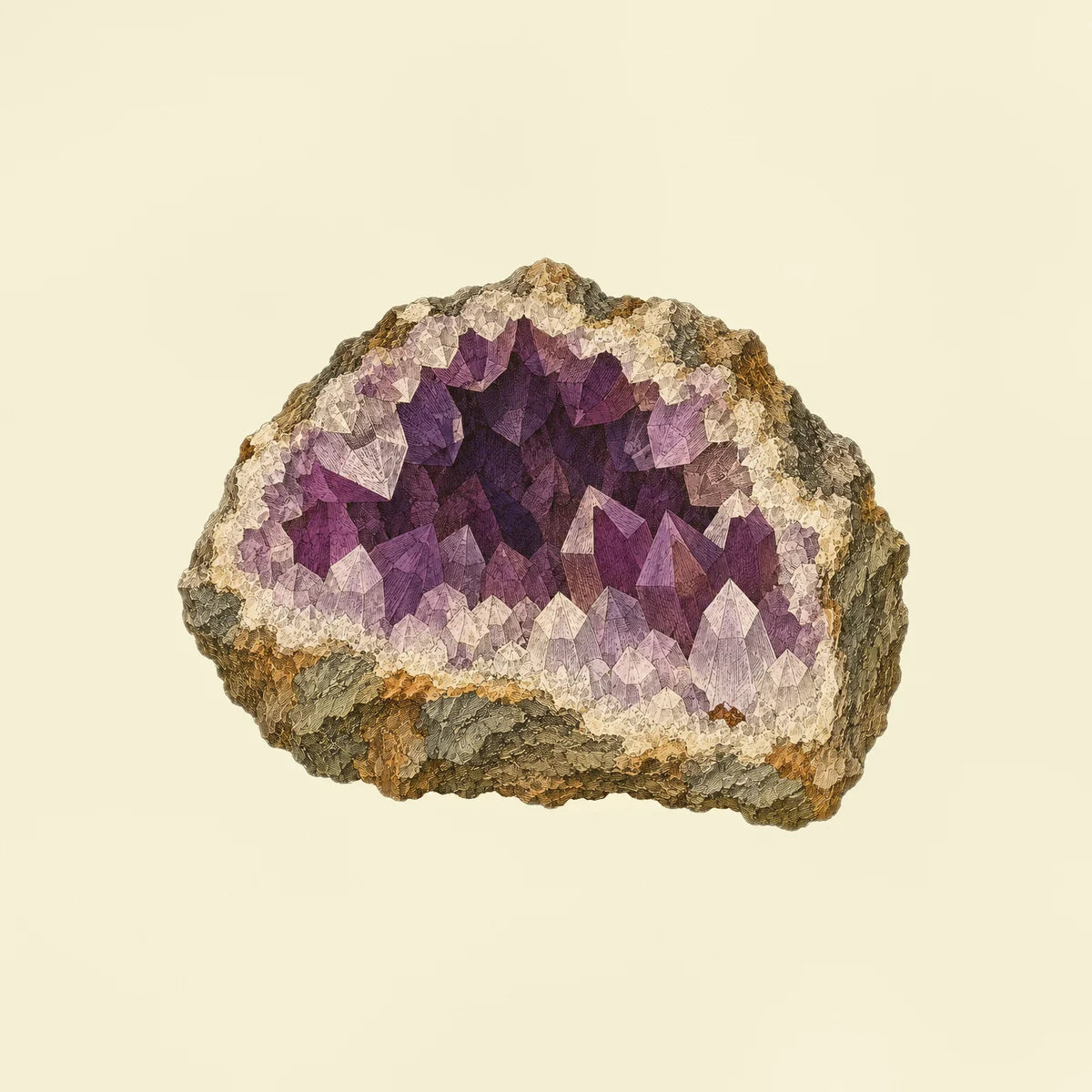
Stone No. 02 · The Void series
Amethyst
The colour came later, from a second process working on it over time.
- Mineral
- Amethyst, the purple variety of quartz
- Ideal formula
- SiO₂
- Crystal system and hardness
- Trigonal, Mohs 7
- Origin
- Bolivia
- Treatment
- Untreated. No heating, dyeing, coating or irradiation.
Amethyst
Pieces in this stone.
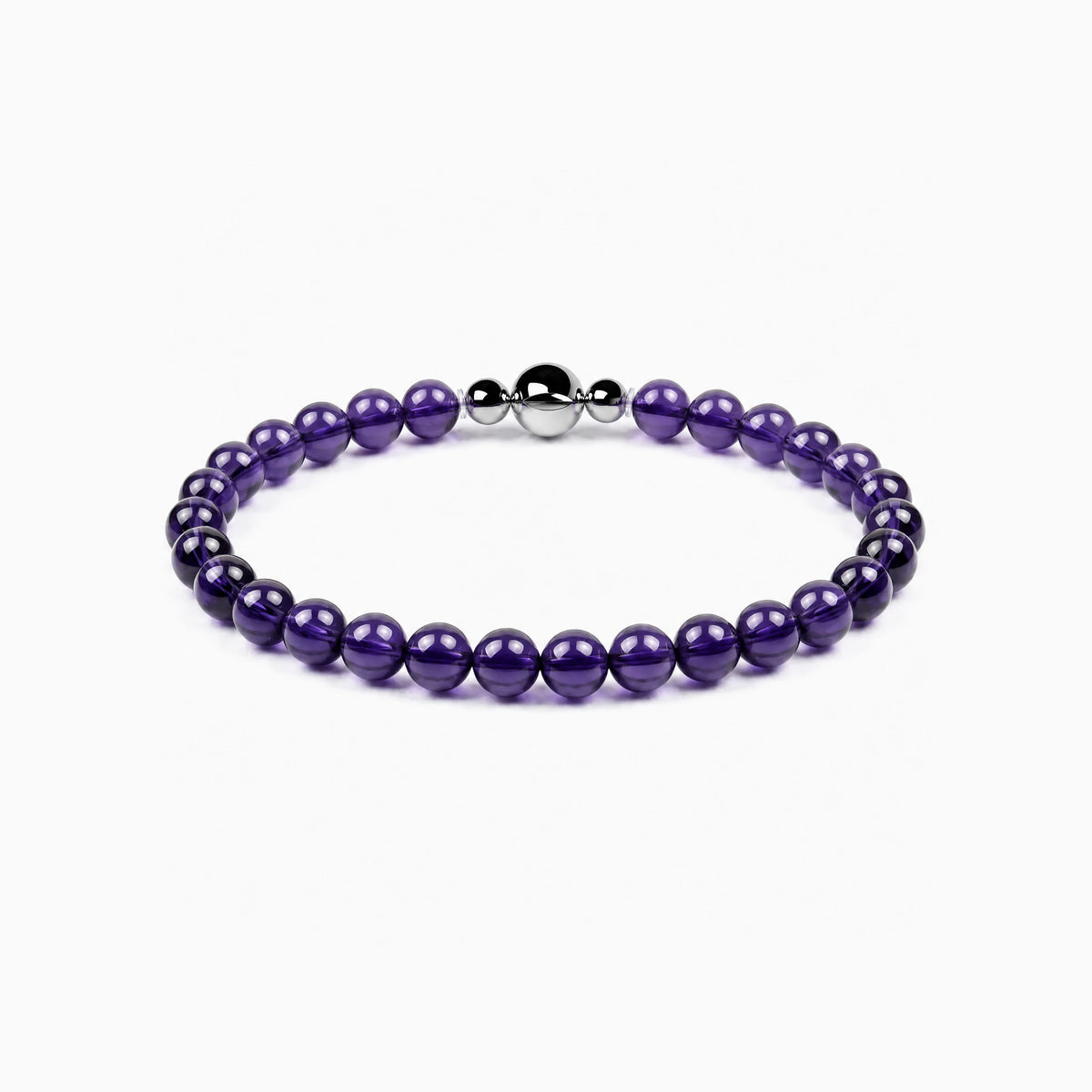
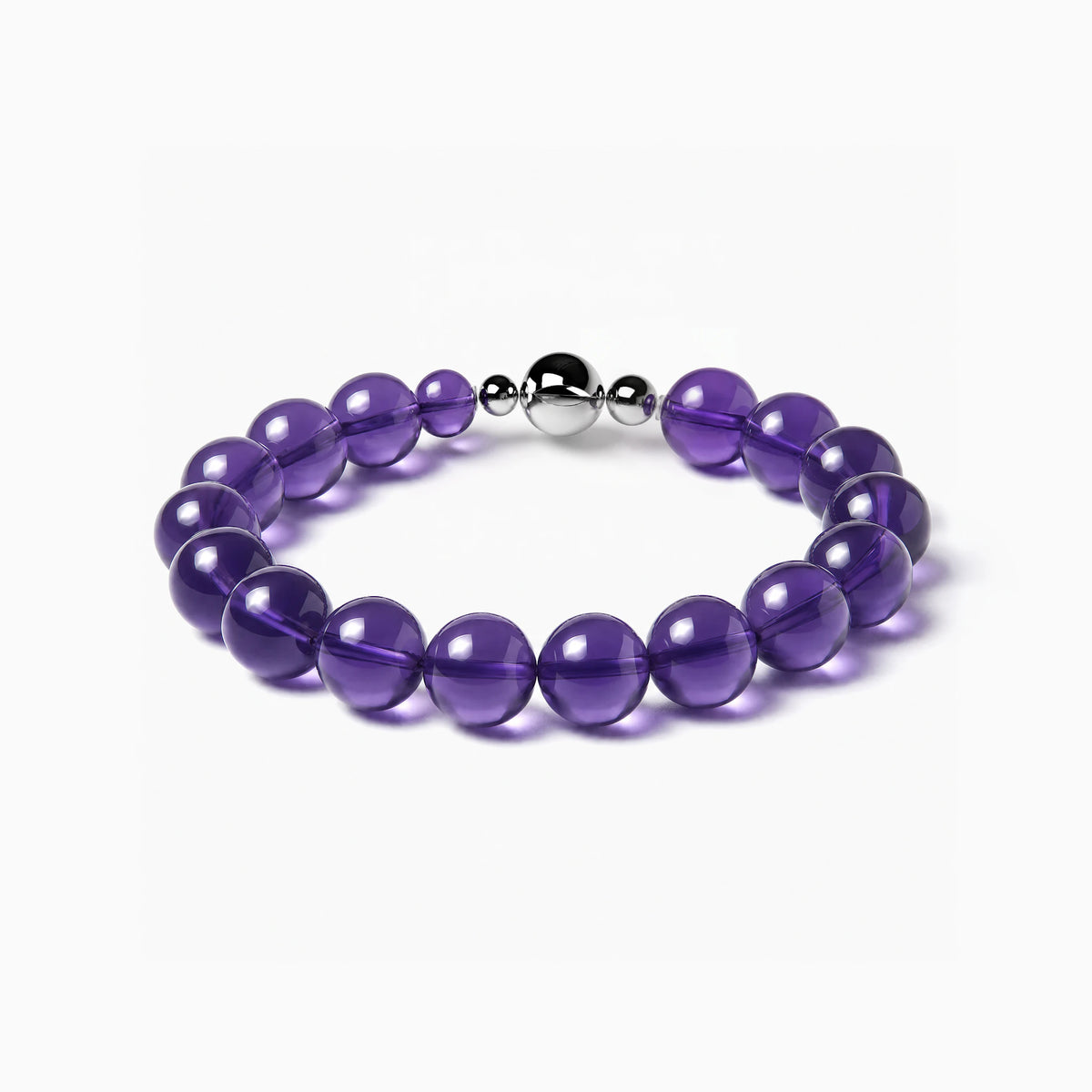
Two amethyst strand bracelets, in 6mm and 10mm beads, from $500. The amethyst is Bolivian and untreated, so the violet is the colour it came out of the ground with, and every piece ships with a Stone Origin Record. At Mohs 7 it takes everyday wear; keep it out of long hours of direct sun, which can slowly pale the colour.


On this page
How it formed
Between about 900 and 500 million years ago, in what is now eastern Bolivia near the border with Brazil, carbonate sediment settled in layers and hardened into limestone, and an episode of mountain building later folded it. Somewhere in that span, between about 575 and 542 million years ago, the first large, complex living things appeared in the sea.
Later, faults cracked the limestone into sharp-edged fragments. Hot water carrying silica pushed into the gaps. As the pressure on it fell, the water boiled, and on the wall of one small cavity silicon and oxygen began to come out of it and lock together. A crystal of quartz had started. It was clear, with no violet in it. Today the place is the Anahí mine.
The crystal lengthened face by face into a prism, in the trigonal pattern of quartz. With the silicon and oxygen it took in a little iron, Fe³⁺, a few atoms set into particular sites among a great many others. The foreign atoms that colour quartz rarely make up more than 0.1 percent of its weight.
The colour came later. Natural ionising radiation passed through the crystal and turned the sites where the iron sat into colour centres. Each centre absorbs part of the light that enters the quartz, and the light that passes through comes out violet. The violet gathered in zones that follow the faces the crystal had grown, a darker layer next to a paler one.
Heat could take it away again. Some amethyst loses its violet at a few hundred degrees, and some turns yellow or green. The violet crystals found today grew in rock that stayed cool enough for the colour to last.
In 1925 Edward F. Holden, a doctoral student at the University of Michigan, put amethyst to that test. He heated three specimens for 82 hours at about 235 °C, and only one lost any colour, and only part of it. After 49 hours at about 310 °C the other two had paled. It took several hours at 385 to 420 °C to clear the violet completely, and more heat turned the quartz yellow, then milky.
Holden also looked at where amethyst is found. Iron minerals such as hematite and goethite were usually there with it, and in the Lake Superior district the violet was deepest just beneath a thin layer of hematite. He concluded that iron is essential to the colour. Earlier workers had already shown that radium could bring the violet back to amethyst that heat had cleared.
A crystal that reaches a cutter is chosen for its colour, clarity and size. It is ground into a sphere and polished, and the prism faces are gone. Where it had colour zones, they stay, crossing the bead at whatever angle the cut met them.
How to look at yours
Turn an amethyst bead in daylight and the violet moves with it, clear in the light and deeper in shade. Where a bead has colour zones, a paler band sits against a darker one: the layers the crystal added as it grew, now running across a sphere. The violet itself is the iron the crystal took in while it grew, changed afterwards by natural radiation.
The amethyst in our strands comes from Bolivia and has not been treated, so its violet is the colour it came out of the ground with. Each strand comes with a Stone Origin Record.
One way to read it
One way to read this: gemmologists know that iron alone does not turn quartz purple. The violet appears only after natural radiation has worked on iron-related sites inside the crystal. The iron was there first. The colour came later, from a second process working on it over time.
Whole before anything. The meaning is yours.
Amethyst: questions before you buy
Is Bolivian amethyst natural, or heated or lab-grown?
Ours is natural and untreated. Heat turns amethyst yellow, which is why most heated amethyst is sold as citrine rather than as amethyst; lab-grown amethyst also exists and is hard to tell from natural by eye. Each BE. lot is recorded as untreated on its Stone Origin Record: no heating, dyeing, coating or irradiation.
Does amethyst fade in sunlight?
It can, slowly. The violet comes from colour centres that strong light and heat bleach over months of exposure, which is why specimens left in shop windows pale. Wearing it outdoors is fine. Store the strand out of direct sun and away from radiators, and the colour stays.
What is the difference between Bolivian and Brazilian amethyst?
Mainly depth of colour and how much there is. Bolivian amethyst from the Anahí mine tends towards a deep, saturated violet and often grows beside ametrine. Brazilian amethyst is far more plentiful and runs from pale lilac to medium purple. Our strands are Bolivian; the origin is written on each Stone Origin Record.
Should I choose the 6mm or the 10mm amethyst strand?
Choose 6mm for a finer line that sits flat under a cuff and beside a watch, and 10mm for a bolder strand where each bead and its colour zoning shows. Both come from the same Bolivian lot. Measure your wrist before you pick a length; the size guide shows how.
Stone Explorer
Compare amethyst varieties
Amethyst beside chevron, ametrine, prasiolite and pink amethyst.
OPEN THE AMETHYST EXPLORER →