
Amethyst Varieties: Trade Names, Origins and What They Mean
A geology-first guide to amethyst varieties, locality labels, growth patterns and trade names, with clear evidence limits for origin, treatment and rarity.
In this field note
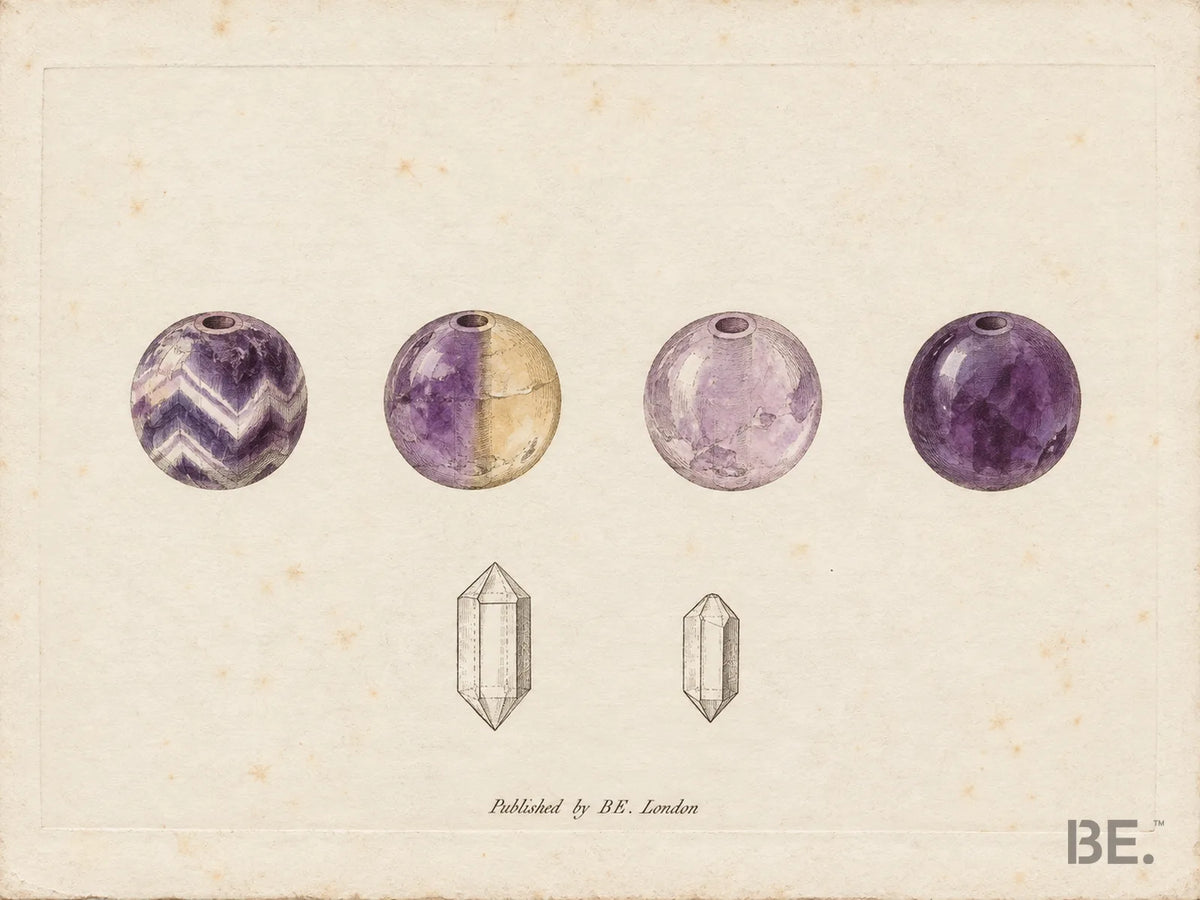
Take four names you can meet on the same shelf. “Chevron” describes a pattern. “Vera Cruz” is a trade name tied to a locality. “Rose de France” is a colour term. “Ametrine” is quartz with purple and yellow-to-orange zones in one crystal. Each name answers a different question, and the sections below sort them one category at a time.
One mineral, several naming systems
At ordinary conditions, amethyst is macrocrystalline quartz with the chemical formula SiO2. Its purple colour is linked to iron-related colour centres and irradiation during or after growth. That mineral identity stays the same across many shades, origins and external shapes.
| Category | Examples | What the name can tell you | What it cannot prove |
|---|---|---|---|
| Mineral variety | Amethyst | Purple macrocrystalline quartz | Mine, treatment history or commercial grade |
| Colour-zoned quartz | Ametrine | Purple amethyst and yellow-to-orange citrine zones in one quartz crystal | Natural origin, mine or formation mechanism from appearance alone |
| Growth or texture | Chevron, phantom, sceptre, drusy | Visible banding, overgrowth or crystal habit | A separate mineral species or a universal quality grade |
| Locality or trade origin | Vera Cruz, Brandberg, Zambian, Uruguayan, Brazilian | A claimed source or a market style associated with a source | Origin without traceable provenance |
| Colour or market grade | Rose de France, Deep Siberian | A pale or richly saturated colour description used in trade | A laboratory-standard grade shared by every seller |
| Altered or green quartz | Prasiolite, “green amethyst” | Green quartz that may be natural or produced from suitable material by treatment | That green quartz remains purple amethyst, or that it is untreated |
| Sample-specific trade label | Pink amethyst, Auralite-23 | A seller or occurrence-specific description that may guide further questions | Uniform composition across all material carrying the label |
How to read an amethyst name
Locality names need provenance
A locality can be geologically meaningful. It may point to a particular host rock, mine or style of growth. It is still a claim that needs a record. Colour, crystal size and inclusions overlap between deposits, so a photograph cannot certify “Brandberg”, “Uruguay” or “Zambia”. The useful evidence is a supplier invoice, mine or region statement, lot record, and any independent report that can be tied to the same material.
Patterns are not species
Chevron amethyst shows repeated pale and purple banding, commonly in a V-shaped or zigzag arrangement when cut. Phantom describes a visible earlier growth stage enclosed by later quartz. Sceptre and drusy describe external growth forms. These terms can be accurate and visually useful without making the material a new mineral.
Colour grades are not universal
“Rose de France” usually signals pale, delicate purple. “Deep Siberian” is often used for strongly saturated purple with flashes of red or blue. Neither term creates a universal grading scale. Compare the actual stone under controlled neutral light, and ask whether images, treatment disclosure and return terms refer to the exact piece or lot.
Multi-colour and treated quartz need a second question
Ametrine is quartz with amethyst and citrine colour zones. Natural material is well documented, and synthetic material also exists. Prasiolite is green quartz; natural examples are uncommon, while treated green quartz is present in the market. The useful next question is “What material is this specimen, and what treatment and origin evidence accompanies it?”
Pink and composite trade labels are sample-specific
Published work supports the use of “pink amethyst” for particular material from the El Choique occurrence in Argentina. That does not turn every pale pink quartz object sold online into the same material. “Auralite-23” is also a trade label with no standing as a mineral species; claims about its inclusions must be demonstrated on the specimen itself.
What origin evidence can show
Origin evidence comes in layers. Each layer answers a different question:
- Seller disclosure: what the supplier represents the material to be.
- Lot continuity: whether the invoice, photographs and finished pieces can be tied to the same batch.
- Gemological testing: what can be established about material identity, treatment or natural versus synthetic growth.
- Geographic origin opinion: a specialised conclusion that may be unavailable or inconclusive for quartz.
A named mine on a product page, a laboratory origin opinion and a mine-chain record are three different claims. Good disclosure keeps them separate.
Choosing between amethyst “types”
Begin with the decision you need to make. For colour, compare saturation, zoning and how the stone looks in neutral daylight and warm indoor light. For a crystal specimen, examine habit, damage, repairs and matrix. For jewellery, consider drilling, polish, durability of the assembly and treatment disclosure. For locality collecting, prioritise the chain of records over a visual resemblance to online photographs.
Uniform colour and high clarity can be attractive, but they do not prove natural origin. Inclusions and uneven zoning may be consistent with natural growth, but they do not certify it either. Natural and hydrothermal synthetic amethyst can require laboratory methods to separate reliably.
Where to go deeper
The other amethyst questions each have their own page. Why amethyst is purple and how quartz is built is covered in the amethyst complete guide. What light and heat do to the colour is in how amethyst turns violet. Pink amethyst against rose quartz is in amethyst vs rose quartz. The four formation routes behind these stones are in four geological formation paths. To see chevron, ametrine and pink amethyst side by side, open the amethyst Stone Explorer.
Frequently asked questions
Q1.How many types of amethyst are there?
Mineralogically there is one: amethyst is purple quartz. The additional terms need to be sorted by category.
Q2.Is chevron amethyst a different mineral?
No. Chevron describes visible banding or zoning in quartz, and the mineral underneath stays quartz.
Q3.Is ametrine a type of amethyst?
Ametrine is colour-zoned quartz containing both amethyst and citrine regions. It is useful to group it with amethyst for comparison. The name itself refers to the two-colour material.
Q4.Is “green amethyst” the same as prasiolite?
“Green amethyst” is a market phrase for green quartz, often called prasiolite. The phrase can obscure whether the colour is natural or treatment-produced, so ask for the material and treatment disclosure.
Q5.Can colour prove where amethyst came from?
No. Deposits can overlap in colour and appearance. A defensible origin claim needs traceable records and, where possible, appropriate expert testing.
References
Field Notes.
One stone at a time: its geology, and how to read quality. The Stone Buying Checklist comes with your first email.
By subscribing you agree to receive emails from BE. Unsubscribe anytime.
Sent. Check your inbox.