
How Crystals Form: Four Geological Paths (Igneous to Hydrothermal)
A geology-first walk through the four ways crystals form — igneous, metamorphic, sedimentary and hydrothermal — and what each path tells you about a stone.
In this field note
Put a clear quartz point next to an amethyst point: same chemistry, same hardness, same crystal system. Add a garnet prised out of schist and a turquoise nodule from a desert. Four stones, four different ways of growing. How a crystal grew leaves marks on the finished stone, and once you know what the four routes look like you can usually tell which one you are holding. BE. Crystal Jewellery records the formation path for every lot it buys.
The four paths are igneous, metamorphic, sedimentary and hydrothermal. Each section below gives the typical minerals and the visual clues that give the path away on a finished crystal.
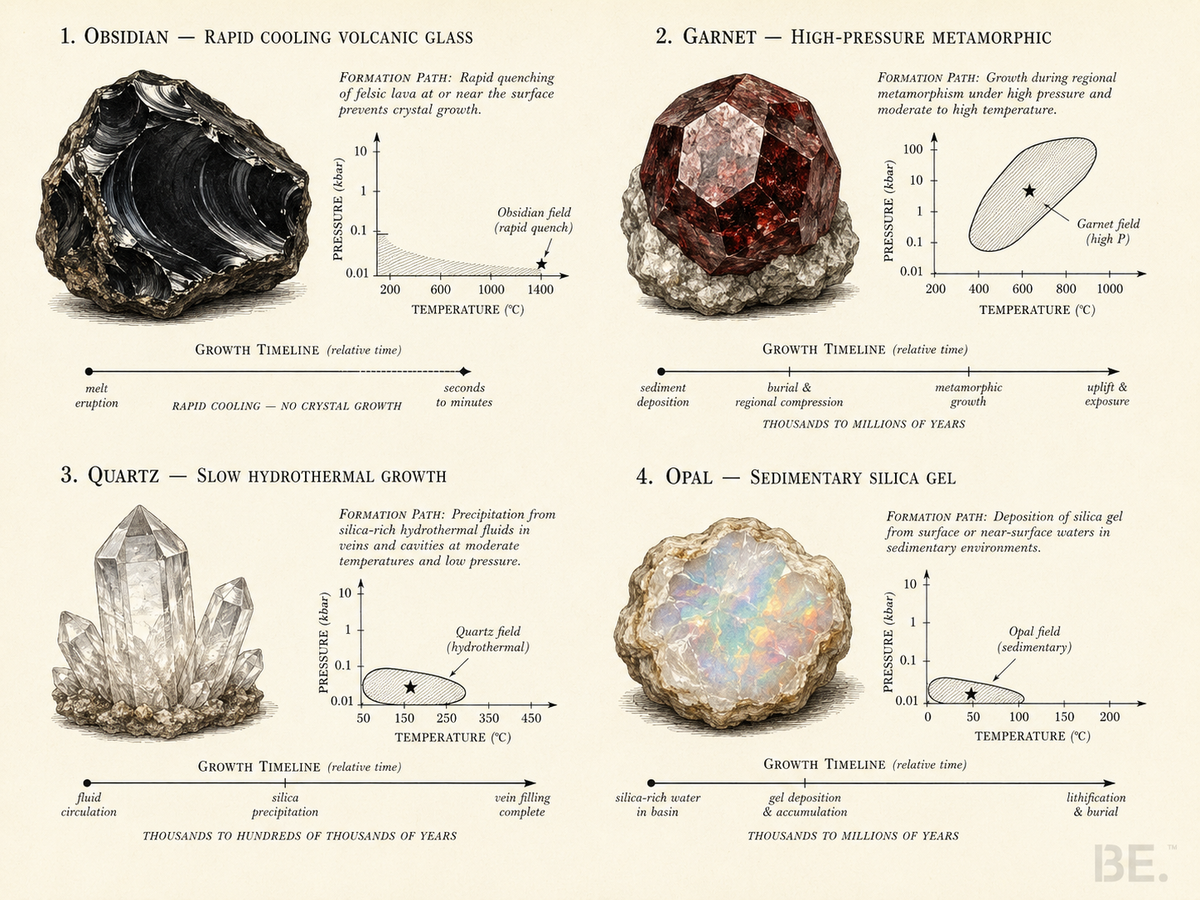
Path 1: Igneous
Igneous crystals grow directly out of cooling molten rock. The starting condition is magma, a hot fluid of silicate ions somewhere between 700 °C and 1300 °C. The trigger is temperature dropping below the point at which each mineral becomes thermodynamically stable. Different minerals freeze out at different temperatures. That is why a single cooling magma can produce a whole sequence of different crystals as it cools.
The decisive variable is cooling speed. Magma that cools deep underground, insulated by overlying rock, may take a hundred thousand years to solidify. Atoms have time to organise into large, well-formed crystals: this is how granite and pegmatite are made. Magma that erupts to the surface and chills against air or water in days produces fine-grained rock (basalt) or, if cooling is fast enough, no crystals at all (obsidian).
Pegmatites are the slowest, water-rich, late-stage pockets of a cooling magma. They are where collectors find the spectacular igneous specimens: large topaz, aquamarine, tourmaline, spodumene, gem-grade feldspar. The water content matters because dissolved water lowers the freezing temperature and keeps the system fluid long enough for very large crystals to form. Single tourmaline crystals over a metre long have been recovered from pegmatite cavities.
Common igneous crystal species: quartz, feldspar, olivine, mica, hornblende, topaz, beryl, tourmaline, spodumene. Visual signature: clean external faces if grown in a cavity; otherwise interlocking grains with no preferred orientation.
Path 2: Metamorphic
Metamorphic crystals grow inside rock that never melts. The starting condition is a pre-existing rock of any kind: sedimentary, igneous or older metamorphic. Heat (typically 200–800 °C), pressure, or both act on it, usually because the rock has been buried deep in a mountain-building event or pushed against a hot intrusion. Existing minerals become unstable at the new conditions and recrystallise into new ones, atom by atom, in the solid state.
Because the rock is solid throughout this process, growing crystals have to push against their neighbours for space. The result is often a flattened, foliated texture (schist, gneiss) and crystals with unusual shapes constrained by the available room. Garnet’s classic twelve-faced dodecahedra, kyanite’s blue blade-like tablets and staurolite’s twinned crosses are all signatures of growth under directional stress.
Metamorphic minerals are particularly useful for geologists because each one is stable only within a narrow temperature-pressure window. Find sillimanite in a rock and you know the rock saw at least 600 °C and several kilobars of pressure. Find kyanite and a different blade is in the window. Geologists use these as natural thermometers; jewellery buyers can use them as proof of origin.
Common metamorphic crystal species: garnet, kyanite, sillimanite, staurolite, andalusite, epidote, tremolite, ruby (in marble), sapphire (in some occurrences). Visual signature: blocky or tabular shapes embedded in a foliated host rock; rarely free-standing prisms.
Path 3: Sedimentary
Sedimentary crystals form at or near the Earth’s surface, at low temperatures, almost always from water. The starting condition is water carrying dissolved ions; the trigger is evaporation, a chemistry change, or contact with a different rock that destabilises the dissolved load and forces precipitation. The process is slow, low-energy, and tends to produce crystals in layers, crusts and replacements rather than discrete prismatic individuals.
Several routes count as sedimentary. Evaporite crystals (gypsum, halite) form when shallow seas or lakes dry out. Replacement crystals (turquoise, malachite, azurite) form when mineral-bearing groundwater seeps through porous rock and deposits its load in the available pore spaces. Biogenic minerals (aragonite in pearls and shells, calcite in coral) are precipitated by living organisms from seawater. Cementation products like agate and chalcedony fill cavities in older rocks with slow, layered silica.
Most sedimentary stones are not transparent and do not form free-growing prisms. Instead they form bands, layers, botryoidal crusts and massive concretions. The stone tells you about a particular surface chemistry. Turquoise, for instance, only forms where copper, aluminium and phosphate solutions converge in an arid environment, which is why every major turquoise deposit on Earth lies within a desert.
Common sedimentary crystal species: turquoise, malachite, azurite, opal, chalcedony, agate, gypsum, halite, aragonite, calcite. Visual signature: banded, layered or massive textures; little or no transparent prismatic habit.
Path 4: Hydrothermal
Hydrothermal crystals grow from hot, mineral-saturated water moving through cracks and cavities in rock. The water carries dissolved silica and other ions extracted from the country rock; when temperature, pressure or chemistry shifts as the fluid moves, the dissolved load precipitates onto cavity walls and grows into crystals one atom at a time. Temperatures range from about 50 °C at the cool end up to around 400 °C in the hottest systems.
This is where most of the dramatic crystal cabinets come from. Hydrothermal growth is slow, often millions of years per centimetre. The fluid delivers ions cleanly enough to build transparent, well-faceted crystals on open cavity walls. Most of the geodes that line collector shelves are hydrothermal: a cavity in basalt or rhyolite, opened by gas bubbles when the rock first cooled, and slowly filled over geological time with chalcedony, quartz, amethyst and calcite.
The colour of hydrothermal amethyst depends on iron picked up from the host rock. The clarity of hydrothermal quartz depends on how steady the fluid chemistry stayed during growth. Fluctuating conditions produce phantoms, visible internal boundaries between growth episodes. Hydrothermal stones are often the most visually accessible of all four paths, because they grew in free space.
Common hydrothermal crystal species: amethyst, citrine, clear quartz, smoky quartz, fluorite, calcite, pyrite, galena, gold (in some quartz veins). Visual signature: clean external faces, transparency, prismatic habit, often growing on a base of the country rock.
The four paths at a glance
| Path | Temperature range | Typical minerals | Visual signature |
|---|---|---|---|
| Igneous | 700–1300 °C | Quartz, feldspar, olivine, topaz, beryl, tourmaline | Interlocking grains; clean prisms in pegmatite cavities |
| Metamorphic | 200–800 °C + pressure | Garnet, kyanite, sillimanite, staurolite, ruby (in marble) | Blocky / tabular crystals embedded in foliated rock |
| Sedimentary | 0–200 °C, surface | Turquoise, malachite, opal, agate, gypsum, calcite | Banded, layered, massive; rarely free prisms |
| Hydrothermal | 50–400 °C | Amethyst, citrine, clear quartz, fluorite, calcite | Transparent prisms on cavity walls; geode interiors |
Reading a stone’s formation history
Once you know the four paths exist, working out which one produced a stone in front of you is mostly a matter of looking for a small set of features. None of these is foolproof. The four paths overlap at their edges, and some species form by more than one route. Together, though, they give you a quick first guess that is usually right.
- Transparent free-standing prism. Usually hydrothermal (amethyst, quartz, fluorite) or pegmatitic igneous (topaz, beryl). Both produced free space and slow growth.
- Blocky crystal embedded in a foliated rock. Almost always metamorphic. Garnet in schist is the textbook case.
- Banded or layered texture without discrete crystals. Sedimentary. Agate, malachite, turquoise.
- Crystal interlocked with other crystals in a coarse rock. Igneous, usually plutonic (granite, pegmatite). Each grain grew against its neighbours as the magma froze.
- Microscopic inclusions of fluid or other minerals. All four paths produce inclusions, but the type tells you which: needle-like rutile from metamorphic or pegmatitic origins, two-phase fluid bubbles from hydrothermal, mineral pseudomorphs from sedimentary.
How BE. uses formation path
Every BE. strand ships with a Stone Origin Record. It records the formation path alongside the source region. An amethyst from Bolivia is logged as hydrothermal, a garnet from Mozambique as metamorphic, a rose quartz from a Brazilian pegmatite as igneous. The Crystal 4T framework (Transparency, Tone, Texture and Treasure) is calibrated to what each path tends to produce. A hydrothermal amethyst is graded against the transparency standards for its growth route, never against the milky standard of a sedimentary stone. The path is part of the stone’s identity. BE. Crystal Jewellery writes it onto the lot record, so the information stays with the stone.
Frequently asked questions
Q1.Can a single mineral form by more than one path?
Yes. Quartz, for example, forms igneously in granite, hydrothermally in veins, and sedimentarily as chalcedony and agate. Each occurrence has a different texture and inclusion type, so a trained eye can usually tell them apart even though the chemistry is identical.
Q2.Which path produces the most transparent crystals?
Hydrothermal growth, generally. Slow precipitation from a clean fluid onto an open cavity wall is the most reliable way to build a transparent prism. Pegmatitic igneous growth comes a close second.
Q3.Why are sedimentary stones rarely transparent?
They grow in pore spaces, in layers and crusts, often replacing earlier minerals atom by atom. The result is fine-grained, polycrystalline material rather than single crystals.
Q4.Does formation path affect a stone’s hardness?
Not directly. Hardness depends on the lattice structure, which is the same for a given mineral regardless of how it formed. Path affects size, transparency, inclusion patterns and external shape, but not the Mohs number.
Q5.How can geologists tell where a metamorphic crystal formed?
Each metamorphic mineral is stable only in a known temperature-pressure window. Finding kyanite vs sillimanite, for instance, tells you which side of a particular boundary the host rock crossed. The crystals are natural thermometers and barometers.
Q6.Why does it matter to a jewellery buyer?
The path tells you what to expect and what to test. Sedimentary stones (turquoise, opal) are softer and more porous than hydrothermal quartz; metamorphic ruby has different inclusion patterns than igneous ruby. Knowing the path tells you which of those checks to run before you pay.
References
- USGS: Mineral Resources Program (formation processes)
- Wikipedia: Crystal growth (mechanisms & conditions)
- Wikipedia: Hydrothermal circulation
- GIA Gem Encyclopedia: Mineral formation overview
- Klein, C. & Dutrow, B. (2007). Manual of Mineral Science, 23rd ed. Wiley.
- Best, M. (2003). Igneous and Metamorphic Petrology, 2nd ed. Blackwell.
- BE. Crystal 4T Grading System: how BE. grades colour and material quality on four axes.
- BE. Geological Codex: the studio’s reference catalogue of formation paths and stone families.
Field Notes.
One stone at a time: its geology, and how to read quality. The Stone Buying Checklist comes with your first email.
By subscribing you agree to receive emails from BE. Unsubscribe anytime.
Sent. Check your inbox.