

The Prism
The Prism — Eyes open, still in love.
For seeing structure without losing warmth. Needles, mineral pigment and growth lines make the material legible from more than one angle.
GREEN PHANTOM · CITRINE · GOLDEN RUTILATED QUARTZ · MULTICOLOUR RUTILATED QUARTZ · HEMATOID QUARTZ
The Prism · Current pieces
Structure, made visible.
Five material records, each showing how internal structure changes what light reveals: green phantom quartz, citrine, golden rutilated quartz, multicolour rutilated quartz and hematoid quartz.


Material record
Know what changes the light.
Green phantom preserves interrupted growth, citrine carries iron-related yellow, golden and multicolour rutile redirect light, and hematoid quartz holds iron oxide inside silica. Prism reads inclusion as record, not defect.
Green Phantom Quartz
Earlier crystal surfaces remain visible inside later quartz growth, making interrupted growth readable as layered internal structure.
Citrine
Yellow quartz read through body colour, clarity and treatment record. Treatment status is disclosed by lot rather than inferred from appearance.
Golden Rutilated Quartz
Quartz containing golden rutile needles. Their direction, density and visibility change from bead to bead and are assessed as material structure.
Multicolour Rutilated Quartz
Quartz containing rutile needles in varied mineral tones; direction, contrast and density remain visible from bead to bead.
Hematoid Quartz
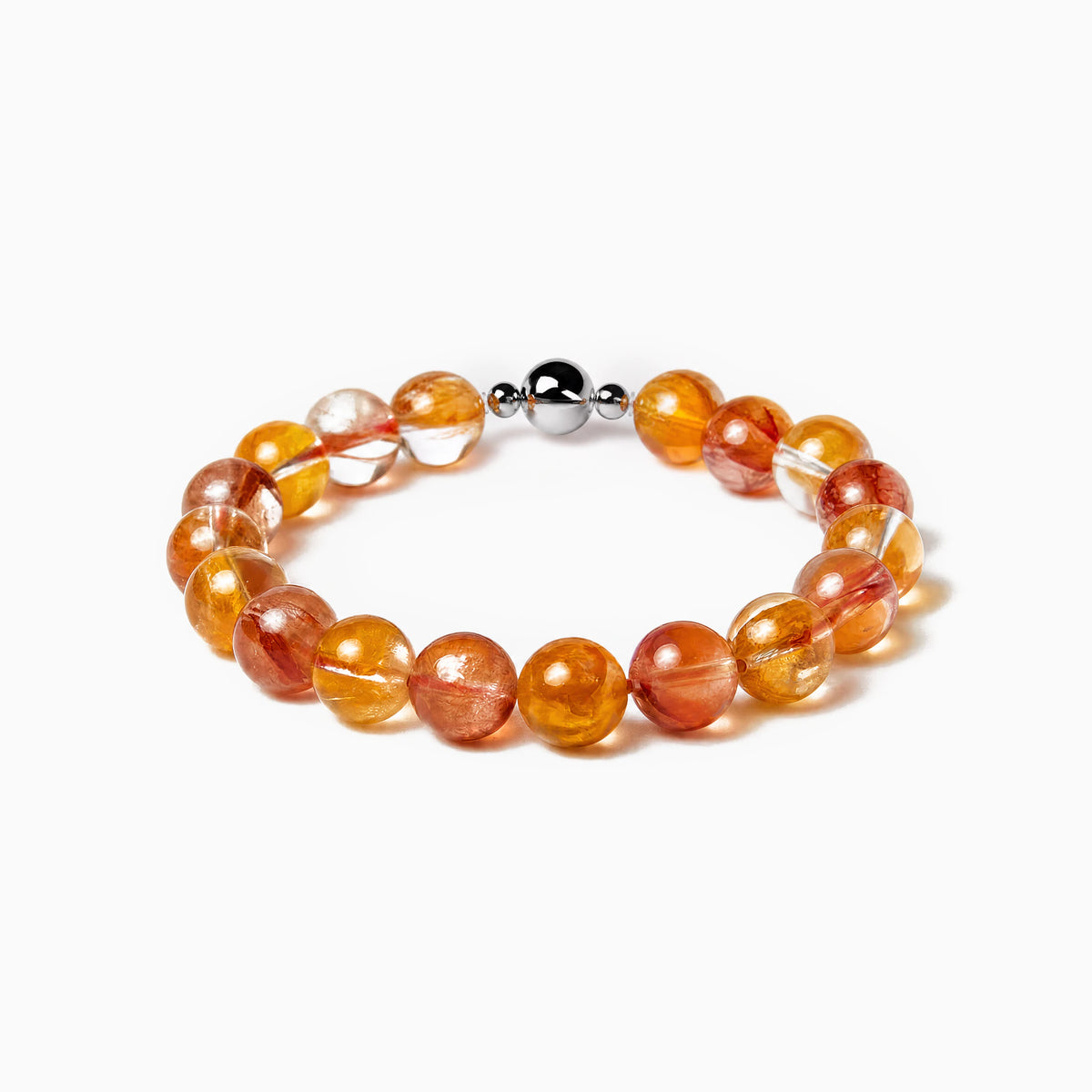
Quartz carrying red-to-orange iron-oxide inclusions inside the host crystal—not surface colour or applied pigment.
Wearing note
Let internal structure do the work.
Black tailoring, bare skin and direct light give needles, pigment and clear windows enough contrast to remain visible.
Keep other jewellery quiet. One internally complex stone can carry the entire visual field without decorative colour around it.

Crystal 4T™
Each stone is graded before production.
Lot ID
The finished piece remains linked to its material lot.
Origin level
Stated only to the level the record supports.
Treatment
Disclosed by lot; unknown remains unknown.
The Prism · Material questions
Questions on the material.
Read the material note
The Prism refracts. Its stones are chosen because the inside remains legible: rutile needles, iron-oxide pigment, phantom growth planes and iron-related yellow held inside quartz.
Inclusion is the point. Green phantom preserves interrupted growth; golden and multicolour rutile make internal direction visible; hematoid carries mineral pigment rather than surface colour.
Every piece is graded under Crystal 4T™ and leaves the studio with a Stone Origin Record that records treatment, lot and origin at the verified level.
01 Are inclusions defects?
In this series they are the identity. Crystal 4T™ grading asks whether inclusions are readable and structured, not whether they exist.
02 What separates a phantom from rutilated quartz?
A phantom records a paused growth surface as a layer or contour. Rutilated quartz holds needle-like inclusions that formed before the quartz enclosed them.
03 Is BE. citrine heated?
Treatment status is disclosed by lot. Natural and heated citrine must not be described as the same sourcing history.
Journal · Recent notes
Recent field notes.
Material notes, selection decisions and practical records from the BE. Journal.
 01
01
Real vs Fake Moonstone: How to Tell if Moonstone Is Real
Moonstone is feldspar with a glow that moves as the bead turns. Screen opalite, resin, chalcedony and coated stones at home; know when a...
Read field note 02
02
Hematoid Quartz vs Garnet: Two Reds from Two Different Causes
Hematoid quartz is quartz with iron-oxide particles inside; garnet is red through its own chemistry. Hardness, weight, light, fakes and matching, compared.
Read field note 03
03
Traceable Crystal Jewellery Brands in 2026: Four Ranked by What They Publish
Four crystal brands ranked on a five-level disclosure ladder, from unfalsifiable claim to named country, batch lot and per-piece record.
Read field note 04
04
Luxury Crystal Jewellery Brands in 2026: Six Compared, and What the Word Buys
Six luxury crystal jewellery brands compared on material, price, sourcing and terms, starting with natural mineral versus man-made crystal glass.
Read field note