
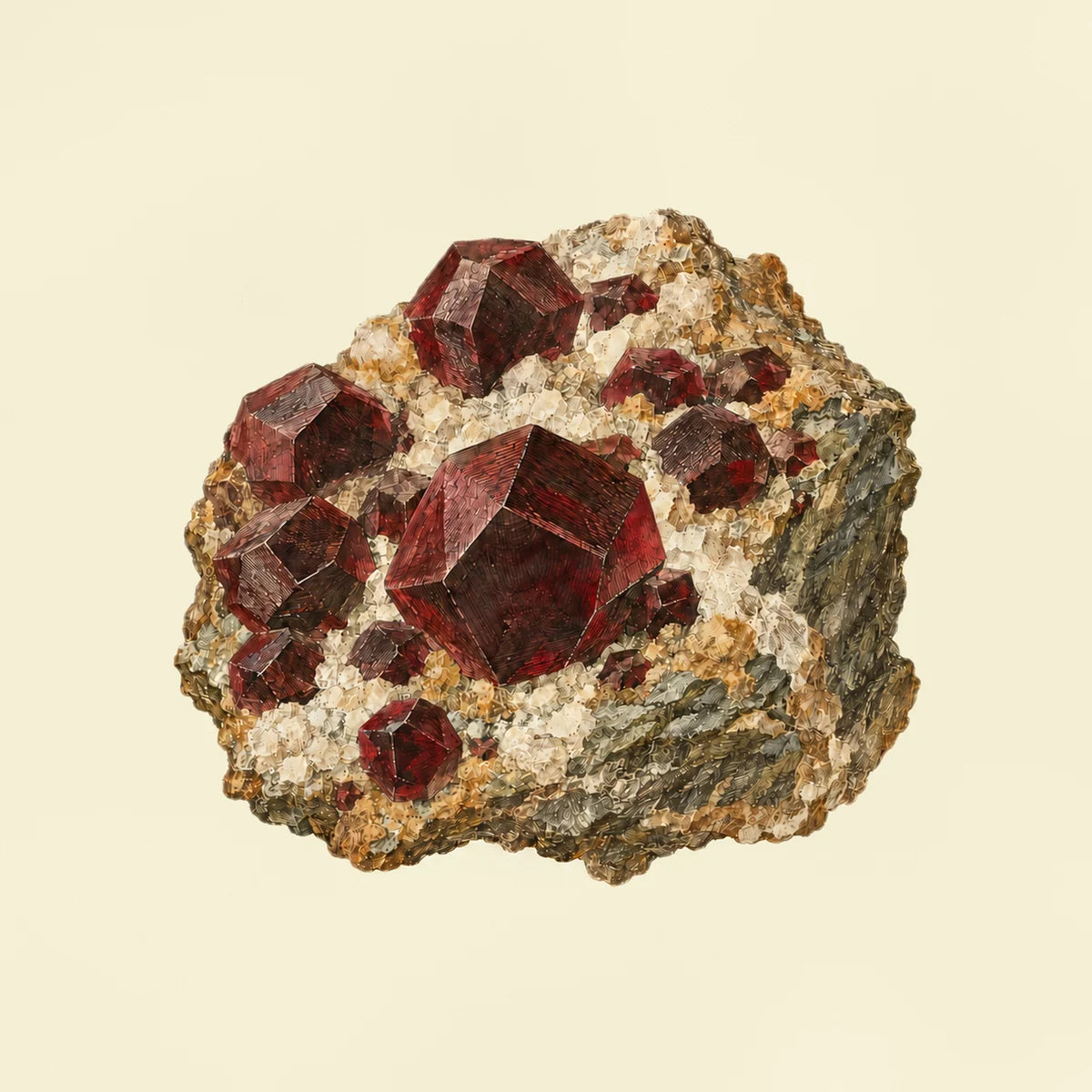
Stone No. 18 · The Anchor series
Almandine Garnet
The garnet is made of the conditions it grew in.
- Mineral
- Almandine, the iron and aluminium member of the garnet group
- Ideal formula
- Fe₃Al₂(SiO₄)₃
- Crystal system and hardness
- Cubic, Mohs 7 to 7.5
- Origin
- Mozambique
- Treatment
- Untreated. No heating, dyeing, coating or irradiation.
Almandine Garnet
Pieces in this stone.
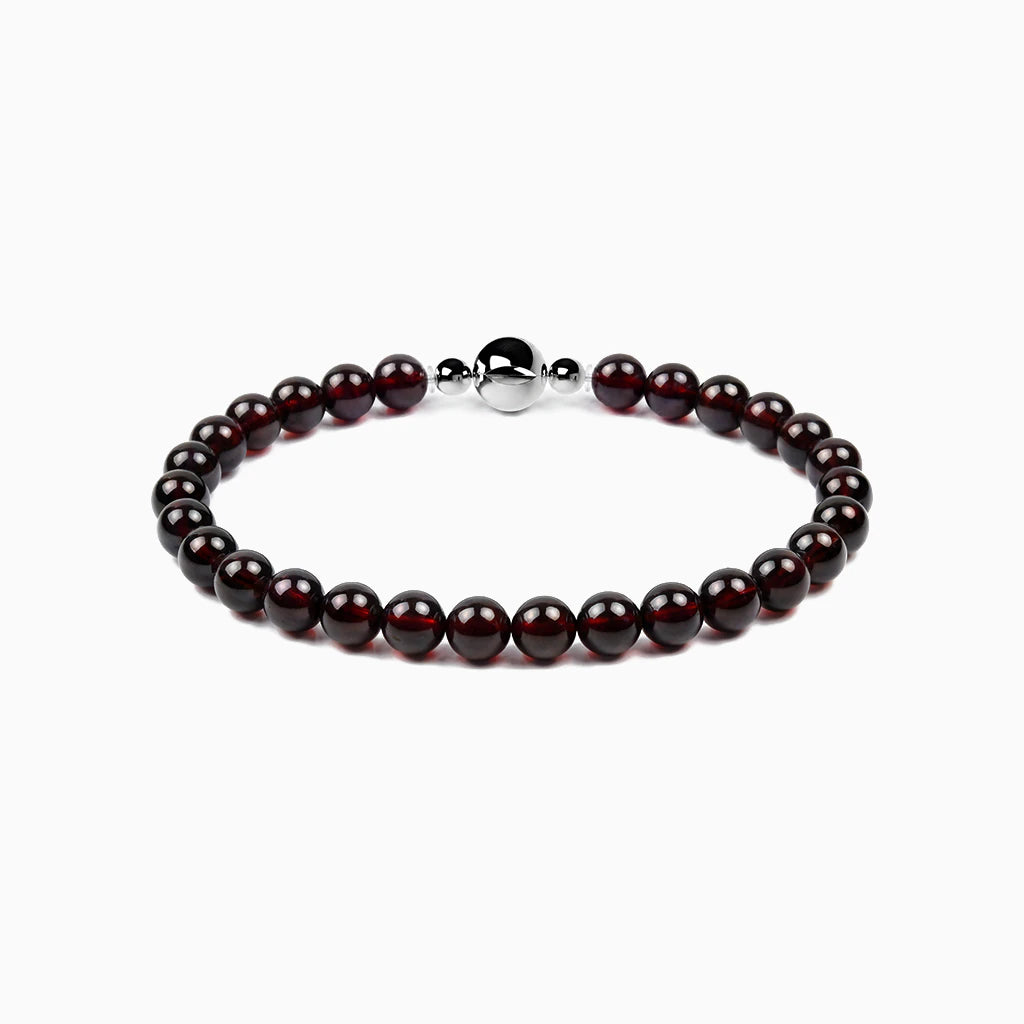
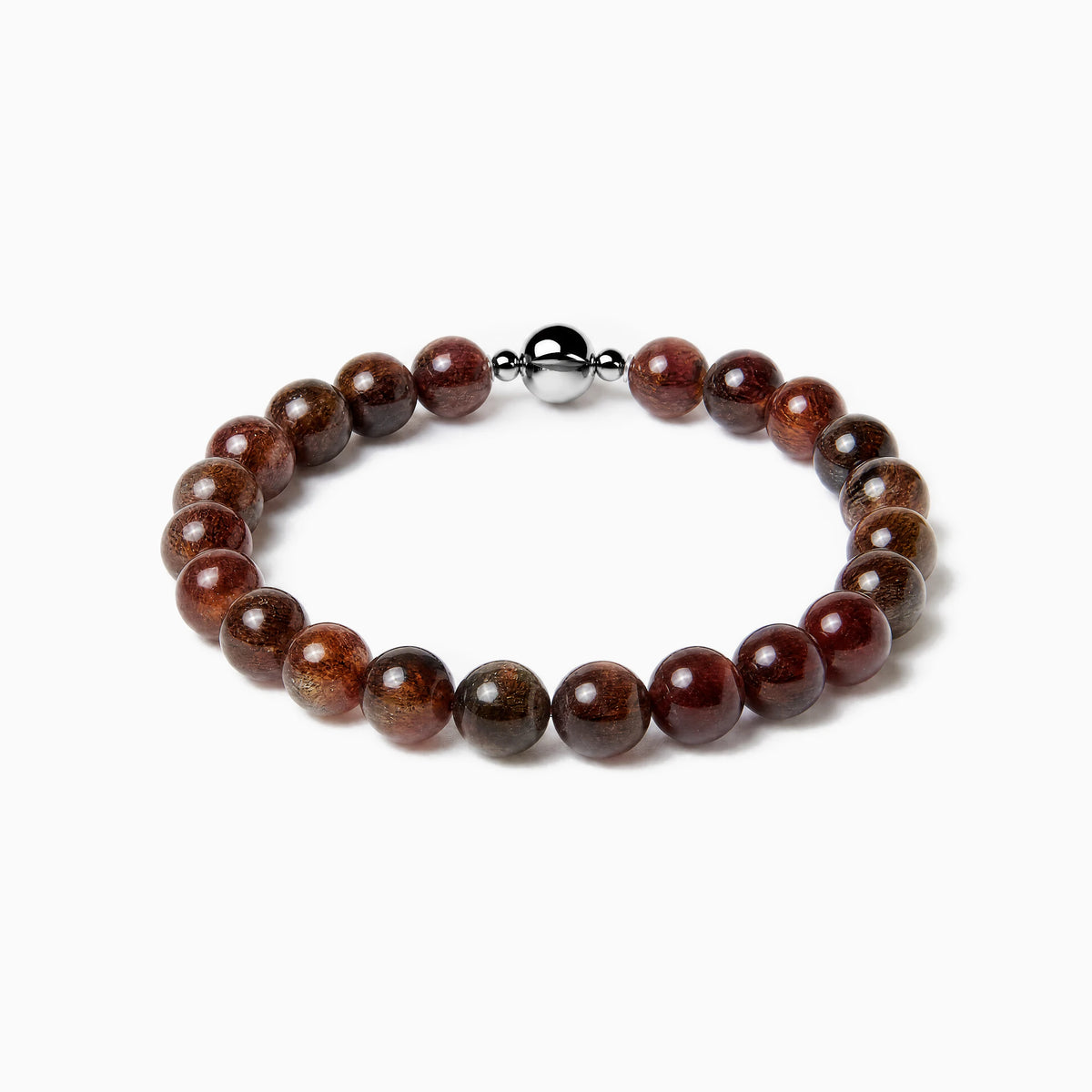
One almandine garnet strand bracelet, in 6mm beads, from $350. The almandine garnet is from Mozambique and untreated; its colour is iron taken into the crystal as it grew, and every piece ships with a Stone Origin Record. At Mohs 7 to 7.5, with no cleavage, it keeps its polish through years of daily wear; a very hard knock can still chip a bead.
On this page
How it formed
More than five hundred million years ago, fine grey mud was settling at the edge of an ocean that no longer exists. Geologists call it Iapetus. The mud held iron, aluminium and silica, spread through grains too small to see, and nothing in it was red. Heat, pressure and a few million years would make a garnet out of it.
About 470 million years ago, a chain of volcanic islands drove into the edge of that continent. The mud, pressed into shale by then, was folded and pushed down into the crust. At shallower levels it turned to slate. Deeper, it turned to a schist that glittered with mica. At twenty kilometres or more and above five hundred degrees, minerals in the rock began to break down, and their atoms had to find a new arrangement. On land above, the first small plants were only beginning to take hold.
Some of those atoms settled into a garnet. It began as a speck, a few atoms of iron, aluminium, silicon and oxygen locked into a cubic pattern, and it grew face by face into the twelve-sided shape a garnet takes when nothing crowds it. It drew what it needed from the rock around it. The grains of quartz it could not use, it closed over and kept. Under a microscope they are still there, small clear islands inside the red.
The world around it kept moving while it grew. The temperature rose. The pressure changed as the mountains thickened and later began to lift. Each change reached the surface of the crystal as a slightly different mix of atoms, and the garnet built each one in. Its centre is rich in manganese, gathered first and almost used up early. Towards the rim there is more iron and magnesium. Cut the crystal in half and map its chemistry, and the rings are there, like the rings of a tree. Where the rock was being deformed as it grew, the trails of quartz inside it curl into a spiral.
In 1893 a geologist named George Barrow walked these same Scottish hills, noting where garnet first appears in the rock. On one side of the line he drew, there is garnet; on the other, there is none. That line marks a temperature reached inside the mountain nearly half a billion years ago, and he found it on foot. Garnets from Barrow's ground have since been dated by the slow decay of samarium locked inside them. They grew in two spurts, about 473 and 465 million years ago.
Dinosaurs appeared about 230 million years ago and were gone by 66 million years ago, while the garnet stayed in its rock. The mountains above it wore down to the high, flat moorland that is there today, cut by deep glens. When the first stone tools were made, about 3.3 million years ago, it was still buried there. It is hard, dense and has no plane along which it splits, so it outlasted almost everything that was built around it.
Not every garnet comes through clear. Many are clouded with inclusions or cracked. The ones that let light through, nearly black at the centre and wine red at the edge, grew with few inclusions and came through whole. Those are the crystals that are cut and polished into beads.
How to look at yours
A garnet bead is darker than most people expect. In shade it is close to black; where light comes through the edge it turns wine red. That colour is iron, taken into the crystal deep in the crust as it grew. Garnet is hard, so a bead keeps its polish through years of daily wear.
The garnets in our strands come from other rocks and other times. They grew the same way. Each strand of ours carries a Stone Origin Record. Where the age of a lot is known, the Record gives it, and the timeline runs from the stone's formation to the day it was strung in the studio and then to you.
One way to read it
One way to read this: geologists cut garnets open to learn how deep a rock once went and how hot it became. Some crystals keep that history as layers of changing chemistry, each layer built from the iron, aluminium, heat and pressure of its moment. The garnet is made of the conditions it grew in.
Chosen weight. The meaning is yours.
The name
The name almandine goes back to Alabanda, an ancient city in today's Turkey, where Pliny said red stones were worked.
Almandine Garnet: questions before you buy
Is almandine garnet natural, or glass?
Ours is natural and untreated. Red glass is the most common stand-in for garnet beads; it is softer, warms quickly in the hand and often shows round bubbles. Natural almandine is dense and dark, nearly black in shade and wine red where light comes through. Our lot from Mozambique is recorded as untreated on its Stone Origin Record.
Is almandine garnet durable enough for daily wear?
Yes. Almandine is about 7 to 7.5 on the Mohs scale and has no plane along which it splits, so it keeps its polish through years of daily wear. Like any gem, it can still chip if it hits stone or metal hard. Wipe it with a soft damp cloth and store it apart from diamond and sapphire.
What is the difference between almandine and other garnets?
Chemistry and colour. Almandine is the iron and aluminium garnet: deep, dark red, often with a brownish or purplish cast. Pyrope, the magnesium garnet, is usually a brighter red, and rhodolite, between the two, leans purplish. Spessartine is orange, and grossular ranges from colourless to green and orange-brown. All share the same cubic crystal structure.
Why does almandine garnet look almost black?
Because it absorbs a lot of light. The iron in almandine absorbs much of the light passing through it, so a bead looks close to black in shade and turns wine red only where light comes through its edge. Hold the strand up to a window or lamp and the red appears; smaller beads show it more easily.
Stone Explorer
Compare garnet varieties
Almandine beside pyrope, spessartine and grossular.
OPEN THE GARNET EXPLORER →Care guide
How to care for your almandine garnet
Cleaning, storage and everyday wear.
READ THE CARE GUIDE →From the Journal