
How to Spot a High-Quality Garnet Bracelet
How to assess a garnet bracelet: colour in ordinary light, bead matching, polish, drilling and the evidence behind the description.
In this field note
Deep red beads can look quite different when light passes through them. That change is worth observing, but it is not a test for genuine garnet or a reliable way to rank species.
For the family background, read the garnet bracelet guide.
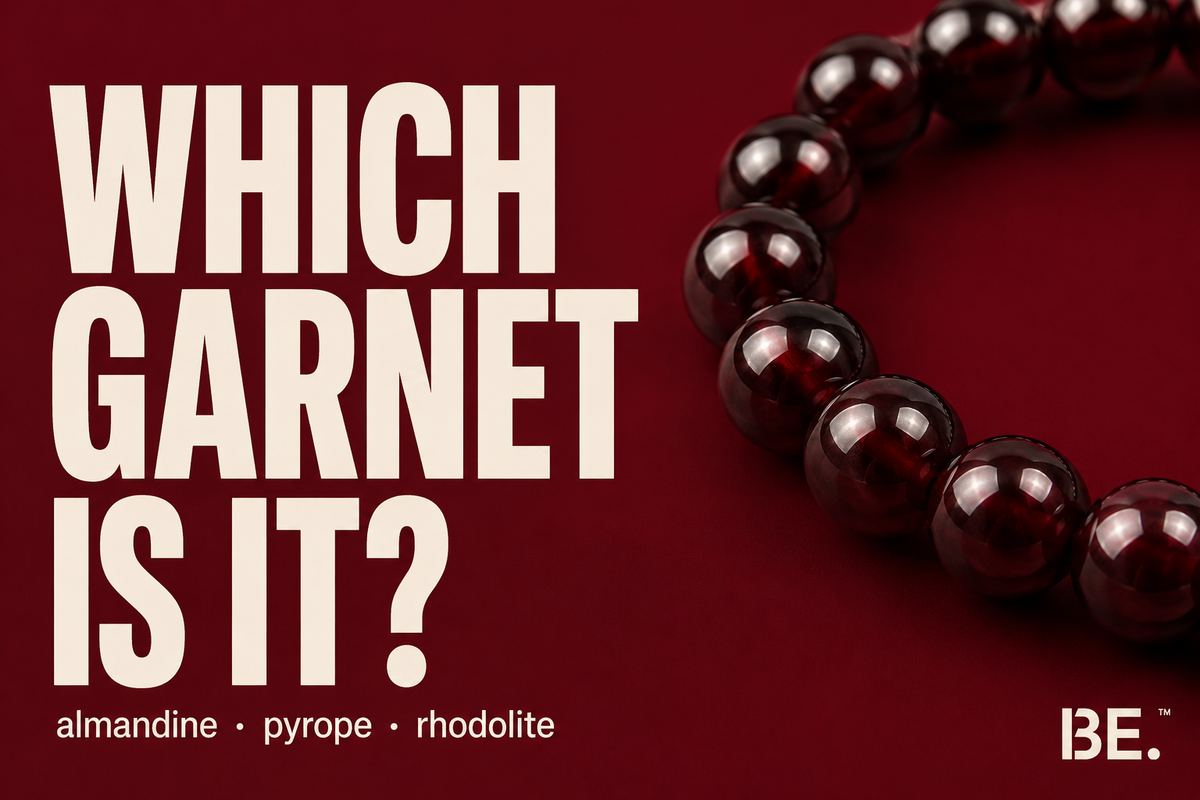
Garnet is a group
Garnet is a family of silicate minerals sharing a crystal structure but differing in metal content, which sets the colour. The common bracelet members are almandine (iron-rich, the everyday deep red), pyrope (magnesium-rich, often a warmer bright red), rhodolite (a pyrope-almandine blend prized for its raspberry glow) and spessartine (manganese-rich, orange to reddish-orange).
| Species or variety | Chemistry (simplified) | Typical colour |
|---|---|---|
| Almandine | Iron aluminium silicate | Deep red to brownish-red; the common “red garnet” |
| Pyrope | Magnesium aluminium silicate | Bright to deep red, often warmer |
| Rhodolite | Pyrope-almandine blend | Purplish-red to raspberry; prized for its glow |
| Spessartine | Manganese aluminium silicate | Orange to reddish-orange |
“Red garnet” is not a precise identification. Ask how the mineral or variety name was established; do not fill in a missing name from colour or price.
The quality tells
| Tell | What to compare | Be wary of |
|---|---|---|
| Colour | Hue and depth of colour in ordinary wear | Photos taken only with strong backlighting |
| Clarity | Transparency under the same lighting and bead size | Heavy inclusions, milkiness, fractures |
| Bead matching | Consistent tone and finish across beads | Unexplained differences between adjacent beads |
| Cut | Round, centred drilling, matched beads | Wobbly drilling, size variation |
A darker strand may suit a different preference from an open, raspberry-red one. Judge both under the same light. A strong backlight can reveal red through a bead without showing how it will look on the wrist. BE.'s 6:48 garnet film demonstrates transmitted light and explains the family.
Reading a finished strand
- Hold it to daylight. Compare the hue and depth of colour in diffuse daylight, then under your usual indoor light.
- Look for transparency. Compare similar bead sizes. Note cloudiness and visible fractures without treating every inclusion as a defect.
- Check tone consistency. Look for a consistent appearance across the strand; matching colour does not prove identical composition.
- Check the variety claim. A raspberry or purple-red colour may be described as rhodolite, but a brief flash is not enough to establish that name or a higher grade.
- Inspect the drilling. Centred, clean holes signal careful cutting.
Trade names, decoded
- “Bohemian garnet.” Historically pyrope from the Czech lands; now often a style or colour reference, not a strict origin.
- “Rhodolite garnet.” A pyrope-almandine blend, not a separate species — prized for its purplish-red glow.
- “Mozambique garnet.” A geographic claim that needs sourcing evidence; it is not a colour or quality grade.
- “Hessonite.” A brownish-orange grossular garnet — a different look from red garnet.
Caring for garnet
Garnet is Mohs 6.5–7.5, durable for daily wear but worth storing apart from harder stones to avoid surface scuffing. Warm soapy water and a soft cloth are safe; avoid ultrasonic cleaners on heavily included stones and avoid hard knocks, which can chip along fractures. Common jewellery garnets are not known for amethyst-style fading in ordinary wear; high heat and harsh treatment should still be avoided.
How BE. grades garnet
BE. uses the in-house Crystal 4T framework: Transparency, Tone, Texture and Treasure. The Stone Origin Record records the observations and sourcing evidence available for the lot. These records do not replace an independent laboratory report, and an unverified species or origin is not presented as a confirmed result.
Frequently asked questions
Q1.What species is my garnet?
Colour alone cannot answer that. Common red jewellery garnets include almandine–pyrope compositions. Ask for the basis of the identification, particularly when a specific variety or origin is claimed.
Q2.Is darker garnet better?
Darker is not automatically better or worse. Judge the colour in ordinary wear, then compare matching, polish, drilling and visible fractures. Bead thickness and lighting affect how dark a stone appears.
Q3.How do I tell real garnet from glass?
A red glow, hardness claim or single inclusion is not enough. A gemmologist can combine appropriate optical and physical tests. Do not scratch a finished bead as a home identification test.
Q4.Does garnet fade?
Common jewellery garnets are not known for amethyst-style fading in ordinary wear. Protect them from high heat and harsh treatment, and follow care advice for the actual material.
Q5.Is rhodolite worth more than almandine?
The name alone does not settle value. Colour, clarity, size, cut or bead finish, and the evidence behind the description all matter. Compare individual stones or strands.
Q6.What’s the difference between garnet and ruby?
Ruby is chromium-coloured corundum, with Mohs hardness 9; garnet is a different mineral group. Their colours may overlap, so red appearance alone cannot distinguish them.
References
- GIA — Garnet Quality Factors
- GIA — Garnet Description
- Wikipedia — Garnet
- Webster, R. Gems: Their Sources, Descriptions and Identification, 5th ed. Butterworth-Heinemann.
- BE. Crystal 4T Grading System
Field Notes.
One stone at a time: its geology, and how to read quality. The Stone Buying Checklist comes with your first email.
By subscribing you agree to receive emails from BE. Unsubscribe anytime.
Sent. Check your inbox.