
The BE. Stone Library: 17 Crystal Bracelet Stones at a Glance
One comparison table for 17 crystal-bracelet stones: mineral, chemical formula, Mohs hardness, what gives each its look, and where to start. A material-first reference.
In this field note
Crystal names are a tangle of trade terms, colours and overlapping varieties. The fastest way to cut through it is to line everything up by what it actually is. Read down this table and a pattern appears: a large family of quartz, separated only by the trace element, inclusion or radiation that coloured it, and a handful of genuine outsiders with their own chemistry.
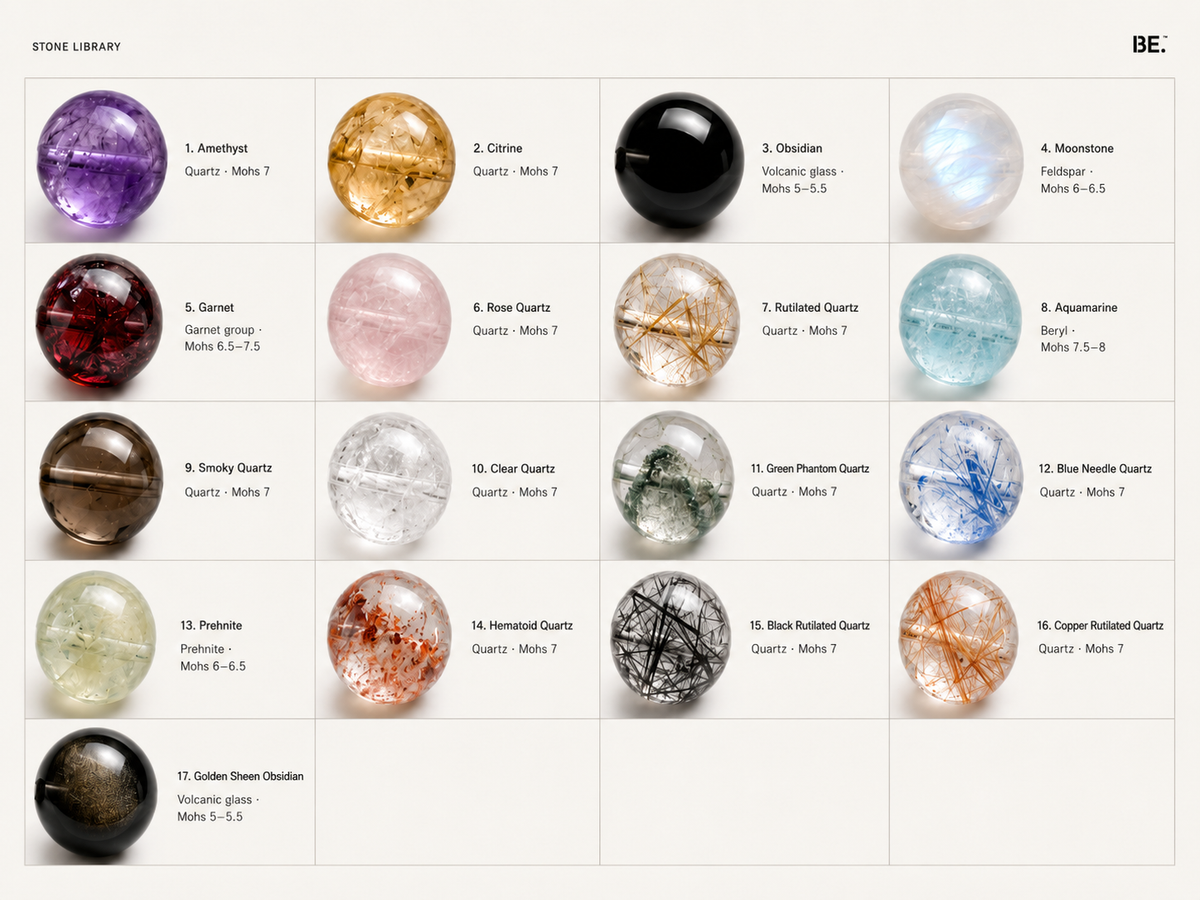
The BE. stone library, compared
| Stone | Mineral (formula) | Mohs | What gives the look |
|---|---|---|---|
| Amethyst | Quartz (SiO2) | 7 | Iron + radiation colour centre → violet. |
| Citrine | Quartz (SiO2) | 7 | Trace elements and defects → yellow-gold; some is heated amethyst. |
| Smoky Quartz | Quartz (SiO2) | 7 | Aluminium + radiation → grey to brown. |
| Rose Quartz | Quartz (SiO2) | 7 | Microscopic fibres → soft pink. |
| Clear Quartz | Quartz (SiO2) | 7 | No visible colour cause → colourless clarity. |
| Rutilated Quartz | Quartz + rutile (TiO2) | 7 | Titanium-dioxide needles → gold threads. |
| Hematoid Quartz | Quartz + iron oxide | 7 | Iron-oxide inclusions → red veils. |
| Blue Smoky Quartz | Quartz, SiO2 | 7 | Tyndall scattering → blue with no pigment. |
| Emerald Phantom | Quartz + fuchsite | 7 | Fuchsite phantom layers → green ghost. |
| Green Phantom | Quartz + chlorite | 7 | Chlorite landscapes → layered green. |
| Super Seven | Quartz + varied inclusions | 7 | Colour zones and inclusions in one quartz body. |
| Aquamarine | Beryl (Be3Al2Si6O18) | 7.5–8 | Iron → sea-blue; hardest here. |
| Garnet | Garnet group | 7–7.5 | Iron-rich almandine → deep red. |
| Moonstone | Feldspar | 6–6.5 | Layered feldspar → adularescent glow. |
| Prehnite | Ca-Al silicate | 6–6.5 | Iron traces → translucent green. |
| Kyanite | Al2SiO5 | 5.5–7 | Trace iron → blue; two hardnesses. |
| Obsidian | Volcanic glass | 5–5.5 | Amorphous glass; sheen from inclusions. |
How to read the library
- Family first. Eleven of the seventeen are quartz, with the same hardness, the same care and a different colour mechanism.
- Colour is a cause, not a label. Each look traces to a trace element, an inclusion, or radiation.
- Hardness sets the care. The 7+ stones are forgiving; obsidian, moonstone, prehnite and kyanite want gentler handling.
- Outsiders earn attention. Aquamarine, garnet, moonstone, kyanite and obsidian each bring chemistry the quartz family can’t.
- Start where the look pulls you. Then confirm hardness and care suit your wear.
The four BE. collections
Beyond mineralogy, BE. groups stones into four philosophical lines: Anchor (grounding, dark stones like obsidian and garnet), Flow (soft, moving stones like moonstone and rose quartz), Prism (light-splitting, included stones like rutilated and hematoid quartz) and Void (deep, contemplative stones like amethyst and kyanite). The collection is a way to choose by feeling once the material facts are clear.
How BE. grades every stone
Whatever the mineral, BE. reads each strand against the Crystal 4T framework (Transparency, Tone, Texture, Treasure) and ships it with a Stone Origin Record recording mineral, hardness and source. The library above is the short version of that record, gathered in one place.
Frequently asked questions
Q1.How many of these stones are quartz?
Eleven of the seventeen. Amethyst, citrine, clear, rose, smoky, rutilated, hematoid, blue smoky, the phantoms and Super Seven are all quartz or quartz-based at SiO2, Mohs 7. Obsidian, moonstone, prehnite, kyanite, garnet and aquamarine are different materials.
Q2.Which stone is the hardest?
Aquamarine, a beryl at Mohs 7.5–8. Almandine garnet follows at 7–7.5, the quartz family at 7, and obsidian is the softest of the seventeen at 5–5.5.
Q3.What makes each crystal a different colour?
Trace elements, inclusions or radiation. Iron and radiation make amethyst violet; rutile needles make rutilated quartz golden; iron oxide makes hematoid red; feldspar structure makes moonstone glow.
Q4.Is obsidian a crystal?
No. It is a natural volcanic glass, amorphous with no lattice, which is why it breaks with a conchoidal fracture. It is included because it is widely worn as a bracelet stone.
Q5.Which stone should a beginner choose?
A Mohs 7 quartz such as clear quartz, amethyst or smoky quartz is the most forgiving. Choose by the colour and material story you connect with, then check hardness and care.
Q6.Why list the chemical formula?
The formula shows what a stone actually is. Knowing amethyst, citrine and smoky quartz are all SiO2 explains why they share hardness and care, and why heat can change the colour of some amethyst and smoky quartz.
References
- Mineral data: Mindat.org
- Gem Encyclopedia: GIA
- Quartz: Wikipedia
- Deer, Howie & Zussman (2013). An Introduction to the Rock-Forming Minerals, 3rd ed.
- Hurlbut & Klein (1993). Manual of Mineralogy, 21st ed. Wiley.
Field Notes.
One stone at a time: its geology, and how to read quality. The Stone Buying Checklist comes with your first email.
By subscribing you agree to receive emails from BE. Unsubscribe anytime.
Sent. Check your inbox.