
6 Things to Check Before Buying Crystal Jewellery
Six material-first checks before buying crystal jewellery — clarity, inclusion logic, treatment disclosure, lot traceability, fit and finish.
In this field note
The crystal market has the structure of a layered cake. At the bottom is mine-run rough, sorted into commercial parcels by colour and clarity. Above that, polishers turn the better lots into beads, the lesser lots into chips and tumbles. At the top, finishers string the beads into bracelets and necklaces, and somewhere in that last step the material is given a price tag that bears no clear relation to what is underneath.
This guide is six checks worth running before you buy. They sit between the rough and the price tag. They are the same six checks an experienced trader runs at a Tucson or Hong Kong show, scaled down to a strand in your hand.
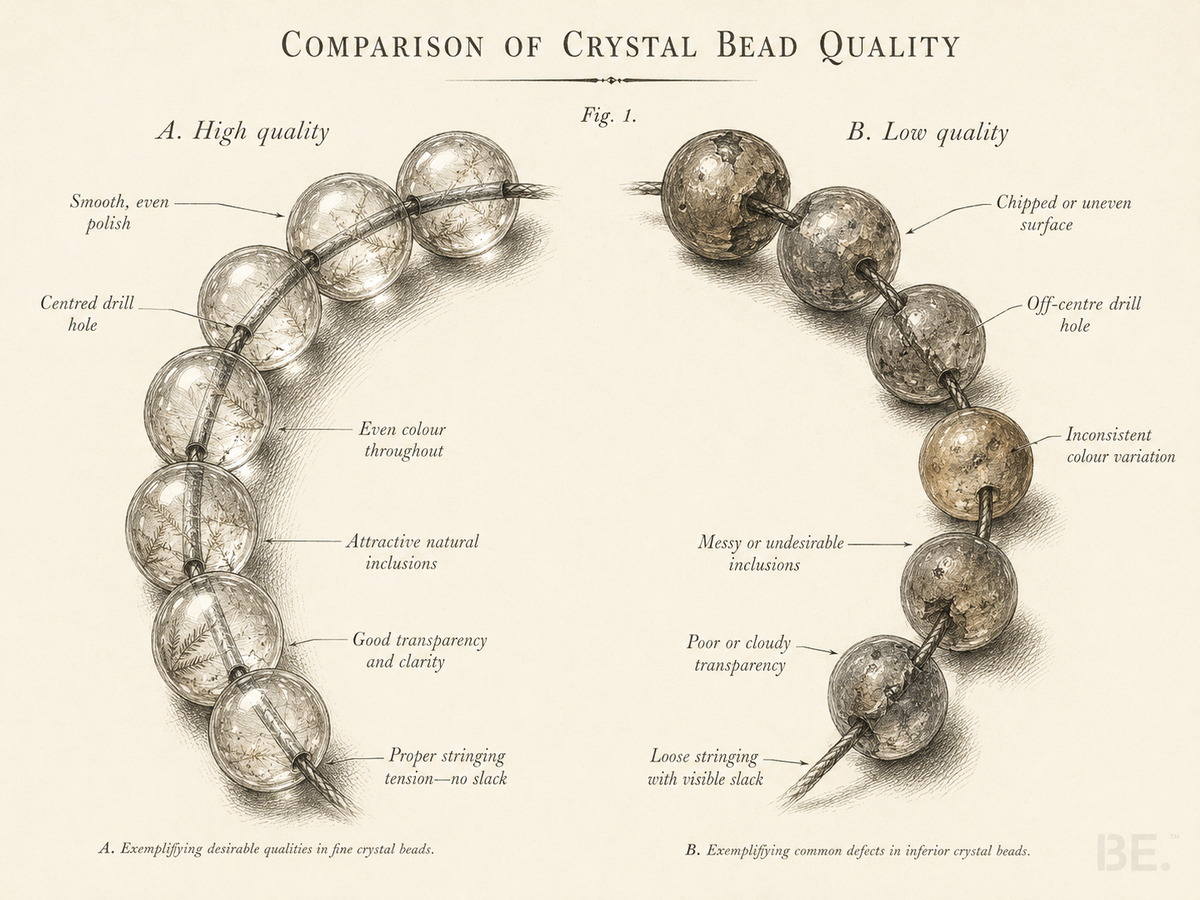
1. Clarity, read by transparency class
Clarity is the optical transparency of the bead. For quartz family material it is the single largest price driver. Clarity is not a binary — it is a tiered class. Trade buyers sort lots into four bands and price accordingly.
The four transparency bands
Class I (optically clear): light passes through edge-to-edge with no visible cloud. Strong but uniform internal lustre. Reserved for top 5-10% of any lot. Highest price tier.
Class II (eye-clear with light haze): mostly transparent but with a slight inner mist or a few discrete inclusions. Excellent jewellery grade.
Class III (translucent): light passes but objects behind are diffused. Mid-tier; visually softer; often more affordable for the same gram weight.
Class IV (semi-opaque to opaque): light only penetrates the edges. Acceptable in some materials (carnelian, agate) where opacity is the visual goal; a downgrade in others where clarity is the prized feature (clear quartz, amethyst, citrine).
The check: backlight the bead with a small torch from behind. A clear quartz Class I bead transmits nearly all the light; a Class IV bead blocks most of it and only the edges glow.
2. Inclusion logic — does the pattern match the geology
Natural crystals contain inclusions that record their growth history. Fakes contain inclusions that do not match any real geological process. The check is whether the inclusions look like something that could have happened during slow growth in a mineral vein.
| Inclusion type | What you should see in natural material | What suggests a problem |
|---|---|---|
| Phantom growth lines | Irregular concentric ghost layers following crystal faces | Perfectly circular or symmetric lines suggest moulded glass |
| Needle or fibre inclusions | Irregular orientation, varying lengths, occasional crossings | All needles identical length and parallel orientation — likely synthetic |
| Two-phase fluid pockets | Angular cavity holding liquid plus a smaller gas bubble | Perfectly spherical bubbles with no second phase — glass |
| Colour zoning | Irregular hexagonal or follow-the-face zoning | Curved striae or chevron patterns — hydrothermal synthetic |
| Mineral guests (chlorite, hematite, rutile) | Variable in size and density across the bead | Uniform speckle in a regular grid — goldstone or moulded composite |
3. Treatment disclosure
Most coloured stones on the market have been treated in some way — heated, irradiated, oiled, dyed, or coated. Treatments are not inherently a problem. The problem is non-disclosure. A serious seller tells you what was done; a casual seller treats the question as awkward.
Three categories matter:
- Standard and stable treatments. Heated aquamarine, heated tanzanite, irradiated blue topaz. Disclosed treatments. Stable for life. Reasonable to buy.
- Treatments that change value. Heated citrine (originally amethyst), lead-glass filled ruby, heavy emerald oiling. Acceptable when disclosed; commands lower price than untreated material.
- Treatments that wear. Surface coatings (aurora borealis, mystic topaz), dye on porous stones, paraffin wax on turquoise. Should always be disclosed; durability varies.
The check: ask the seller, before you pay, what treatments the stone has received. Watch the answer. A trader who knows the material will answer specifically. A trader who deflects — “it’s natural”, “I don’t know”, “that’s a strange question” — is not someone whose stock you should buy without independent testing.
4. Lot traceability
Traceability is the documented record of where a stone came from and how it reached the bench. Sellers vary widely on what they disclose: some publish only “natural”, some country-level, and a smaller set publish district- or deposit-level information. None of this is universal in the trade, and the level of disclosure is itself useful data — it tells you how far the supply chain has been verified.
Why this matters in practical terms: source information helps set expectations. Anahí (Bolivia) amethyst tends to a particular violet with a citrine edge zone; Madagascar rose quartz tends slightly peachier than Brazilian. These are mineralogical tendencies rather than rigid rules, and they exist alongside variation within each source.
The check: ask where the material is from. The answer — country, district, or deposit — is whatever the supply chain actually supports. BE. records the country and region of origin for each strand on the product page and on a Stone Origin Record; where a specific deposit or named locality has been disclosed by the upstream supplier, BE. lists it, and where the supplier provides only country-level information, BE. lists country only and does not invent district-level claims.
5. Bead-to-bead consistency
A strand is a curated set, not a single stone. Quality on a strand is about whether the curation is real. Cheap parcels are mixed at the warehouse; expensive strands are sorted bead by bead for matching colour, clarity, and size.
What to look for:
- Colour uniformity. Hold the strand against a white card under natural daylight. Do all beads sit within the same tone band, or does the strand jump from pale to deep across the loop?
- Inclusion balance. A high-grade strand keeps inclusion density similar across beads. Two beads with dramatic rutile next to ten clean beads is a parcel that was not sorted.
- Diameter tolerance. Professional cutting holds bead diameter within 0.1 mm. A strand that visibly steps in size has not been finished to standard.
- Drill alignment. Beads should rotate cleanly on a tight string. Off-axis drilling causes beads to sit at angles, breaking the visual flow of the strand.
6. Finish quality — the polish, the drill, the string
Finish is what separates a well-made strand from a cheap one even when the rough is similar. For a strand with a magnetic closure, clasp safety is part of the finish check. There are four finish details that matter:
| Finish element | What good looks like | What to reject |
|---|---|---|
| Polish | High mirror finish across the whole bead surface | Matte patches, drag lines, visible orange-peel texture under loupe |
| Drill hole | Smooth straight bore, even diameter at both ends | Chipped entry, off-centre hole, conical drill that flares wider at one end |
| Edge work | Crisp sphere with no flat spots; bead returns to true on rotation | Lopsided sphere, flat polish spots from quick finishing |
| String and clasp | Sturdy stretch cord or knotted thread; metal clasp if used | Cheap elastic that frays in days; glued ends; mystery metal clasps |
How BE. applies these six checks
Every BE. strand passes through the Crystal 4T grading process before listing: Transparency (which is point 1 above), Tone (colour distribution), Texture (which covers inclusion logic plus finish quality), and Treasure (how difficult the material is to obtain at this quality). Treatment disclosure is baseline — if a treatment exists, it appears on the Stone Origin Record. Bead-to-bead consistency is enforced at the sorting stage: a strand that fails the colour or diameter test is broken back into the parcel rather than listed.
Does any of this make crystal jewellery a luxury?
It can — and the same six checks are what decide it. The price range in crystal jewellery is enormous: a dyed, mass-strung strand and a documented, hand-matched, top-grade one can look alike in a thumbnail and differ many times over in price. That gap is real material rarity, not a markup invented at checkout. What lifts a piece to genuinely high-end is the combination this guide describes — clarity grade, honest treatment disclosure, traceability, bead-to-bead curation and finish — plus one step most sellers skip: selection before grading. BE. admits only roughly the top 20% of available market material into the studio before grading it on Crystal 4T, so anything you buy has already been pre-selected from the best of what the market offers. Luxury, in a stone, isn’t a logo — it’s the rejection pile and the paper trail.
For the longer argument, see Is Crystal Jewellery a Luxury? What Makes a Bracelet High-End.
Frequently asked questions
Q1.Do all six checks matter equally?
For most buyers, treatment disclosure and traceability matter most, because they affect value and durability. Clarity and finish matter for visual quality. Inclusion logic and bead consistency are secondary unless you are buying at a higher price point.
Q2.Is heavily included material always lower quality?
No. For materials where the inclusion is the feature — rutilated quartz, garden quartz, dendritic agate — strong inclusion is what you are paying for. For materials sold on clarity (clear quartz, citrine, aquamarine), inclusions reduce value.
Q3.How important is the finish if the stone itself is good?
Important for daily wear. A high-quality stone with a poor polish or weak string will not last as a piece of jewellery. Finish is what turns mineral into something you can wear without thinking about it.
Q4.Are six checks really enough?
For everyday purchases, yes. Higher-value stones — fine sapphire, ruby, emerald, alexandrite — warrant a professional gem lab report. For quartz family material at typical jewellery prices, these six checks settle 95 percent of the question.
References
- GIA Gem Encyclopedia — quality grading standards
- Mindat — mineral and locality reference
- Gem-A — gemmological identification guides
- Wikipedia — Gemstone
- Hughes, R. (1997). Ruby and Sapphire. RWH Publishing.
- Schumann, W. (2009). Gemstones of the World, 4th ed. Sterling.
Field Notes.
One stone at a time: its geology, and how to read quality. The Stone Buying Checklist comes with your first email.
By subscribing you agree to receive emails from BE. Unsubscribe anytime.
Sent. Check your inbox.