
Crystal Jewellery for the Skeptic: A Material-First Reading
Crystal jewellery without healing claims is a small market. BE. is built for people who love stones for geology, optics and cultural history — not energy.
In this field note
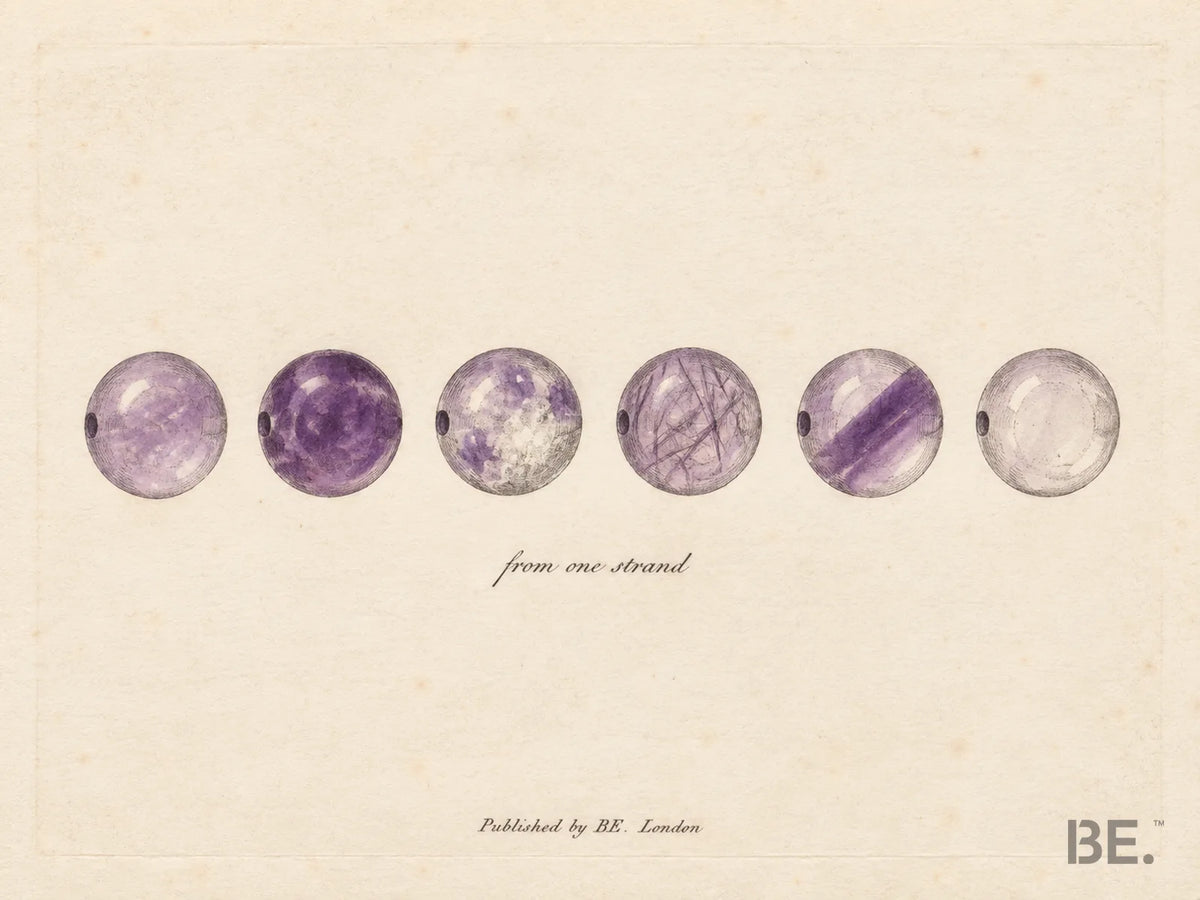
I started BE. because I am one of these people. I love quartz: the way an amethyst bead transmits violet light when you hold it against a window, the way a clear quartz strand catches sun and turns silver-white, the way rose quartz turns light into a soft pink haze. I love knowing that the colour in amethyst comes from trace iron in the crystal and natural irradiation acting on it, and that the softness of rose quartz comes from microscopic fibres inside it. None of that is metaphysical to me. It is geology, and it is enough on its own. No two stones grow the same way. Two amethyst beads cut from the same geode carry different bands of colour, because the iron and the irradiation were never spread evenly through the rock. People are like that too. Nobody is a copy of anybody else, and I like a stone the way I like a person: for what it is.
But almost every brand that sold the strand I wanted came with a sales script I could not say out loud. Charge under the full moon. Cleanse with sage. Set your intention. Align your third eye. I respect that these scripts work for many people. I just am not one of them, and the market gave me very few places to spend money without buying into them.
Why this market gap exists
The crystal jewellery category grew up inside the wellness industry. Wellness sells because it offers a felt promise: do this, feel this. Geology does not work that way. A piece of amethyst is a piece of amethyst whether you charge it or not, and that is exactly the framing many wellness buyers find unsatisfying. The market is structured around the felt promise because the felt promise is what most buyers are paying for.
This leaves a gap. There are people who love stones, the optical character, the geological formation, the cultural history, and who walk away from every product page that opens with "this stone helps you manifest abundance". Until recently, the gap was filled by gemmological houses (which sell loose stones and faceted gems, not strands) and by independent mineralogists (who sell raw specimens at gem shows). Neither is built to deliver a wearable strand with a published Stone Origin Record.
What a skeptical buyer wants
Underneath all of this is a way of looking at nature. A stone is a record of conditions: how hot it was, how much pressure it sat under, what happened to be dissolved in the water, how slowly it cooled. Liking a stone for that record is a taste, in the same way that some people are drawn to old timber or hand-thrown clay. BE. is built for that taste. I started by writing down what I wanted from a brand and then trying to deliver it. The list looked like this:
| Dimension | What a wellness buyer wants | What a skeptical buyer wants |
|---|---|---|
| Primary information | What the stone does for me | What the stone is and where it came from |
| Trust signal | Brand tone, ritual instructions, testimonials | Chemical formula, Mohs, treatment disclosure, origin region |
| Editorial voice | First-person guidance, intention-setting | Third-person material description, gemmological vocabulary |
| Photography | Mood-led, candle and grid | Macro of the stone, polished surface, inclusions visible |
| Long-form content | Properties guides, affirmations | Formation chemistry, regional geology, cultural history |
| Permission | Permission to believe | Permission to like the stone for what it is |
BE.'s position: what sits on every product page
Concretely, six things sit on every strand product page on thebeworld.com:
- Mineral identity in chemical terms. SiO2 for quartz, with the cause of colour named. Iron for amethyst, fibre inclusions for rose quartz, rutile inclusions for rutilated quartz.
- Mohs hardness. Stated explicitly, with the implication for daily wear. Mohs 7 quartz resists scratching from common dust; Mohs 5-5.5 obsidian tolerates daily wear but is softer.
- Treatment disclosure. Untreated, heated, irradiated, dyed. Standard gemmological vocabulary. No hidden treatments.
- Crystal 4T™ grading. Transparency, Tone, Texture, Treasure. Each scored 1 to 5. The full rubric is published on the Crystal 4T™ grading system page.
- Stone Origin Record. Country plus broad region. Bolivian amethyst, Mozambican rose quartz, Brazilian rutilated quartz. Not the mine. Not the cutter. The level a buyer can verify.
- Cultural framing. Where relevant, the Journal discusses the historical use of the stone: Pliny on amethyst, Egyptian malachite as pigment, Roman intaglios in carnelian. It treats these as cultural history and draws no claims about energy from them.
What BE. does not say
An equally important list is the things BE. does not say. Each one is a position we chose.
- Charge. Stones do not store and release human-readable energy. The verb implies a physics that the literature does not support.
- Cleanse. Stones do not accumulate negative emotional residue that needs ritual removal. Cleaning the bead with a soft cloth removes oil and dust, which is cleaning in the ordinary sense.
- Activate. Stones do not have dormant states that ritual switches on. The mineral lattice is the mineral lattice.
- Heal. Stones do not have curative properties. Health claims attached to crystals are regulated in most markets for good reason.
- Manifest. Stones do not influence external events through wearer intention. The word comes from wellness marketing.
- Chakra. The mapping of specific stones to specific chakras dates from twentieth-century New Age publishing. The older traditions it borrows from did not map stones this way.
People who use these words have their own reasons, and I have no quarrel with them. BE. simply sits on a different shelf in the same shop, and this list is how you find it.
A long history of liking stones for what they are
What I find most interesting about stones is that they have a longer history with humans than almost any other material category, and almost none of that history was metaphysical in the modern sense. Here is a partial selection of how stones have been used.
| Era | Cultural use of stones | What it tells us |
|---|---|---|
| Egyptian (3000-30 BCE) | Malachite ground as eye pigment; obsidian worked into cutting blades; carnelian carved into beads and seals | Stones used as pigment, tool and ornament. Material, practical and decorative. |
| Greek and Roman (500 BCE-500 CE) | Roman workshops cutting carnelian and sardonyx into intaglio seals; Pliny the Elder cataloguing dozens of stones in Natural History | A literary and naming tradition that survives in modern mineralogy. Pliny's cataloguing remains the founding reference for European gemmology. |
| Medieval European (500-1500) | Sapphire reserved for clergy; ruby as royal stone; lapidaries written as combined natural-history and moral instruction | The lapidary tradition treated stones as objects of natural philosophy. The metaphysical framing then was very different from the modern crystal-healing one. |
| Victorian (1837-1901) | Whitby jet carved and polished into beads and brooches; acrostic jewellery spelling names in coloured stones | Stones used as private language. The meaning was symbolic and cultural, a nineteenth-century habit of carrying a message in stone. |
| 20th-century mineralogy | Goethe writing on quartz; Mindat and the modern mineralogical literature | Stones reframed as objects of geological investigation. This is the lineage BE. sits in. |
None of this history requires me to charge a crystal under the moon. It just requires me to take the material seriously.
Field Notes, the Substack
This essay is part of Field Notes, the BE. Journal's first-person lane. If you would like to know more about us, Our Story is the place to start. The longer stone-by-stone pieces are in the Journal.
Material-first strands are listed in the BE. collection, and every strand ships with a Stone Origin Record that states its lot, its four Crystal 4T™ readings and what those readings do not claim.
Frequently asked questions
Q1.I love crystals but find chakra claims uncomfortable. Is this brand for me?
Yes. BE. is built for people who like the stone itself. Every product page reads like a gemmology card: chemistry, hardness, treatment, origin, and the Crystal 4T™ readings.
Q2.Does BE. ever use the word energy?
Only in its physical sense. The word appears when discussing measurable light absorption and photon scattering in mineralogical context. The wellness sense of the word does not appear anywhere on the site.
Q3.What if I do believe in crystal healing, can I still wear BE.?
Of course. The strands are strands. You can layer your own meaning on top of any material object, and that meaning stays yours. We just do not sell it to you.
Q4.How is BE.'s approach different from a generic no-claims disclaimer?
A disclaimer at the bottom of the page is a legal hedge. BE.'s approach is structural: the entire product page architecture is gemmological. Chemistry, Mohs, treatment, origin and Crystal 4T™ are the primary content. There is no wellness content to disclaim.
Q5.Where does BE. sit between mass-market and high-end?
Upper mid-market to entry high-end. Every strand carries published Crystal 4T™ grading and a Stone Origin Record.
Q6.Where can I read more in this approach?
The Journal publishes long-form geology-first pieces on individual stones. Our Story sets out why I built BE. this way. The Geological Codex sits alongside as the four-series taxonomy.
References
- BE. Our Story
- BE. Geological Codex
- Mindat, mineral database
- Pliny the Elder (c. 77 CE). Natural History, Book 37 (on gems and minerals).
- Schumann, W. (2009). Gemstones of the World, 4th ed. Sterling.
- Hall, J. (1996). Illustrated Dictionary of Symbols in Eastern and Western Art. Westview Press.
Field Notes.
One stone at a time: its geology, and how to read quality. The Stone Buying Checklist comes with your first email.
By subscribing you agree to receive emails from BE. Unsubscribe anytime.
Sent. Check your inbox.