
Prehnite Stone: Calcium Aluminium Silicate & the Collector's Green
A geology-first guide to prehnite — the calcium aluminium silicate behind the collector's green, its epidote needles, where it forms, and how to read a strand.
In this field note
Prehnite is the stone collectors describe as looking lit from within. Hold a good piece to the light and it has the half-transparent, slightly milky glow of frozen olive oil or a peeled grape — a quality the trade calls jelly-like and almost no other green stone has. That texture, not a vivid colour, is what people are really buying.
This guide takes prehnite from the mineralogy up: what it actually is, why the green varies, what those black needles inside it are, and how to read a strand — a more material reading than the usual meaning-led write-ups.
What prehnite actually is
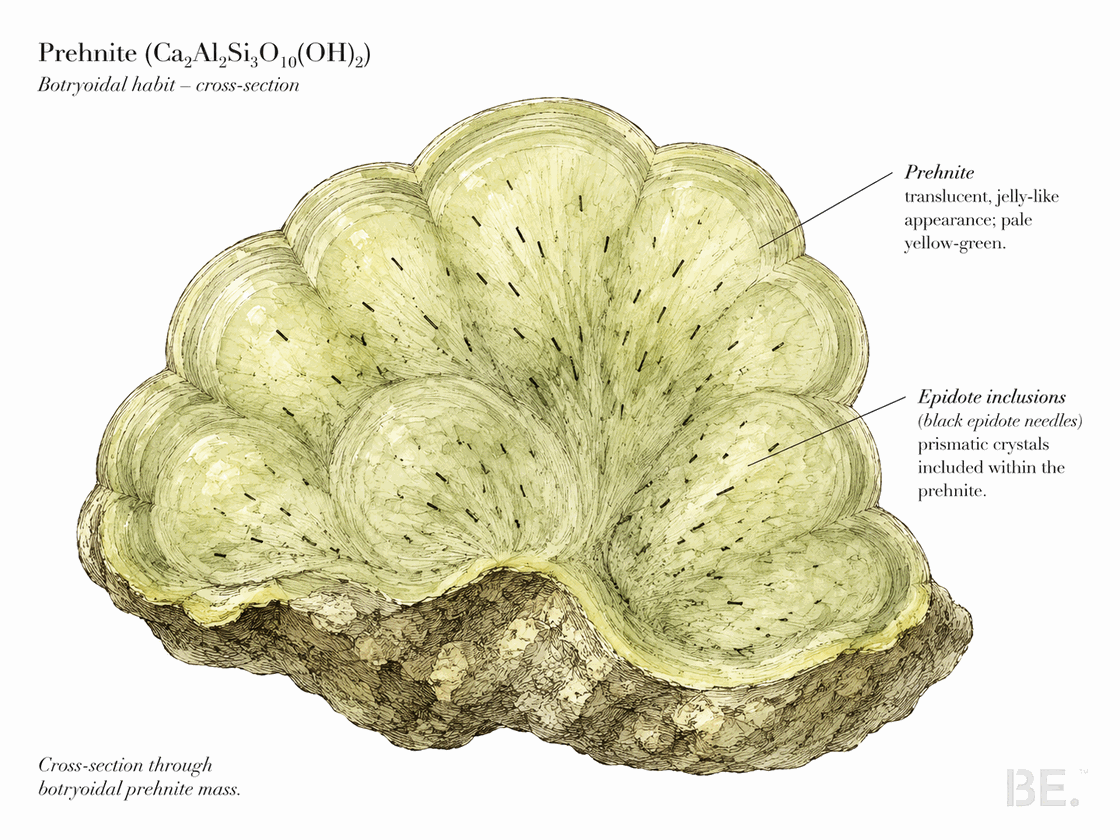
Prehnite is a calcium aluminium silicate with the formula Ca2Al2Si3O10(OH)2. It forms at low temperatures in the gas cavities and fractures of volcanic rock, often alongside zeolites, growing not as sharp single crystals but as rounded, grape-like aggregates — a habit called botryoidal. Internally it is made of countless fine fibres packed together, and that fibrous structure scatters light to produce the soft, glowing translucence that defines it.
The colour — pale yellow-green to a deeper bottle green — comes mainly from small amounts of iron. It is rarely vivid; prehnite’s register is muted and luminous rather than saturated. At 6 to 6.5 on the Mohs scale it is distinctly softer than quartz, which matters for wear and is why prehnite is treated more carefully than a quartz strand.
Prehnite was, incidentally, the first mineral ever named after a person — the Dutch colonel Hendrik von Prehn, who carried it back to Europe in the 18th century. It is a quietly historic stone as well as a quietly beautiful one.
Why the green varies
| Appearance | Cause | What it tells you |
|---|---|---|
| Pale yellow-green, glowing | Low iron, fine fibrous structure | The classic jelly-like prehnite look |
| Deeper bottle-green | Higher iron content | More colour, sometimes less translucent |
| Green with black needles | Epidote inclusions | Natural; adds contrast and character |
| Greyish or chalky | Less ordered structure / impurities | Lower translucence; reads cheaper |
The black needles many buyers ask about are usually epidote, a related green-black silicate that crystallised alongside the prehnite. They are entirely natural and, well distributed, can make a piece more interesting rather than less.
Where prehnite forms
| Origin | Typical character | What to look for |
|---|---|---|
| Mali | Bright yellow-green, high translucence; epidote needles | The collector reference; glowing jelly quality |
| Australia (Wave Hill) | Even pale green botryoidal masses | Clean translucence |
| South Africa / various | Variable green, sometimes greyer | Check for chalkiness |
Prehnite is widespread in basalt terrains, but gem-quality translucent material is concentrated in a few sources. Origin hints at character; the glow and evenness in the bead decide quality.
Reading a prehnite strand
- Translucence. The single most important quality — look for the lit-from-within glow, not flat opacity.
- Even colour. A consistent yellow-green across beads; avoid chalky or patchy material.
- Epidote distribution. If black needles are present, they should read as natural accents, evenly scattered, not muddy clumps.
- Polish. Softer than quartz, so check for a smooth, even surface without scratches from careless handling.
- Consistency. Translucence and tone should match reasonably across the strand.
Trade names, decoded
- Grape jade. A marketing name for botryoidal prehnite. It is not jade — a different mineral entirely.
- Cape emerald. An old misleading name; prehnite is unrelated to emerald.
- Prehnite with epidote. The accurate description when black-green needles are present.
- “Prehnite jade”. Same stretch as grape jade; ask for the mineral name.
Caring for a prehnite strand
Prehnite’s softness is the thing to respect. At Mohs 6 to 6.5 it scratches more readily than quartz, so store it on its own, away from harder stones, and take it off for anything where it might be knocked. Clean with a soft, damp cloth; avoid ultrasonic cleaners and prolonged soaking, which can affect the fibrous surface over time. Treated gently it keeps its glow for years; treated like quartz it will dull.
How BE. grades it
BE. grades prehnite on the Crystal 4T framework — Transparency (the all-important glow), Tone (the green), Texture (epidote distribution and freedom from chalkiness) and Treasure (sourcing confidence and material scarcity) — and every strand ships with a Stone Origin Card recording the material and source. For the meaning-and-culture side of the stone, see our prehnite stone reading; for how it sits among the other greens, see our guide to green crystals.
Frequently asked questions
Q1.What is prehnite?
Prehnite is a calcium aluminium silicate, Ca2Al2Si3O10(OH)2, that forms in low-temperature volcanic cavities and grows in grape-like botryoidal masses. Its soft yellow-green, jelly-like translucence is its signature.
Q2.What are the black needles in prehnite?
They are usually epidote inclusions, a related green-black silicate that grew with the prehnite. They are natural and often add to the stone's character.
Q3.Is prehnite soft? Can I wear it daily?
Prehnite is about 6 to 6.5 on the Mohs scale, softer than quartz, so it can scratch more easily. It is fine for daily wear with care: store it apart from harder stones and avoid knocks.
Q4.Is prehnite related to jade?
No. Trade names like grape jade or Cape emerald are misleading. Prehnite is its own mineral, unrelated to jade or emerald.
Q5.How do I care for prehnite?
Wipe with a soft damp cloth, store separately to avoid scratches, and avoid ultrasonic cleaners and prolonged soaking.
Q6.How do I choose a good prehnite strand?
Look for an even, glowing translucence, a green you like, well-distributed epidote if present, and a clean polish across consistent beads.
References
- Mindat — Prehnite
- GIA Gem Encyclopedia
- Deer, Howie & Zussman (2013). An Introduction to the Rock-Forming Minerals, 3rd ed.
- Anthony et al. (1995). Handbook of Mineralogy.
Field Notes, weekly.
One stone, its geology, and how to read quality — no folklore. The Stone Buying Checklist comes free with your first email.
By subscribing you agree to receive emails from BE. Unsubscribe anytime.
Sent. Check your inbox.