
Green Crystals: Prehnite, Green Phantom & Emerald Phantom
A geology-first guide to green crystals — what makes a stone green, the mineral families involved, top deposits, and how to choose a strand.
In this field note
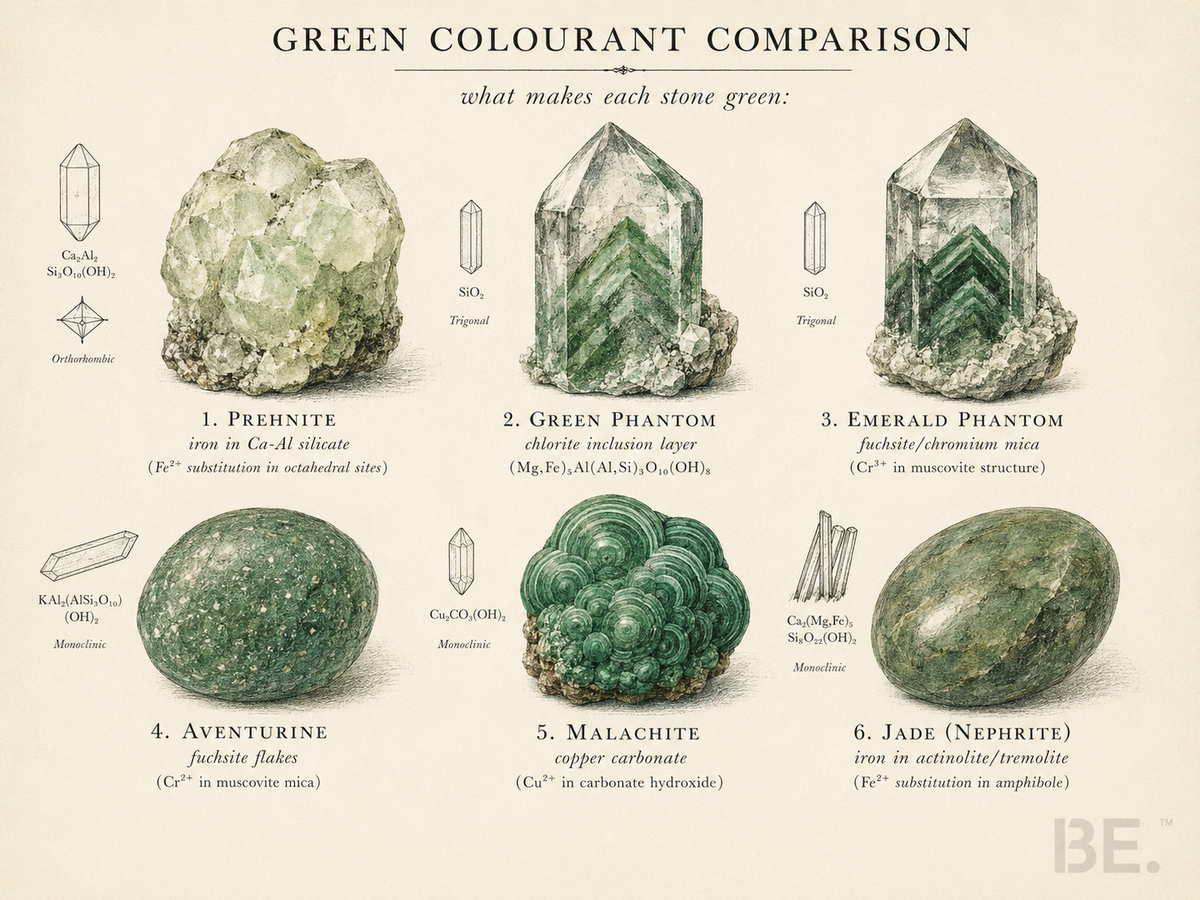
Green crystal identification starts with material class
Green can come from selective absorption in a host lattice, structural defects, dispersed inclusions or an added treatment. The same apparent hue can therefore occur in unrelated silicates, carbonates, fluorides, aggregates and manufactured glass. The chemistry behind each route is in how crystal colours form.
Which green crystal names match which materials?
Start with the material and visible structure. Colour narrows the list. High-value names such as emerald, jadeite and demantoid also need a treatment disclosure and gemmological testing behind them.
| Name | Mineral | Colour cause | Visual clue | Common confusion |
|---|---|---|---|---|
| Emerald | Beryl | Chromium or vanadium | Transparent to translucent green with fissures or inclusions | Green beryl, tourmaline, glass |
| Peridot | Olivine | Iron within the mineral structure | Yellow-green to olive-green transparent material | Green glass, tourmaline |
| Jadeite jade | Jadeite aggregate | Chromium or iron, depending on colour | Compact texture with vitreous polish; translucent to opaque | Nephrite, serpentine, dyed material |
| Nephrite jade | Amphibole aggregate | Iron | Fibrous, interlocking texture with a greasy to waxy lustre | Jadeite, serpentine |
| Green tourmaline | Tourmaline group | Chromium, vanadium or iron | Transparent green, often darker along one viewing direction | Emerald, peridot, glass |
| Tsavorite | Grossular garnet | Vanadium or chromium | Bright transparent green with garnet-like brilliance | Demantoid, emerald, glass |
| Demantoid | Andradite garnet | Chromium | Yellow-green to vivid green with strong dispersion | Tsavorite, peridot |
| Chrysoprase | Chalcedony | Nickel-bearing compounds | Even apple-green translucent body colour | Dyed chalcedony, jade |
| Prasiolite | Quartz | Iron-related colour centres, commonly produced by treatment | Pale leek-green transparent quartz | Green glass, pale beryl |
| Prehnite | Calcium aluminium silicate | Iron-related absorption | Pale yellow-green translucent body, sometimes with dark inclusions | Serpentine, pale jade |
| Green aventurine | Quartz aggregate | Green mica inclusions | Fine glitter across an opaque to translucent green body | Dyed quartz, jade |
| Malachite | Copper carbonate hydroxide | Copper within the mineral | Opaque light and dark green bands | Dyed stone, reconstructed material |
| Green phantom quartz | Quartz | Chlorite inclusions | Green ghost layers or clouds inside clear quartz | Moss agate, dyed quartz |
Continue through the colour naming series: black, blue, purple, pink, white and clear, yellow and gold, and brown.
Green crystals: names and identification matrix
Mohs values are typical reference ranges for each material.
| Material | Typical appearance route | Mohs | What sets it apart | Treatments and look-alikes |
|---|---|---|---|---|
| Emerald | Transparent to translucent green beryl; fissures and inclusions are common | 7.5–8 | Green beryl coloured by chromium or vanadium [1] | Oil or resin in fissures is the usual clarity treatment; green beryl, tourmaline and glass look similar |
| Peridot | Transparent yellow-green to green olivine | 6.5–7 | Olivine; the yellow-green comes from iron in the structure [3] | Green glass and tourmaline look similar |
| Jadeite jade | Compact aggregate; translucent to opaque, often vitreous | 6.5–7 | Jadeite and nephrite are different materials grouped by the word jade [2] | Bleaching, polymer impregnation and dye are the treatments to know |
| Nephrite jade | Compact fibrous aggregate; translucent to opaque, commonly waxy | 6–6.5 | Texture and toughness matter more than a single hue [2] | Serpentine and dyed stone can look similar |
| Green tourmaline | Transparent to opaque; colour zoning and directional colour can occur | 7–7.5 | A mineral group; the green often deepens along one viewing direction [4] | Emerald, peridot and glass look similar |
| Tsavorite garnet | Transparent vivid green grossular | 6.5–7.5 | Grossular garnet coloured by vanadium or chromium [5] | Colour can overlap with emerald, tourmaline and glass |
| Demantoid garnet | Transparent yellow-green to green and often highly dispersive | 6.5–7 | Andradite garnet with strong dispersion [5] | Tsavorite and peridot look similar |
| Chrysoprase | Translucent, commonly even apple-green chalcedony | 6.5–7 | Chalcedony coloured by nickel-bearing compounds [6] | Dyed chalcedony and jade look similar |
| Prasiolite | Transparent pale yellow-green to leek-green quartz | 7 | A green quartz variety [6] | Commonly produced by heating or irradiation [7] |
| Prehnite | Transparent to translucent, often pale yellow-green with a waxy or vitreous look | 6–6.5 | Calcium aluminium silicate; the yellow-green is iron-related absorption [8] | Serpentine and pale jade look similar |
| Aventurine quartz | Translucent to opaque quartz with reflective platelets | 6.5–7 | Quartz with green mica platelets that glitter in the light [6] | Aventurescent glass is a manufactured look-alike |
| Malachite | Opaque green copper carbonate, commonly banded | 3.5–4 | Copper carbonate with light and dark green bands [9] | Stabilisation, dye and reconstituted material are the treatments to know |
| Fluorite | Transparent to translucent, sometimes colour-zoned; perfect cleavage | 4 | Soft, with perfect cleavage, so it needs gentle handling [10] | Glass and coated material can share the colour |
| Green and emerald phantom quartz | Transparent quartz host with green clouds, layers or phantom inclusions | 7 | Green phantom layers are chlorite-group minerals; emerald phantom layers are fuchsite, a chromium-bearing mica | Dyed quartz and glass can imitate the look |
A four-step green crystal identification flow
- Place the material class. Record transparent, translucent, opaque or aggregate; then note vitreous, waxy, greasy or silky lustre.
- Describe structure before naming it. Record banding, zoning, fibres, platelets, fissures, clouds, phantoms, bubbles or flow.
- Check the documented property route. Published hardness, refractive index, specific gravity and spectroscopy guide non-destructive gemmological testing. Do not scratch, heat or apply chemicals to jewellery.
- Read the Stone Origin Record. For a BE. strand, the Record lists the stone identity, the treatment, the lot and the origin, so the name and the treatment arrive with the strand.
Treatments to know by material
- Jade: “jade” must resolve to jadeite or nephrite, and bleaching, polymer impregnation or dye must be disclosed [2][7].
- Emerald: fissure filling is common enough that type and degree of clarity enhancement belong in the purchase record [1][7].
- Chalcedony, quartz and glass: dye, coating, irradiation, heating and manufactured look-alikes can create overlapping greens [7].
- Phantom quartz: green phantom quartz takes its green from chlorite-group minerals and emerald phantom quartz from fuchsite. Both are natural inclusions sealed inside the quartz, and BE.’s phantom quartz is untreated.
For the same material-first triage in a warm colour family, compare the red and orange crystal guide.
BE. catalogue: the green materials we string
Prehnite: pale-green calcium aluminium silicate
Prehnite is Ca₂Al(AlSi₃O₁₀)(OH)₂ and is commonly reported at Mohs 6–6.5 [8]. In beads it shows pale yellow-green to green transparency or translucency, sometimes with dark inclusions. BE.’s prehnite is untreated, and its Stone Origin Record lists the stone identity, the treatment and the origin at sourcing level.
Green phantom quartz: quartz with chlorite phantoms
Green phantom quartz is quartz whose staged growth preserved green layers inside the crystal. The green comes from chlorite-group minerals, mainly clinochlore. In BE.’s strands the layers read deep moss to olive green, often shaped like small landscapes inside the clear quartz.
Emerald phantom quartz: quartz with fuchsite phantoms
Emerald phantom quartz is quartz with pale green phantom layers of fuchsite, a chromium-bearing mica with the formula K(Al,Cr)2(AlSi3O10)(OH)2. The chromium in the mica gives the green. In BE.’s strands the phantoms read as a soft, pale mint-green mist inside clear quartz. The name borrows emerald for the colour; the stone is quartz, and the mica sits sealed inside it.
BE. catalogue material comparison
| Catalogue group | Host or material | Visual reading | Typical Mohs | Colour source |
|---|---|---|---|---|
| Prehnite | Calcium aluminium silicate | Pale yellow-green to green bodycolour; transparent to translucent | 6–6.5 | Iron-related absorption |
| Green phantom quartz | Quartz with chlorite phantom layers | Deep moss to olive-green layers inside a transparent-to-translucent host | 7 for quartz host | Chlorite-group minerals (clinochlore) |
| Emerald phantom quartz | Quartz with fuchsite phantom layers | Pale mint-green mist inside a clear quartz host | 7 for quartz host | Fuchsite, a chromium-bearing mica |
How to choose between them
- Choose material before colour. Decide whether you want prehnite bodycolour or a quartz host with an internal inclusion landscape.
- Describe the visual structure. Compare translucency, host clarity, layer definition, saturation and surface condition.
- Match care to the material. Prehnite (Mohs 6–6.5) is a little softer than quartz (Mohs 7), so store it apart from harder stones.
- Read the Record. Each BE. strand’s Stone Origin Record lists the stone identity, the treatment, the four 4T readings, the lot and the origin at sourcing level.
What BE. selects for in each
Crystal 4T™ scores Transparency, Tone, Texture and Treasure. For prehnite, BE. looks at body transparency, how evenly the colour sits in each bead and across the strand, and surface condition. For phantom quartz, BE. looks at host clarity and how clearly the phantom layers show in each bead.
How to wear green strands with other BE. series
Green is one of the colours that sits easily across BE.’s four series. Prehnite pairs cleanly with the softer translucent strands (clear quartz, rose quartz, moonstone) because all of them read as a soft internal glow. The two phantom quartzes pair more naturally with other inclusion-bearing materials (rutilated quartz, hematoid quartz, Super Seven), because each of those strands shows a landscape inside the stone. A common layered combination is one prehnite strand with one green phantom strand, which produces two different greens at two different optical depths on the same wrist.
Caring for green crystal jewellery
Care depends on the material. Fluorite and malachite are much softer than quartz, and emerald may contain filled fissures. For BE.’s prehnite and phantom quartz strands, wipe with a soft cloth, skip steam and ultrasonic cleaners and household chemicals, and store them apart from harder jewellery.
Where to start
Start with the look you want: prehnite for a soft green bodycolour, green phantom quartz for a deep green landscape inside clear quartz, or emerald phantom quartz for a pale mint mist.
Frequently asked questions
Q1. What are common green crystals?
Common names include emerald, peridot, jadeite, nephrite, green tourmaline, tsavorite, demantoid, chrysoprase, prasiolite, prehnite, aventurine, malachite, fluorite and green-included quartz. They are unrelated materials that can overlap in colour.
Q2. Can colour identify a green stone?
No. Use colour only to narrow candidates, then evaluate material class, lustre, internal texture, measured properties and treatment disclosure.
Q3. Are jadeite and nephrite the same material?
No. Both can be sold as jade, but jadeite and nephrite are different mineral aggregates with different structures and properties [2].
Q4. Is every green phantom in quartz chlorite?
No. In green phantom quartz the green layers are chlorite-group minerals, mainly clinochlore. In emerald phantom quartz they are fuchsite, a chromium-bearing mica.
Q5. Is emerald phantom quartz emerald?
No. It is quartz with pale green phantom layers of fuchsite, a chromium-bearing mica. Emerald is green beryl.
Q6. Which treatment disclosures matter for green stones?
Examples include emerald fissure filling, jade bleaching or polymer impregnation, dye in jade or chalcedony, and heating, irradiation or coating where applicable. The relevant disclosure depends on the material [7].
References
- [1] GIA: Emerald. Beryl identity and clarity-enhancement context.
- [2] GIA: Jade. Jadeite, nephrite and treatment boundary.
- [3] GIA: Peridot. Olivine gem properties.
- [4] GIA: Tourmaline. Group and appearance context.
- [5] GIA: Garnet description. Garnet-group identity.
- [6] Handbook of Mineralogy: Quartz.
- [7] GIA: Gem treatment. Disclosure categories and limitations of appearance.
- [8] Handbook of Mineralogy: Prehnite.
- [9] Handbook of Mineralogy: Malachite.
- [10] Handbook of Mineralogy: Fluorite.
Field Notes.
One stone at a time: its geology, and how to read quality. The Stone Buying Checklist comes with your first email.
By subscribing you agree to receive emails from BE. Unsubscribe anytime.
Sent. Check your inbox.