
Are Expensive Crystal Bracelets Worth It? A Material Reading
An honest material-first look at when premium crystal bracelets justify the price — and when they don't. Mineral grade, finish, origin transparency, and brand work.
In this field note
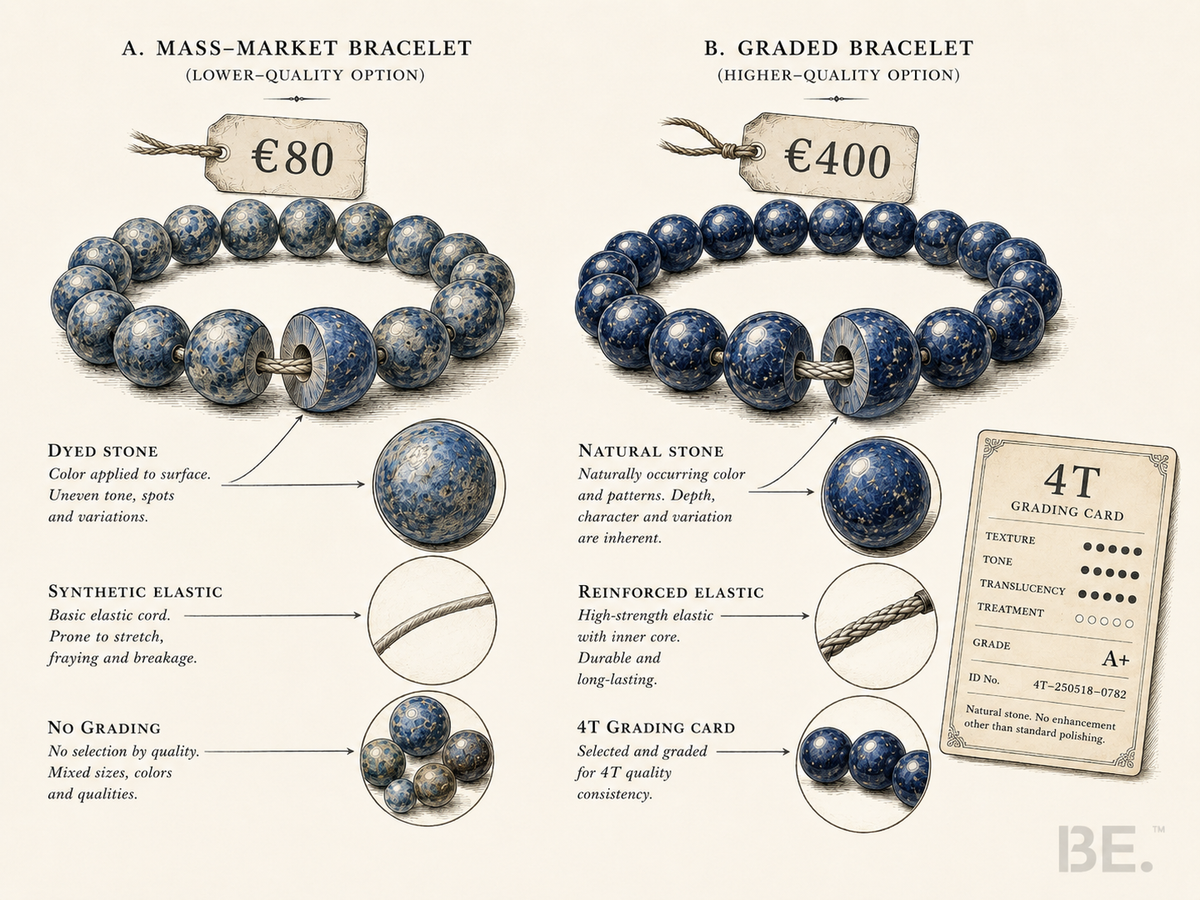
What you are paying for in a crystal strand
A finished crystal strand is the end of a long run of choices: the grade of the rough, the precision of the cutting, the polish, the sorting that matches one bead to the next, and the written record of origin and treatment. A strand priced above another should be better on these, and on a good strand you can see it.
Where price comes from in this category
Four things set the price of a crystal strand:
- Scarce material. Some stones are hard to find at a given colour and clarity. Rough of that quality is scarce before a single bead has been cut.
- Sorting and cutting. Good beads are picked out of the rough, and 70–90% of the material is set aside along the way. One internal fracture rules a bead out.
- Written records. Each lot is logged with its country of origin, lot number, treatment status and grading, and the record stays with the finished piece.
- Made to order. A studio that grades in-house and strings each piece to the ordered size puts hands-on time into every strand.
What a higher price should be buying
A higher price should show up in four things. Each one is either visible on the wrist or written down, and BE. records all four for every strand.
1. Verifiable source information
The product page should name the country the stone comes from, and a written record should travel with the piece. Every lot in the BE. supply chain has a Lot ID, the product page names the country of origin, and each strand comes with its Stone Origin Record.
2. Visible finish quality
Hold the strand under a single light and look along it. The polish should look the same on every bead, and the drill-hole edges should be clean and smooth. On a well-finished strand, every bead looks like the same object repeated.
3. Documented treatment status
Treatment status should be written on the product page or the record that comes with the strand: untreated, heated, irradiated or stabilised. Every BE. strand states its treatment status on its Stone Origin Record.
4. Bead-to-bead consistency
Sorting shows on the wrist. On a well-sorted strand each bead holds a deep, even colour of its own, and the beads match one another from end to end. A loosely sorted strand jumps in tone between neighbouring beads, and you can see it at conversational distance.
How BE. prices its strands
BE. prices each strand by its material and its tier, from the entry strands up to Heritage pieces in the low thousands. Four choices go into every strand.
- Direct supply. BE. works directly with upstream suppliers, and every lot is recorded from the day it arrives.
- Crystal 4T™ grading. BE. only lets about the top 20% of inspected material into the studio, then scores each lot on the Crystal 4T™ system: Transparency, Tone, Texture and Treasure.
- Made to order. Each strand is strung by hand on stainless steel wire to the ordered wrist size, so it sits correctly from the first wear.
- Lot ID and Stone Origin Record. Every strand carries a Lot ID that matches its product page and order record, and ships with its lot certificate.
What the difference looks like on the wrist
A well-sorted, well-finished strand holds a deep, even colour from end to end, and every bead catches the light the same way. You see it at conversational distance, before anyone looks closely. The colour is in the stone and the polish lasts, so a strand made this way is one you keep wearing for years.
The check before you buy
Four checks work on any strand once it is in your hand.
- Tone. In daylight, each bead should hold a deep, even colour, and the beads should match along the strand.
- Drill holes. Look closely at the drill holes. The edges should be clean, with no ragged chipping or filler.
- Origin. The product page should name the country the stone comes from.
- Treatment. The product page or the record should say whether the stone is untreated, and if treated, how. On a BE. strand it is on the Stone Origin Record.
Frequently asked questions
Q1. What does the BE. starting price reflect?
Four things: direct work with upstream suppliers, Crystal 4T™ grading that lets only about the top 20% of inspected material into the studio, strands made by hand to the ordered wrist size, and a Lot ID with a Stone Origin Record for every piece. Above the entry strands, price rises with scarcer material and higher 4T tiers.
Q2. Are higher-priced crystal bracelets always better?
They are when the price comes with better stone: deep, even colour from bead to bead, a clean finish, a stated treatment status and a stated country of origin. The first two you can see at conversational distance.
Q3. What is a fair price for a quality crystal bracelet?
It depends on the material. A prehnite strand and a green phantom strand are priced differently because the rough and the share of it set aside at sorting are different. Within one material, a fair price comes with even colour, a clean finish, a stated treatment status and a stated country of origin.
Q4. How can I tell whether a strand has been treated?
Read the product page or the record that comes with the strand; treatment status should be written there. On a BE. strand it is on the Stone Origin Record.
Q5. Is it worth paying more for a Heritage-tier strand?
Heritage tier under BE.’s 4T system means Transparency, Tone and Texture all read Exceptional and Treasure reads Exceptional too: the material is at the top of the system and hard to replace at that quality. It is the finest material BE. strings.
Q6. Where should I start if I am buying my first higher-end crystal bracelet?
Start with the stone you like most. Every BE. strand, from the entry pieces to Heritage, comes with the same Stone Origin Record and the same finishing standard; the tier follows the 4T readings of the material.
References
- The 4T grading system: the material framework behind BE.’s tiers.
- The Geological Codex: material entries for the stones BE. works with.
- Our Story: the geology-first position the brand is built from.
- The Strands collection: the catalogue these material standards produce.
Field Notes.
One stone at a time: its geology, and how to read quality. The Stone Buying Checklist comes with your first email.
By subscribing you agree to receive emails from BE. Unsubscribe anytime.
Sent. Check your inbox.