
Moonstone for Beginners: Adularescence & Starter Picks
A beginner's guide to moonstone — what adularescence is, how to pick a first strand, and what to expect from this feldspar.
In this field note
Moonstone is the first stone many buyers fall for after a year or two of quartz family bracelets. The blue-white sheen catches light in a way clear quartz cannot, and the visual reads more uniquely than amethyst or rose quartz. It is a real upgrade in optical phenomenon — and a real downgrade in durability, which beginners should understand before buying.
This guide explains what adularescence actually is, the three main types of moonstone on the market, how to pick a starter strand, and the practical care that turns a fragile material into something you can keep for a decade.
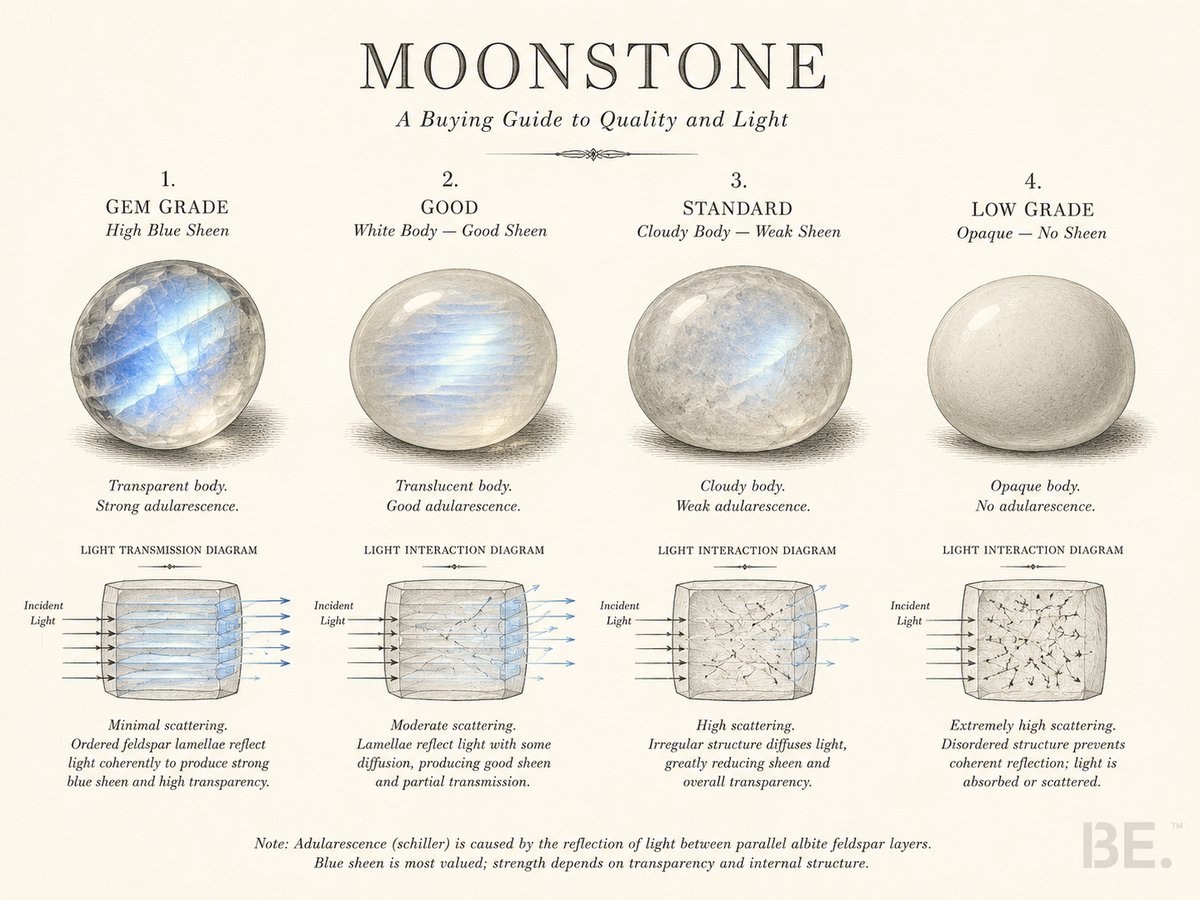
What moonstone actually is
Moonstone is not a single mineral. It is a variety of orthoclase feldspar (KAlSi₃O₈) that has undergone a slow cooling process called exsolution. When the original feldspar was hot, it accommodated both potassium and sodium atoms in a single crystal. As it cooled over geological time, the structure separated into alternating thin layers — orthoclase (potassium-rich) and albite (sodium-rich) — because the two ions no longer fitted comfortably in the same lattice.
These alternating layers are extremely thin, on the order of the wavelength of visible light. When light enters the stone, the layers act as a stack of partial mirrors. Most wavelengths pass through. The blue end of the spectrum (around 450 nm) is scattered preferentially by the layer spacing, and this scattered blue light is what floats across the surface of a polished moonstone bead as adularescence.
The phenomenon is the same physics that makes the sky blue — selective scattering of shorter wavelengths. In moonstone the scatterers are internal, lamellar, and stationary, so the blue light appears to drift across the bead as the angle changes.
The three commercial types of moonstone
| Type | Mineralogy | Visual character | Typical origin |
|---|---|---|---|
| White moonstone | Orthoclase + thin albite lamellae | Cool white body with silvery sheen; cheaper grades have weak or no sheen | India (most commercial), Madagascar |
| Blue moonstone (classic) | Same composition; thicker even lamellae | Transparent to translucent with strong floating blue sheen; the prized type | Sri Lanka (Meetiyagoda), Burma |
| Rainbow moonstone | Plagioclase feldspar (labradorite), not orthoclase | Body shows flashes of blue, purple, gold, sometimes green | India, Madagascar |
| Peach / pink moonstone | Orthoclase with iron trace | Warm body colour, modest sheen, often without strong blue | India |
| Cat’s eye moonstone | Orthoclase with parallel fibrous inclusions | Single bright line across the cabochon; rare in bead form | Sri Lanka, India |
A note on rainbow moonstone
What the trade calls “rainbow moonstone” is technically labradorite, a different feldspar. The colour play is labradorescence (not adularescence) and the cause is similar but distinct — thicker lamellae diffract different colours rather than only the blue end. Whether this matters depends on your purpose: visually, rainbow moonstone is a beautiful stone; mineralogically, it is something else under the trade name. A serious seller will tell you which one they are selling.
How to pick a starter strand
Three things matter: sheen quality, body transparency, and bead match. Walk through them in order.
Sheen quality
Strong adularescence appears as a discrete blue cloud that moves across the bead as you tilt it. Weak sheen looks like a faint general haze without clear movement. The premium for strong sheen is significant but worth it — a moonstone strand with weak sheen reads as a white bead, not as a phenomenon stone.
The check: under direct daylight, rotate the strand slowly. The blue floating light should appear and disappear with angle, not stay static. If you see no movement, the sheen is too weak.
Body transparency
Top-grade moonstone is translucent to near-transparent in the body, which lets the adularescence float without being muddied by underlying cloud. Commercial grade is more opaque white. The difference is significant in price — transparent Sri Lankan blue moonstone is several times the cost of opaque white — and significant in visual.
Bead matching
A moonstone strand benefits more from sorting than a quartz strand because the sheen direction can vary. Beads should ideally be cut so the lamellar planes align with the bead axis, allowing the sheen to wrap around uniformly. Poorly oriented beads show sheen on only one side.
Durability — what beginners need to know
Moonstone is Mohs 6, soft enough that household dust (which contains quartz at Mohs 7) will scratch the surface over time. It also has two cleavage directions, meaning sharp impact can chip the stone along internal weakness planes. This is not a stone for kitchen work or rough wear.
Practical care:
- Remove for manual work. Cleaning, gardening, contact sports, weightlifting — anything where the bracelet might knock against a hard surface.
- Avoid temperature shocks. Do not go from a hot shower into cold air. Feldspars can develop tiny stress fractures over many cycles.
- Store separately. Wrap in a soft pouch or store in a divided box. Other harder bracelets (quartz, garnet) will scratch moonstone on contact.
- Clean with mild soap and a soft cloth. No ultrasonic cleaners (they can propagate cleavage fractures). No steam.
- Refresh string annually. Stretch cord weakens over time; a snapped string on a moonstone strand often means chipped beads.
Pricing reality
White moonstone with weak sheen is cheap — entry strands from $20-$40. Strong-sheen white moonstone runs $80-$200 for a good 8 mm strand. Top-grade Sri Lankan blue moonstone with body transparency starts around $250 and runs to $1,000+ for collector quality. Rainbow moonstone sits in the mid-range, $80-$300 typically.
For a first purchase, the sensible spend is $100-$200 on a strong-sheen strand. Below that the sheen is usually weak; above that, the buyer needs to know what they are looking for.
Common reading points on the strand
- Direction of sheen. Should move with rotation. Static sheen indicates poor orientation or weak phenomenon.
- Colour of sheen. Blue is most prized. White or silver is fine but lower tier. Yellow or orange hints suggest peach moonstone variety.
- Body inclusions. Small parallel cracks (called centipedes by traders) are typical and not a flaw. Large dark inclusions reduce value.
- Drill area integrity. Check carefully at both drill holes. Chips here from drilling are common and shorten the life of the strand.
- Strand uniformity. Sheen strength should be consistent bead-to-bead. Two strong beads next to ten weak ones means an unsorted parcel.
How BE. handles moonstone
BE. lists moonstone strands by the Crystal 4T grade with sheen strength scored under the Texture axis. Origin is documented on the Stone Origin Record — Sri Lankan material is named separately from Indian. We do not stock white moonstone with weak sheen, because the visual difference between weak and strong is the entire point of the stone.
Frequently asked questions
Q1.What is the difference between moonstone and rainbow moonstone?
Classic moonstone is orthoclase feldspar with thin albite layers, showing a blue-white floating sheen. Rainbow moonstone is labradorite, a different feldspar, with thicker layers producing flashes of multiple colours. They look similar at a glance but are mineralogically different stones.
Q2.Is moonstone too fragile for daily wear?
It can be worn daily with care, but it should come off for manual tasks. Compared with quartz it is more delicate and more careful handling extends its life by years.
Q3.Why does my moonstone look different in different light?
That is the point of the stone. Adularescence is a directional optical phenomenon; the angle of light, angle of bead, and angle of view all change the apparent sheen. Photographs taken outdoors at midday will show different sheen from indoor evening light.
Q4.How do I spot a fake moonstone?
The most common fakes are opalite (man-made glass with milky body) and pressed glass. Real moonstone shows directional sheen that moves with angle; opalite shows a static cloudy interior. A loupe view of fluid inclusion patterns is conclusive.
Q5.Is moonstone safe to wear in water?
Brief contact is fine. Long contact (extended swimming, hot tubs) can dull the surface over time through fine etching. Removing for swimming and hot showers is the conservative habit.
Q6.What size bead works best for moonstone?
10 mm shows the sheen most dramatically because there is more surface for the phenomenon to play across. 8 mm reads more delicate. Below 8 mm the sheen is often hard to see and the stone loses its advantage over plainer materials.
References
- GIA Gem Encyclopedia — Moonstone
- Mindat — Orthoclase data
- Wikipedia — Moonstone (gemstone)
- Wikipedia — Adularescence
- Webster, R. (2002). Gems: Their Sources, Descriptions and Identification, 5th ed. Butterworth-Heinemann.
- Deer, W.A., Howie, R.A., Zussman, J. (2001). Rock-Forming Minerals: Volume 4A Framework Silicates. Geological Society of London.
Field Notes.
One stone at a time: its geology, and how to read quality. The Stone Buying Checklist comes with your first email.
By subscribing you agree to receive emails from BE. Unsubscribe anytime.
Sent. Check your inbox.