
Types of Obsidian: Eight Varieties, Told Apart by Sight
A geology-first guide to obsidian — volcanic glass formation, black/snowflake/rainbow/sheen varieties, top deposits, and how to read a strand.
In this field note
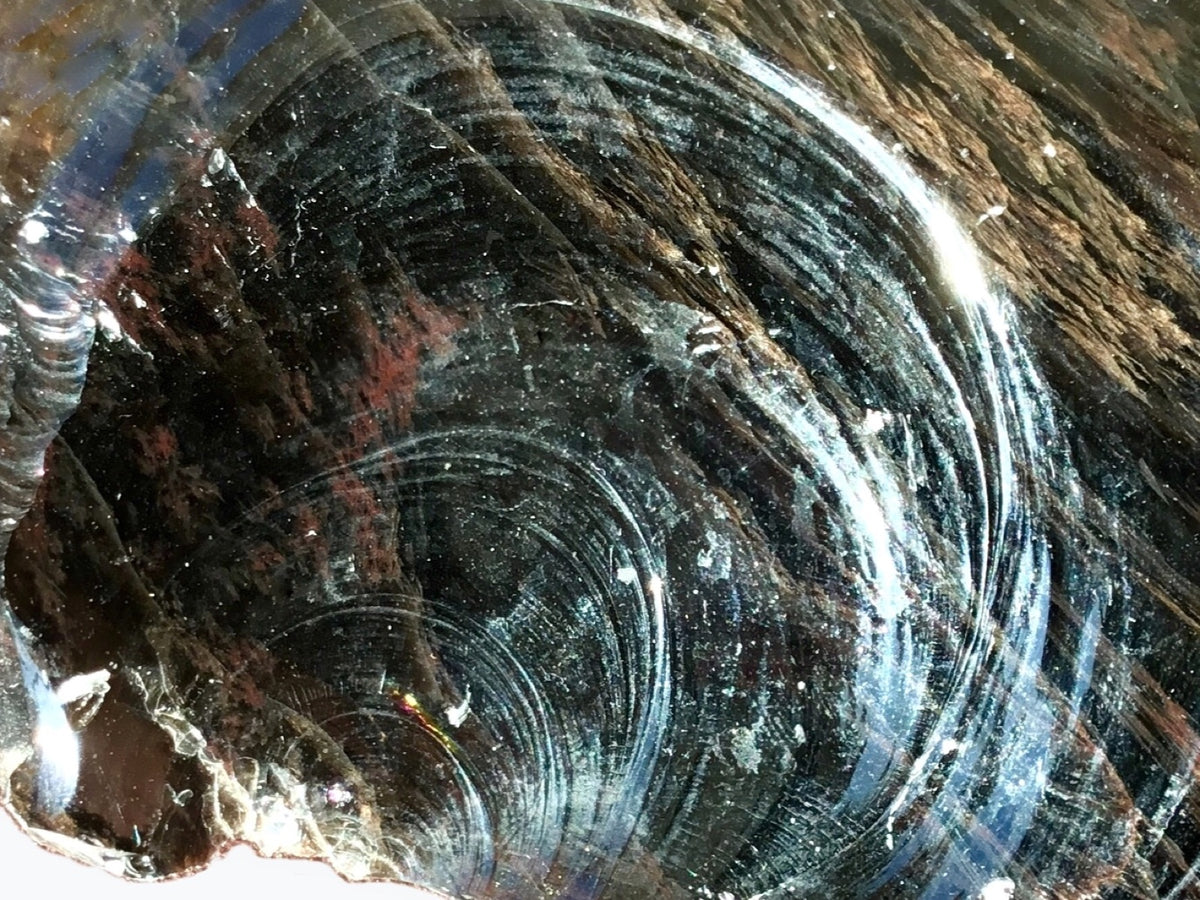
What is obsidian?
Obsidian is a naturally occurring volcanic glass. In many well-known deposits, silica-rich lava is so viscous that crystals grow slowly; if the melt cools fast enough, most of it solidifies as an amorphous glass instead. The word glass describes that structure: the atoms froze before they could line up into crystals.
When obsidian breaks, the break is conchoidal: smooth, curved surfaces spread out from the point of impact, like the inside of a shell. That clean break made obsidian the material of choice for early cutting tools. Polished, the same glass takes a deep, mirror-like lustre.
| Property | What it is | In practice |
|---|---|---|
| Material class | Natural volcanic glass, a mineraloid with no crystal structure | Small crystals, bubbles and flow bands can sit inside the glass |
| Typical composition | Often silica-rich, with composition varying by source | Each volcanic flow has its own chemistry |
| Fracture | Conchoidal, a smooth curved break | The same curved break seen in flint |
| Hardness | Around Mohs 5–5.5 | Softer than quartz; store it apart from harder beads |
| Appearance | Black, brown, banded, spotted or with a sheen that moves with the light | Each look has its own trade name, listed below |
How obsidian forms
Obsidian records a race between cooling and crystallisation. The melt can contain the ingredients needed for minerals, yet cooling and high viscosity limit how far those ingredients can move and organise. The result is predominantly glass, sometimes crossed by flow bands or populated by microlites, spherulites and vesicles.
Because each flow cools in its own way, two pieces of obsidian from different volcanoes can look quite different, with their own bubbles, flow bands and tiny crystals.
Types of obsidian by appearance
Black obsidian
Specialist guide: Black Obsidian identification and quality guide, on screening and selection.
Black obsidian is the broad baseline: a dark glassy field that may transmit brown-grey light at a thin edge. It can contain flow features, bubbles or microscopic phases even when the polished face looks uniform.
Snowflake obsidian
Specialist guide: Snowflake Obsidian Guide, on spherulites, quality and screening.
Snowflake obsidian contains pale, radiating spherulitic areas produced as parts of the glass devitrify. They grow inside the glass. Their size and shape vary from piece to piece, so no two snowflake beads carry the same pattern.
Mahogany obsidian
Specialist guide: Mahogany Obsidian Guide, on the brown-red pattern, quality and screening.
Mahogany obsidian combines black glass with brown to red-brown fields. Iron-bearing minerals in the glass give the brown-red colour. When choosing, look at how strong the contrast is and whether the pattern runs through the bead.
Apache tears
Specialist guide: Apache Tears Obsidian Guide, on nodule habit, context and screening.
Apache tears are rounded or subrounded obsidian nodules weathered from hydrated flows or pyroclastic deposits. The name describes their shape and where they are found.
Rainbow, gold sheen and silver sheen obsidian
Specialist guide: Rainbow Obsidian Guide, on angle-dependent colour and selection.
Specialist guides: Silver Sheen Obsidian Guide for the cool directional appearance; Gold Sheen Obsidian Bracelet Guide for gold-sheen mechanism evidence and bracelet selection.
These names describe a sheen that moves as the bead turns. In studied Mexican sheen obsidian, the sheen comes from tiny flattened bubbles and crystals of pyroxene and feldspar lined up along the direction the lava flowed. Oregon fire obsidian gets its colour from magnetite-rich layers a few hundred nanometres thick, which split light the way a film of oil on water does.
For choosing a gold sheen strand, see the Gold Sheen Obsidian Bracelet Guide; for choosing between the two, see the Gold Sheen vs Black Obsidian comparison.
Fire obsidian
Specialist guide: Fire Obsidian Guide, on Oregon material and selection.
Fire obsidian is an Oregon material with exceptionally vivid, angle-dependent colour. Its colour comes from thin-film interference in magnetite-rich layers.
To see the differences at full size, compare these varieties side by side in the obsidian comparison tool.
Related volcanic glasses and other names
Pele’s tears and Pele’s hair. These are droplets and very fine strands of basaltic volcanic glass thrown out during eruptions. They are collected as geological specimens.
Marekanite. This is a local or historical name used for rounded obsidian nodules.
Pitchstone, perlite and tachylite. These are related volcanic glasses with names of their own. Pitchstone and perlite hold more water than obsidian and have a different texture; tachylite is a dark basaltic glass, while obsidian is usually a silica-rich rhyolitic glass.
Blue, green and red “obsidian”. Natural obsidian is mostly black or brown. Bright blue, green or red beads sold under the name are often manufactured glass.
How to identify obsidian
Start with what you can see: lustre, light through a thin edge, curved flow lines, bubbles, inclusions and sheen that moves with the angle. Turn the bead under daylight and then under a small lamp, and watch what changes.
Bubbles and a curved break show up in both natural and manufactured glass, so neither settles it on its own. For telling obsidian from onyx, tourmaline and glass, use the Black Bead Identification Guide; for two common mix-ups, see Obsidian vs Onyx and Smoky Quartz vs Obsidian.
How to choose obsidian quality
Start with identity: the Stone Origin Record on every BE. obsidian strand names the stone and states its treatment. Then look at how much of each bead shows sheen or pattern, the polish, the drill holes and how well the beads match along the strand. Sheen is easiest to judge by turning the strand under a lamp.
For black obsidian, look at the thin edge, the drill holes and the surface under a loupe. For snowflake or mahogany, check that the pattern runs through the body of the bead.
Caring for obsidian
Wipe polished obsidian with a soft damp cloth and dry it. Store it apart from harder quartz beads, and skip steam and ultrasonic cleaners. For more on cleaning and storage, see the obsidian surface care guide.
Skip flame, acid, hot-needle and scratch tests at home; they mark the bead and still do not tell natural from manufactured glass.
Where to go next
- What Obsidian Knows About Stillness: a material observation on frozen movement and reflection.
- Sheen, adularescence and the Tyndall effect: what each optical term means.
- the obsidian comparison tool: seven varieties side by side, with their surfaces, formation and screening points.
Frequently Asked Questions
Q1. What is obsidian?
Obsidian is natural volcanic glass. It forms when silica-rich melt cools quickly enough that most of the material cannot build an orderly crystal lattice.
Q2. What are the main types of obsidian?
Common appearance names include black, snowflake, mahogany, rainbow, gold sheen, silver sheen and fire obsidian. Apache tears are rounded obsidian nodules.
Q3. What causes gold sheen in obsidian?
In studied Mexican gold sheen obsidian, the sheen comes from tiny bubbles and mineral crystals lined up along the direction the lava flowed. Oregon fire obsidian is different: magnetite-rich layers create thin-film interference.
Q4. Can bubbles prove that obsidian is fake?
No. Natural volcanic glass and manufactured glass can both contain bubbles. Look at the thin edge, the flow lines and the sheen as well.
Q5. Is obsidian hard enough for everyday jewellery?
Yes. At around Mohs 5–5.5 it is softer than quartz, so store it apart from harder beads and skip steam and ultrasonic cleaners.
Q6. Is every green or blue glass sold as obsidian natural?
No. Natural obsidian is mostly black or brown; bright transparent green or blue glass sold as obsidian is often manufactured.
References
- USGS: Obsidian, a scarce commodity in Hawai‘i
- USGS: Yellowstone’s tool-making lava flows
- USGS Professional Paper 1523: chemistry and Apache-tear occurrences
- GIA: Phenomenal Gemstones: obsidian sheen mechanisms
- CaltechAUTHORS: Origin of fire obsidian
- GIA: Fire obsidian from Oregon
- GIA: Bubble obsidian from Armenia
- TÜBİTAK Earth Sciences: snowflake obsidian devitrification study
- Periodico di Mineralogia: spherulites in snowflake obsidian
- Minerals: colour and microvesiculation in obsidian
Field Notes.
One stone at a time: its geology, and how to read quality. The Stone Buying Checklist comes with your first email.
By subscribing you agree to receive emails from BE. Unsubscribe anytime.
Sent. Check your inbox.