
What Obsidian Knows About Stillness
Obsidian is volcanic glass, not crystal: a material formed without a lattice, made sharp by fracture and luminous through microscopic gas bubbles in gold sheen obsidian.
In this field note
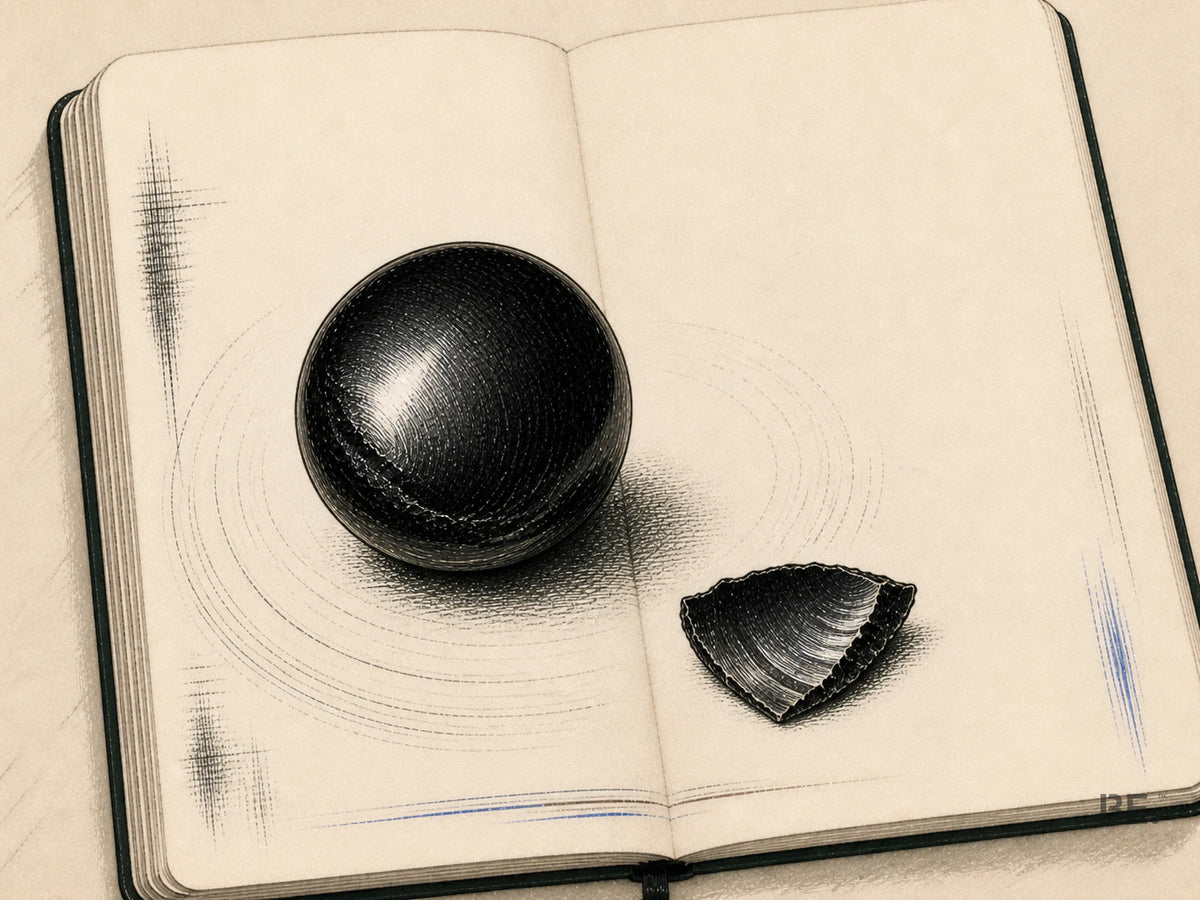
A surface that holds light
A bright crystal scatters attention across facets and inclusions. Polished black obsidian often does the opposite. Much of the field stays dark while a reflection travels across it. The eye receives less information, so the object can feel visually quiet.
That quiet is conditional. Turn the glass and the reflection moves. Thin the edge and brown-grey transmission may appear. Chip it and a conchoidal fracture interrupts the plane. Stillness is not a permanent substance inside obsidian; it is one relationship between surface, light and viewer.
Frozen movement
Obsidian forms when volcanic melt cools quickly enough that most of its components do not organise into a repeating crystal framework. Calling it glass does not make it empty. Flow banding can record movement in the melt. Bubbles can preserve gas. Microlites and spherulites can mark partial crystallisation or later devitrification.
The contradiction is useful: an apparently seamless black object can be a record of viscosity, shear, cooling and time. The polished face is calm because the making was not.
Reflection without a claim
An obsidian object may help someone pause because it is cool to the touch, dark, smooth or personally associated with a ritual. That experience can be real for the person without becoming evidence that the glass emits a calming field. The material fact and the private meaning do not need to compete.
One way to use the object is simply to describe what is present: dark field, moving highlight, curved surface, small chip, weight in the hand. The exercise returns attention to observation. It asks less of the stone and more of the person looking.
Reading the material
- Move one light source and watch whether the highlight travels across the surface or appears from inside.
- Look at a thin edge without scratching or chipping it; note any transmitted brown-grey colour.
- Separate observation from interpretation: “the surface is dark and reflective” is different from “the stone absorbs energy.”
- Stop if a chip exposes a sharp edge; obsidian’s conchoidal fracture is a handling risk, not a home test.
The broad geology and variety map belongs to the Types of Obsidian guide. The historical claim boundary belongs to Why Is Obsidian Called a Protection Stone?
Frequently Asked Questions
Q1. Why can obsidian look still?
A polished dark surface suppresses much visual noise and can return a controlled reflection. The appearance is quiet even though the glass records rapid cooling, flow and fracture.
Q2. Is obsidian a crystal?
No. Obsidian is predominantly amorphous volcanic glass, although small crystals and other internal features may occur within it.
Q3. Does stillness mean obsidian has no internal structure?
No. Flow bands, bubbles, microlites and devitrification features can remain inside the glass. A uniform polished face does not erase that history.
Q4. Does obsidian have a scientifically proven calming energy?
No specific calming field has been established as a material property of obsidian. A person may still find the object useful as a visual or tactile cue, which is a personal experience.
References
Field Notes.
One stone at a time: its geology, and how to read quality. The Stone Buying Checklist comes with your first email.
By subscribing you agree to receive emails from BE. Unsubscribe anytime.
Sent. Check your inbox.