
Crystal 4T™ · BE.'s selection standard
Crystal Grading: How BE. Grades Every Stone (Crystal 4T™)
Crystal grading has no single industry-wide standard. BE. uses Crystal 4T™ to score Transparency, Tone, Texture and Treasure from 1 to 5 against published criteria. The lowest material score sets the tier: 3 for Studio and 4 for Signature. Heritage requires 5 in all four readings. Three material scores of 5 with a lower Treasure score make Signature. A score below 3 in Transparency, Tone or Texture means rejection.
Read the four readingsA stone enters BE. only if it is untreated or its heating is declared, and its country of origin is known. It is then read four ways, each scored 1 to 5. Anything at 2 or below on Transparency, Tone or Texture is sent back. The lowest of those three readings names the piece: Standard makes a Studio piece, Strong a Signature piece, and three Exceptionals with an Exceptional Treasure make Heritage. About one stone in five gets through.
Entry
01Nothing is scored until it passes entry.
Crystal 4T™ is a studio standard. No laboratory issues it. Before any reading is taken, the material has to clear three conditions.
- 01No dye, coating, filling or artificial irradiation.Material treated this way does not enter.
- 02Heat is declared, or it does not enter.Heated material enters only when the treatment is stated on the Stone Origin Record and on the product page. It cannot be Heritage.
- 03A country of origin, at least.Material with no country-level source information does not enter.
Material that fails entry goes back to the supplier.
Four readings
02Four questions. Each answered 1 to 5.
Transparency, Tone and Texture describe the material in hand. Treasure describes how difficult that material is to obtain at this quality, size and colour.
1 and 2 are below standard. 3 is Standard. 4 is Strong. 5 is Exceptional. Product pages and the Stone Origin Record show the word; the number stays internal.
A reading word describes one property of one stone. A tier name describes the finished piece. Readings are Standard, Strong or Exceptional. Pieces are Studio, Signature or Heritage.
READING 1 OF 4
Transparency
Transparency measures how light passes through a bead and how clearly its internal features can be seen; opaque materials are assessed by surface lustre and optical effects.
Read with the unaided eye at wearing distance, about 40 cm, against a white card under daylight-balanced light. 10× magnification only confirms what the eye has found.
 5ExceptionalLight passes through freely. No clouding or fracturing visible at wearing distance. Under 10×, internal features are absent or minor.
 4StrongLight passes through. Slight clouding is difficult to see at wearing distance and confirmed under 10×.
 3StandardLight passes through most of the bead. Clouding is noticeable on close inspection but does not dominate at wearing distance.
 2Below standardClouding or fracturing is obvious at wearing distance on a large share of the strand.
 1Below standardCloudy or opaque throughout.


Amethyst under the same light. Each bead sits beside the reading it earns. 2 and 1 are sent back.
READING 2 OF 4
Tone
Tone assesses colour saturation and depth within each bead, plus colour consistency across the strand, against the natural colour of that variety.
Each variety is judged against its own natural colour. A naturally deep colour and a naturally light colour can both score 5. The question is whether the colour is full for that variety. Depth on its own decides nothing. Crystal 4T™ does not rank one hue above another.
 5ExceptionalSaturation is vivid, the full colour of the variety, neither washed out nor dulled. Depth is even within each bead. No variation between beads is visible at wearing distance.
 4StrongSaturation is strong. Depth is even within each bead. Slight variation between beads is difficult to see at wearing distance.
 3StandardSaturation is moderately strong. Depth may vary slightly within a bead. Variation between beads is noticeable on close inspection but does not break the strand at wearing distance.
 2Below standardSaturation is weak: the colour reads washed out or dulled on a large share of the strand, or variation between beads is obvious at wearing distance.
 1Below standardSaturation is very weak or absent: the variety cannot be identified by its colour at wearing distance.


The second half of the reading: the same beads, strung as two strands.
READING 3 OF 4
Texture
Texture assesses the finished bead through surface polish, drill-hole condition, roundness and diameter consistency across the strand.
Read under 10× magnification, and confirmed with the unaided eye. The same reading for every material.
- 5ExceptionalNo pits, scratches or drill-hole chipping under 10×. Beads are uniform in roundness and diameter.
- 4StrongMinor pits or drill-hole chipping are difficult to see under 10× and not visible to the unaided eye. Beads are uniform in roundness and diameter.
- 3StandardMinor polishing faults or drill-hole chipping are noticeable under 10× but not visible to the unaided eye. Slight variation in diameter may be present.
- 2Below standardDull patches, grinding marks or rough drill holes are visible to the unaided eye.
- 1Below standardFractures, chips or pitting are visible to the unaided eye.
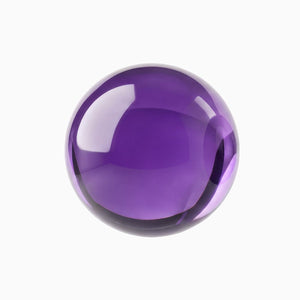
5 · Mirror 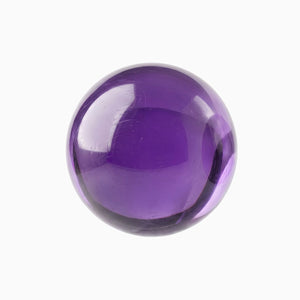
3 · Drag lines PolishMirror finish across the whole bead, against drag lines and dull patches seen under 10×.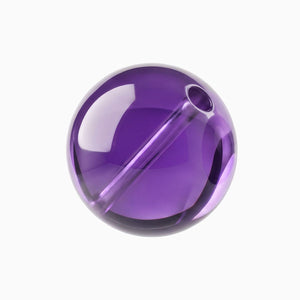
5 · Clean bore 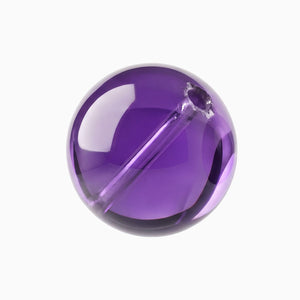
2 · Chipped Drill holeA clean, centred bore, against chipping at the entry that the unaided eye can see.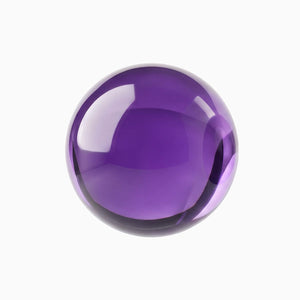
5 · Clean 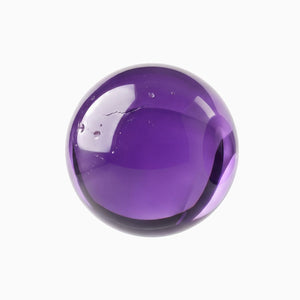
2 · Fractured SurfaceNo pits or scratches under 10×, against fractures visible to the unaided eye.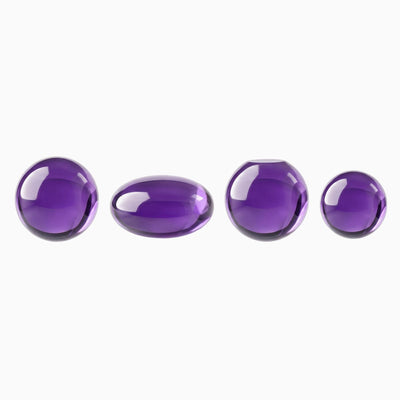
Round · flattened · flat spot · runs small Roundness and diameterA true sphere at the strand's diameter, against a flattened bead, a flat spot, and one that runs small.
READING 4 OF 4
Treasure
Treasure scores how difficult a material is to obtain at a given quality, bead size and colour, using BE.'s supply records.
Assigned from BE.'s supply record for the variety, size and colour. The individual strand does not change it. Source and treatment are recorded separately on the Stone Origin Record and are not scored. There is no photograph for this reading: it comes from the record, and the eye cannot check it.
- 5ExceptionalSupply depends on a particular find. When a lot sells out, material of the same quality may not be available again for years, or at all.
- 4StrongMaterial of this quality is uncommon: only a small part of each parcel reaches this standard, or few sources can supply it. Restocking takes time and is not guaranteed.
- 3StandardMaterial of this quality is restocked within a normal buying cycle.
- 2Below standardCommodity material, available in quantity at any time.
- 1Below standardNot stocked by BE.
Tiers
03The lowest material reading sets the tier.
Take the lowest of Transparency, Tone and Texture. That reading names the piece. Treasure never lowers a tier. It matters only for Heritage.
The lowest material reading is Standard.
LOWEST = 3The lowest material reading is Strong.
LOWEST = 4All three material readings are Exceptional, and Treasure is Exceptional too. If Treasure is 4 or below, the piece is Signature.
ALL 5 + TREASURE 5- 4 · 4 · 3 + T 5The lowest material reading is 3, so the piece is Studio.
- 5 · 5 · 4 + T 5The lowest material reading is 4, so the piece is Signature.
- 5 · 5 · 5 + T 4All three material readings are 5, but Treasure is not, so the piece is Signature.
- 5 · 5 · 5 + T 5The piece is Heritage.
A reading word describes one property of one stone. A tier name describes the finished piece. A piece is never called Strong, and a reading is never called Signature. Keeping the two apart means "Strong" on a Record always refers to one reading, and "Signature" always refers to the whole piece.
Rejection
04About four in five stones do not get through.
A stone that scores 2 or below on Transparency, Tone or Texture is rejected. It is not made up, and it is not sold under a lower tier. Material that fails entry goes back to the supplier.
These figures are BE.'s own estimate from years of buying. They are not a statistic. They describe the material offered to BE. The pieces on sale are counted separately.
- ≈ 80%of all offeredRejectedFails entry, or scores 2 or below on a material reading.
- ≈ 10%50% of enteredStudioThe lowest material reading is Standard.
- ≈ 8%40% of enteredSignatureAll three material readings are Strong or better.
- ≈ 2%10% of enteredHeritageAll three material readings are Exceptional. Occurs only in varieties whose Treasure is Exceptional.
Of every hundred stones offered to BE., about twenty enter. Ten become Studio, eight Signature, two Heritage.
Material types
05A 5 means the best this material can show.
Texture and Treasure are read the same way for every material. Transparency and Tone are read against the reference for the material type: rose quartz is not asked to be as clear as amethyst, and obsidian is not asked to transmit light at all.
When a strand mixes two materials, each is read by its own type. The strand takes the lower readings.
Transparent single crystals
Clear quartz · amethyst · citrine · smoky quartz · blue smoky quartz · aquamarine · kyanite · and garnet that transmits light
Light through the whole bead and the absence of clouding. A 5 is fully transparent. A 3 shows light haze that is difficult to see at wearing distance. A 2 shows cloud that is obvious at wearing distance.
Saturation, depth and evenness against the variety reference.
Amethyst · Transparency


Amethyst · Tone


The full five-step ladder for both readings is shown in section 02.
Naturally translucent single crystals
Rose quartz · moonstone
These materials are translucent by nature and never fully transparent. A 5 is the clearest the material reaches, with no milky patches. A 3 shows small milky patches on close inspection. A 2 shows patches that are obvious at wearing distance.
Saturation and evenness. Moonstone's sheen is read under Tone.
Rose quartz · Transparency


Rose quartz · Tone


Included crystals
Rutilated quartz · green rutilated quartz · hematoid quartz · Koi phantom quartz · green and emerald phantom · Super Seven
The clarity of the host crystal, and whether the inclusions can be read sharply through it. Haze or cloud around the inclusions lowers the score. The inclusions themselves do not. A 5 shows the inclusions sharp through a clear host. A 3 shows some haze around the inclusions on close inspection. A 2 shows the inclusions blurred at wearing distance.
The colour of the inclusions and their contrast against the host, together with their definition and arrangement: sharp needles, clear phantom layers, an even distribution across the strand.
Rutilated quartz · Transparency


Rutilated quartz · Tone


Translucent aggregates
Prehnite · chalcedony · agate
How much light passes through the bead. A 5 lets light through the whole bead. A 3 lets light through at the edge only. A 2 lets almost none through.
Colour and the evenness of banding or layering.
Prehnite · Transparency


Opaque and optical-effect stones
Gold sheen obsidian · tiger's eye · lapis · dark garnet
Read as surface light response: lustre and the strength of the optical effect, such as sheen or chatoyancy. A 5 shows the effect on every bead at wearing distance. A 3 shows it on most beads on close inspection. A 2 shows it on few beads or not at all.
Purity of the body colour and the colour of the optical effect.
Gold sheen obsidian · Transparency


What is recorded
06The Stone Origin Record carries the evidence.
Every reading is taken under the same conditions: daylight-balanced light at 5500 K over a white reference card, the unaided eye at about 40 cm for Transparency and Tone, 10× magnification for Texture, and BE.'s reference for each variety. What comes out of it is written on the Record.
The lot the beads came from.
Mineral name and variety.
Transparency, Tone, Texture and Treasure.
Studio, Signature or Heritage.
At the level verified for that lot: country, region or deposit. Recorded as a fact. Not scored.
Recorded as a fact. Not scored.
Sourcing disclosure can be read on five levels, from nothing a buyer can check to a documented chain from the mine to the individual piece. BE. works at Level 3: every piece ships with its own numbered Stone Origin Record, carrying the country, treatment status and Crystal 4T™ grading of its lot. Level 4, a documented chain from the mine to the individual piece, is the next step.
- No checkable information
Silence, or “ethically sourced” with no place.
- Named country
Stated at brand level.
- Batch lot published
The lot number is on the listing.
- Per-piece record
A numbered record for each piece, with its lot's country, treatment and grading.
- Mine-to-piece chain
Every stage documented, from the mine to the piece.
What Crystal 4T™ is not
07A selection standard, published.
It is BE.'s own selection standard, published so that anyone can see how stones are chosen and tiered.
- —It is not a gemmological identification and does not replace a laboratory report.
- —It does not grade faceted gemstones.
- —It makes no claim about future value.
Ten checks you can run on any strand before you buy: the BE. Stone Buying Checklist.
Crystal grading questions
Is there a crystal grading system?
Crystal grading has no single industry-wide standard. BE. publishes Crystal 4T™ criteria for Transparency, Tone, Texture and Treasure, with each reading scored from 1 to 5.
What is grade A crystal?
Grade A is a seller-defined quality label. Its criteria vary between sellers. Ask for the grading criteria, treatment status and photographs of the actual material.
How does BE. grade its stones?
BE. scores Transparency, Tone, Texture and Treasure from 1 to 5. Transparency and Tone are read under daylight-balanced light against a white card. Texture is checked under 10× magnification. Treasure comes from supply records.
Is Crystal 4T™ an industry standard?
Crystal 4T™ is BE.'s registered grading system. Its published criteria govern selection at BE. Industry-wide adoption is not implied.
What are the Studio, Signature and Heritage thresholds?
The lowest score in Transparency, Tone and Texture sets the tier: 3 gives Studio and 4 gives Signature. Heritage requires all four readings to score 5. If all three material scores are 5 and Treasure is lower, the piece is Signature. Any material score below 3 means rejection.