
Gold Sheen Obsidian Bracelet: What Causes the Sheen & How to Choose
Why gold sheen obsidian glows — nano-inclusions of magnetite create a directional flash. Covers sheen types, grading criteria, and bracelet care.
In this field note
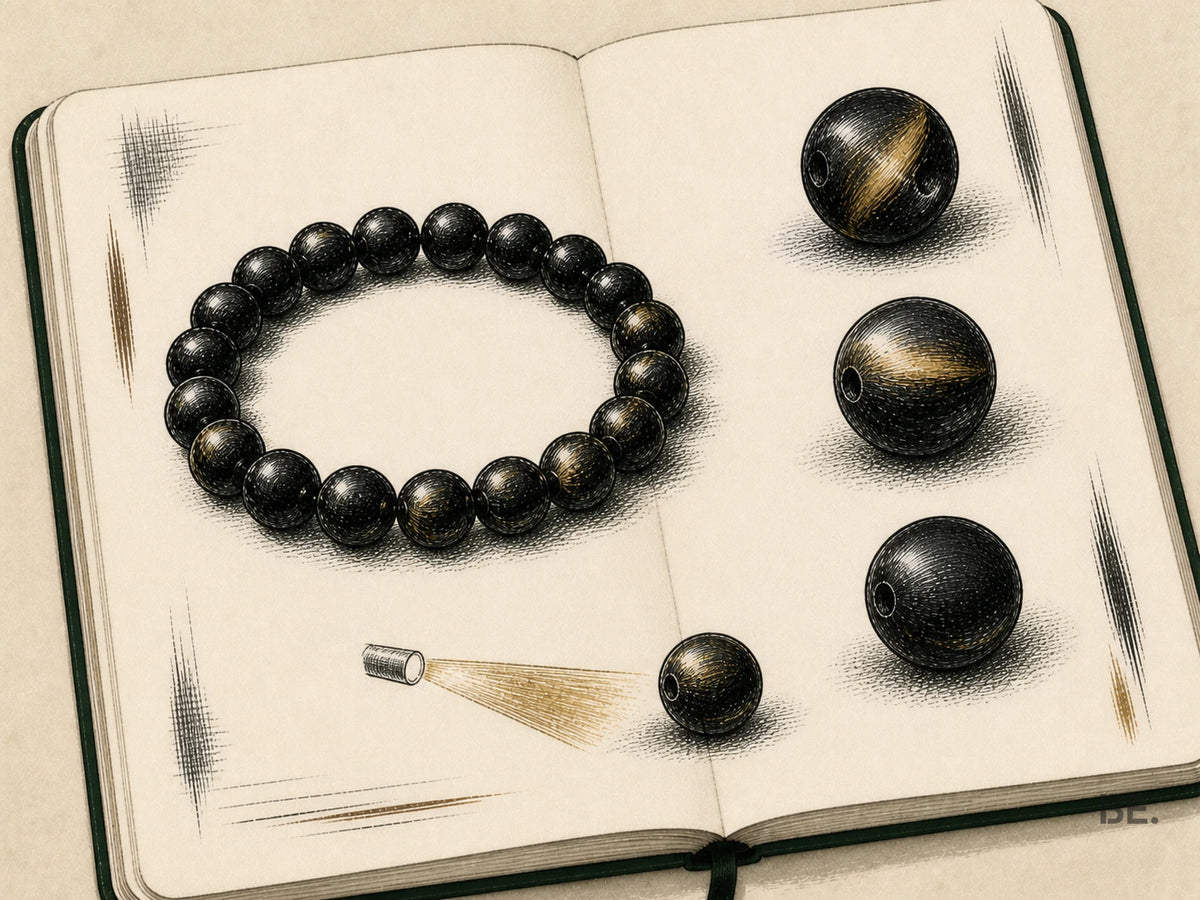
Hold a polished obsidian bead under a desk lamp and tilt it slowly. At most angles the stone looks like any other black volcanic glass — opaque, featureless, almost austere. Then you hit a narrow window of reflection and a broad, warm glow rolls across the surface, somewhere between antique brass and dark honey. That single moment of revelation is what makes gold sheen obsidian one of the more theatrical members of the obsidian family, and one of the more misunderstood.
This guide separates the evidence behind that optical effect from the observations a buyer can make: how the flash moves, how much of the strand responds, how well the beads match, and how cleanly they are finished.
What causes the gold sheen
Obsidian is volcanic glass — SiO₂-rich magma that cooled so rapidly it never developed a crystal lattice. In most specimens the glass is uniformly dark. In gold sheen obsidian, something extra happened during or immediately after solidification.
There is not one verified mechanism for every material sold as gold sheen obsidian. A 2025 GIA review notes that studies remain limited; analysed Mexican sheen material has been associated with flow-aligned lenticular gas or different-glass features together with oriented pyroxene and feldspar phases. The safe claim is directional internal structure, not a universal magnetite-platelet recipe.
A separate, well-analysed route exists in Oregon fire obsidian: magnetite-rich layers roughly 300–700 nanometres thick produce thin-film interference in studied specimens. That result is strong evidence for Oregon fire obsidian, but it must not be generalised to every gold, silver or rainbow obsidian deposit.
In natural sheen obsidian, the optical structure formed in the volcanic material rather than as a metallic surface coating. A finished object still needs specimen-level examination: coatings, manufactured glass and misleading trade names cannot be ruled out by the word sheen alone.
Gold sheen vs silver sheen vs rainbow obsidian
All three varieties are the same base material — rhyolitic volcanic glass — but they differ in what creates the optical effect and what colour range it produces. The comparison matters because vendors sometimes label one as another, and the price implications vary.
| Property | Gold Sheen | Silver Sheen | Rainbow Obsidian |
|---|---|---|---|
| Evidence route | Directional internal features; published mechanisms vary by analysed source | Directional internal features; published mechanisms vary by analysed source | Angle-dependent colour; structure and phases vary by analysed deposit |
| Sheen colour | Warm gold to bronze | Cool silvery white | Multi-colour — green, purple, magenta bands |
| Flash pattern | Broad, single-direction glow | Broad, single-direction glow | Concentric or banded colour zones |
| Transparency of base | Opaque black | Opaque to slightly translucent grey-black | Opaque black |
| Source claim | Require provenance; do not infer a deposit from appearance | Require provenance; do not infer a deposit from appearance | Require provenance; do not infer a deposit from appearance |
| Selection focus | Visible directional flash, coverage, matching and polish | Consistent silver response, matching and polish | Colour movement, pattern continuity, provenance and polish |
If a bead marketed as golden obsidian shows multi-coloured iridescence rather than a uniform warm flash, it is more accurately classified as rainbow obsidian with a dominant gold band. Not necessarily a problem, but worth understanding so you know what you are comparing.
For a broader overview of the obsidian family, including snowflake, mahogany, and black varieties, see our complete obsidian guide.
Choosing a gold sheen obsidian bracelet
Because the sheen is directional rather than a fixed body colour, assess the bracelet under one controlled light and use four observable criteria.
- Sheen intensity. The brightest specimens produce a flash visible even under diffuse indoor lighting, not only under a direct spotlight. Tilt the bracelet slowly — the gold reflection should be vivid and warm, not faint or washed-out grey. Strong intensity generally indicates a higher density of well-oriented nano-inclusions.
- Sheen coverage. In an ideal bracelet, every bead shows sheen when rotated. In lower grades, only a fraction of the beads flash, or the sheen covers less than half the bead surface. Full-coverage strands cost more because they require discarding a larger portion of the rough during sorting.
- Base colour depth. The gold flash is most dramatic against a deep, inky black background. Brownish or greyish base tones weaken the contrast and make the sheen look muddy. Hold the bracelet in a position where no sheen is visible — the base should look uniformly dark.
- Polish quality. Obsidian takes an excellent polish because it is amorphous glass with no grain boundaries. A well-polished bead should feel glassy-smooth and show no visible scratches under a 10x loupe. Pitting, dull patches, or a waxy rather than vitreous lustre indicate rushed finishing.
If you are comparing gold sheen obsidian against black obsidian at a similar price point, our gold sheen vs black obsidian comparison breaks down the differences in detail.
Care, durability, and grading
Hardness and wear
Obsidian sits at 5–5.5 on the Mohs scale, which places it below quartz (7) and most silicate gemstones. In practical terms this means a gold sheen obsidian bracelet will accumulate surface scratches faster than, say, an amethyst or garnet strand. The scratches are cosmetic — they dull the polish rather than compromise the stone — but they do reduce the sharpness of the sheen over time.
- Avoid hard impacts. Obsidian is also brittle due to its amorphous structure. A sharp knock against a countertop can chip a bead rather than merely scratch it. Remove the bracelet before activities involving impact risk.
- Store separately. Keep the strand in a soft pouch or a compartmented tray, away from harder stones that could abrade the surface.
- Clean gently. A damp microfibre cloth is sufficient. Avoid ultrasonic cleaners — the vibrations can exploit pre-existing micro-fractures in glass.
- Re-polish if needed. A jeweller with lapidary equipment can restore the vitreous lustre on obsidian beads that have gone dull, though this is rarely necessary with careful wear.
How BE. grades gold sheen obsidian
Each strand is sorted under a standardised directional light. Beads are evaluated for sheen intensity, coverage, base-colour uniformity, and surface finish. Only strands where every bead produces a visible gold flash under normal indoor lighting are listed. The Lot ID on your strand traces back to the specific parcel from which beads were selected, so two strands from the same lot will show closely matched optical character.
For more on how obsidian fits into a quieter, more considered approach to jewellery, see what obsidian knows about stillness.
Frequently asked questions
Q1. What causes the gold sheen in obsidian?
The gold flash comes from directional internal structure in the volcanic glass, but the exact structure is source-dependent. Published work describes more than one route, including aligned lenticular features and mineral phases in some Mexican material; Oregon fire obsidian has magnetite-rich interference layers. Do not assign one mechanism without analytical evidence.
Q2. Is gold sheen obsidian natural or treated?
Natural gold sheen obsidian carries its directional optical structure within the rough, not as metallic paint on the finished surface. That does not authenticate every item sold under the name; coatings and manufactured glass still require specimen-level screening.
Q3. What is the difference between gold sheen obsidian and plain black obsidian?
Both names can describe volcanic glass, but gold sheen material contains directional internal features that return a golden reflection while plain black material lacks that visible effect. The exact sheen mechanism should remain source-specific. Both are brittle and commonly reported around Mohs 5–5.5.
Q4. How should I care for a gold sheen obsidian bracelet?
Surface scratches can dull the polish and make the visible flash harder to read even when the internal optical structure remains.
Q5. Which grade of obsidian is highest?
Gold sheen obsidian has no universal highest grade; judge it by sheen brightness, coverage, black-body uniformity, bead matching and polish. For gold sheen obsidian, the strongest material combines bright sheen visible in ordinary diffuse light, coverage across every bead, a deep uniform black base, matched beads, and a clean scratch-free polish. An A, AA, or AAA label is useful only when the seller publishes and consistently applies its criteria.
Q6. Is gold sheen obsidian worth anything?
Natural gold sheen obsidian can be worth more than plain black obsidian when the sheen is strong, evenly distributed, and matched across a finished strand. Value also depends on bead size, polish, drill finish, construction, and documented material identity. The name alone does not establish value; compare the actual object and the disclosed criteria.
References
Field Notes.
One stone at a time: its geology, and how to read quality. The Stone Buying Checklist comes with your first email.
By subscribing you agree to receive emails from BE. Unsubscribe anytime.
Sent. Check your inbox.