
Smoky Rutilated Quartz: What the Haze Tells You About the Stone
A geology-first guide to smoky rutilated quartz — what causes the brown haze, why it varies from champagne to morion, where the best material forms, and how to read a strand for quality.
In this field note
The attraction of smoky rutilated quartz comes from contrast: a brown-grey quartz field around a fine internal structure. Reading it accurately means resisting a single dramatic formation story.
This guide keeps the host, inclusions, growth relationship, treatment history and strand quality as separate layers.
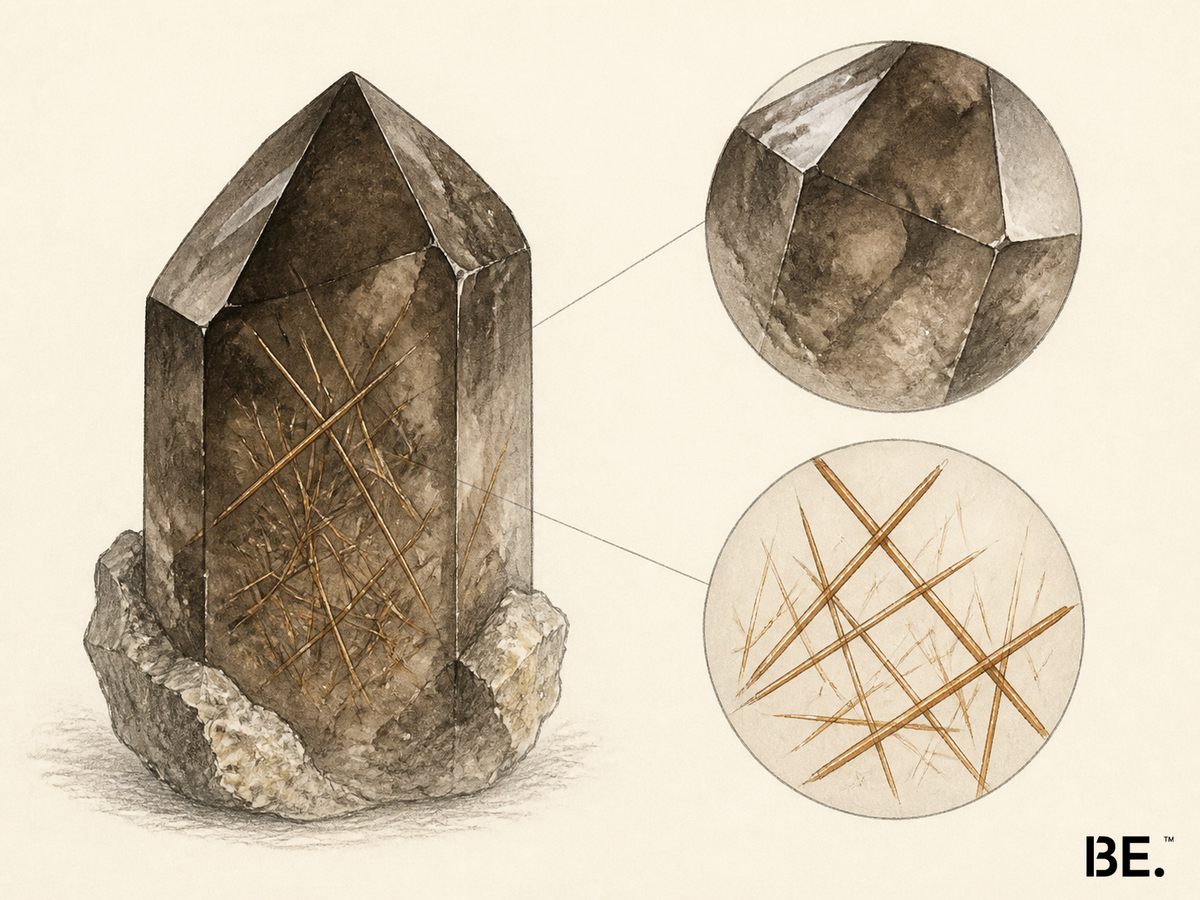
What smoky rutilated quartz actually is
The host is quartz, SiO2. Its smoky field belongs to the same general colour-centre family described in the Smoky Quartz guide: irradiation can act on aluminium-related defects. The needles are a second material question. When analysis identifies them as rutile, they are titanium dioxide, TiO2, enclosed by the quartz.
That combination does not impose one sequence on every specimen. Rutile-bearing quartz can preserve different inclusion and growth relationships. A universal 573 C event, a 10–50 million year clock or a deposit-specific history cannot be read from a bead.
The host colour and the inclusion identity are independent evidence layers. A smoky field does not identify the needles, and needle appearance does not establish the host's treatment history. Read both before comparing the material with Blue Smoky Quartz.
Why the haze varies
Not all smoky rutilated quartz looks the same. The brown body colour ranges from barely perceptible champagne to nearly opaque morion-level darkness. What determines this?
| Observation | Useful description | Not proof of |
|---|---|---|
| Smoky host | Brown-grey colour field in quartz. | Which kind of irradiation produced the colour. |
| Golden needles | Colour and habit of the visible inclusions. | Rutile identity without supporting analysis. |
| Dense needle network | Distribution and visual weight. | One formation temperature or sequence. |
| Dark host | Tone and contrast against inclusions. | Higher quality, age, depth or origin. |
Rutile commonly forms acicular crystals, but hair-like or golden appearance alone does not identify TiO2. Other included phases and altered materials can overlap visually. Microscopy can describe morphology and growth relationships; Raman spectroscopy or another suitable analytical method may be needed to name the phase.
What provenance can document
| Evidence field | What to record | Boundary |
|---|---|---|
| Supplier-stated locality | A traceability field when supported by lot documents. | Needle appearance does not verify the locality. |
| Host description | Record smoky tone, transparency, zoning and fractures. | These observations do not prove natural irradiation. |
| Inclusion description | Record needle colour, form, density and distribution. | Gold colour alone does not identify rutile. |
| Analytical identity | Use microscopy, Raman or another suitable method when needed. | Do not infer one universal formation sequence. |
Reading a smoky rutilated quartz strand
- Needle visibility. Check whether the included structure stays legible through the smoky field.
- Host transparency. Read clear, hazy and fractured areas separately; darkness is not the same as poor clarity.
- Distribution. Compare density, direction and clustering without turning the pattern into an age or origin claim.
- Surface-reaching features. Inspect pits, fractures and polish where inclusions approach the bead surface.
- Disclosure. Ask what supports the rutile name, smoky treatment history and lot provenance.
Trade names, decoded
- Smoky rutilated quartz should mean a smoky quartz host with inclusions identified as rutile.
- Venus hair is a trade description. It carries no analytical result.
- Sagenitic describes a net-like habit; it does not name the host colour or treatment.
- Black rutilated quartz is used inconsistently and must not be assumed to mean tourmalinated quartz or a specific black phase.
- Titanium quartz can be confused with coated aura material; internal inclusions and surface coatings are different structures.
Caring for smoky rutilated quartz
Quartz is Mohs 7, but fractures and surface-reaching inclusions can make a bead less tolerant of impact, steam or ultrasonic cleaning. Use lukewarm water and a soft cloth; avoid aggressive cleaning when fractures are visible. Prolonged direct sunlight is best avoided when colour preservation matters.
How BE. grades smoky rutilated quartz
BE. can record host transparency, smoky tone, inclusion visibility, distribution, polish and the documents supplied for a lot. Those observations do not certify a rutile phase, treatment or origin unless the underlying evidence does.
Smoky rutilated strands are listed in the BE. collection, and every strand ships with a Stone Origin Record that states its lot, its four Crystal 4T™ readings and what those readings do not claim.
Frequently asked questions
Q1. What is smoky rutilated quartz?
It is a trade and material description for a smoky quartz host containing needle-like inclusions identified as rutile. The host colour and the inclusion identity are separate evidence questions.
Q2. Are all golden needles in smoky quartz rutile?
No. Golden or hair-like appearance is not a mineral identification. Microscopy, Raman spectroscopy or another suitable analytical method may be needed when the included phase is uncertain.
Q3. Did the rutile always form before the quartz?
Not always. Rutile can grow before the quartz or at the same time as it, and the order is read specimen by specimen.
Q4. Can zoning prove that the smoky colour is natural?
No. Zoning and uneven colour can be useful observations, but natural and laboratory irradiation can overlap in appearance. Treatment history needs disclosure or laboratory evidence.
Q5. How should a strand be evaluated?
Read needle visibility, host transparency, distribution, fractures, surface polish and disclosure separately. A dark host is not automatically better if it hides the included structure.
Q6. Is smoky rutilated quartz assigned to a Stone Record?
No.
References
- Geological Society of America — Rutile-bearing quartz growth relationships
- GIA — Rutile inclusions and three-rayed asterism in quartz
- Mineralogical research — Rutile and quartz inclusion relationships
- GIA — Irradiation-related colours in quartz
- Gems & Gemology — Natural and artificial irradiation boundary
Field Notes.
One stone at a time: its geology, and how to read quality. The Stone Buying Checklist comes with your first email.
By subscribing you agree to receive emails from BE. Unsubscribe anytime.
Sent. Check your inbox.