
Rutilated Quartz Meaning: Needle Inclusions, Origins & Grading
What rutilated quartz actually means in mineralogy — TiO₂ needles in SiO₂, why colours vary from gold to red, where the best strands come from, and how to read one.
In this field note
Hold a strand of rutilated quartz against window light and you see two minerals at once. The host is transparent quartz, ordinary silicon dioxide. Threaded through it are needles of titanium dioxide, sometimes a single fibre, sometimes a forest. The needles formed first. The quartz grew around them, sealing them in place before either crystal could finish on its own.
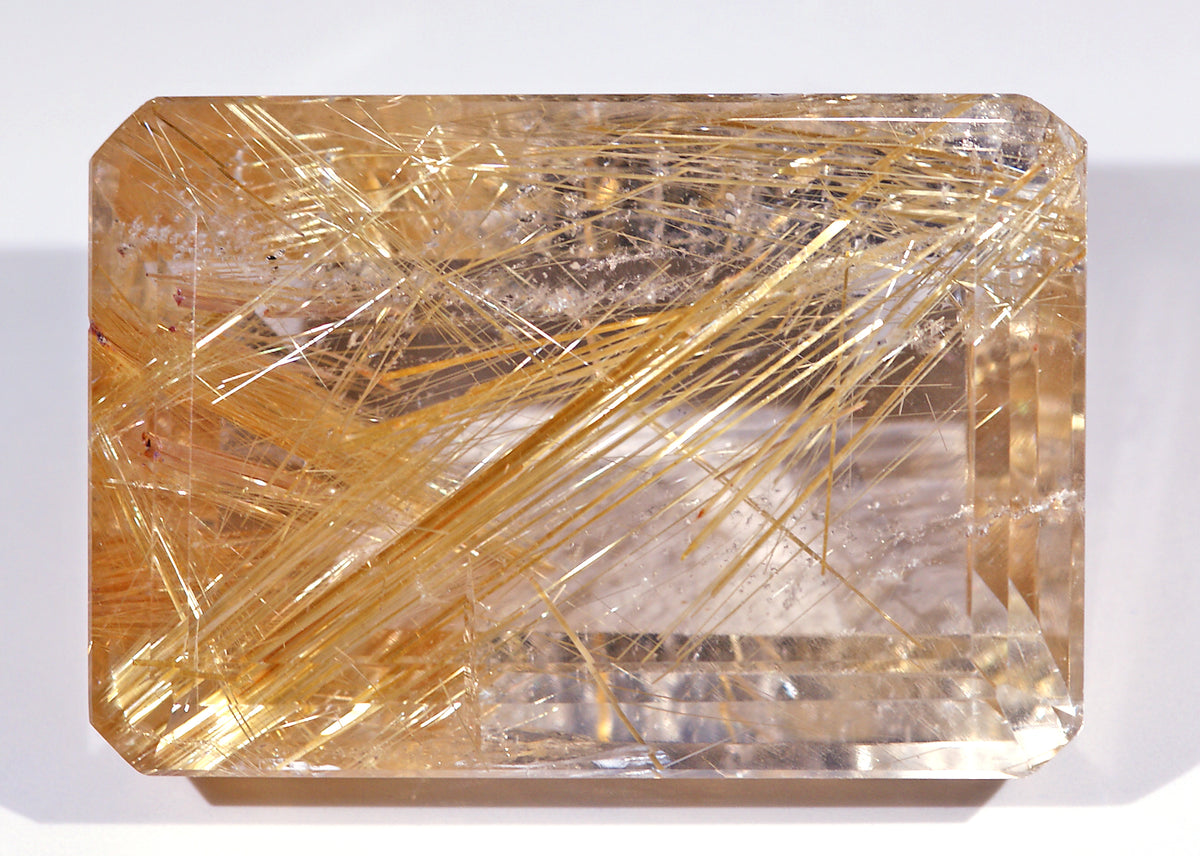
What rutilated quartz is
The host crystal is quartz, SiO2, the same mineral as clear rock crystal and amethyst. The included needles are rutile, TiO2, a titanium dioxide polymorph that crystallises in slender tetragonal prisms. Rutile is the same mineral that gives titanium-white paint its opacity; in quartz it shows up as fine, often parallel, hairs.
The two minerals do not grow at the same time. Rutile crystallises first, at higher temperature, while a hydrothermal fluid is still circulating through a fracture or vug. Then quartz precipitates from the cooler, silica-rich tail of the same fluid, enveloping the rutile fibres without breaking them. This is called a protogenetic inclusion: the included crystal pre-dates the host. The same mechanism, with different included minerals, produces tourmalinated quartz (black tourmaline in quartz), chlorite phantom quartz, and most actinolite-in-quartz pieces.
Because the rutile is already a complete crystal when the quartz seals it in, the needles keep their straight, slightly tapered geometry. You can sometimes see a perfect right-angle junction where one needle grew on another.
Why the needles take different colours
"Golden rutilated quartz" is the version most people picture, but rutile inclusions are not always titanium dioxide alone. The colour you see depends on which trace element substitutes into the rutile structure during growth, and on which other oxide mineral has nucleated alongside it.
| Needle colour | Inclusion mineralogy | What it tells you |
|---|---|---|
| Bright gold to amber | Rutile (TiO2), often Fe-bearing | The classic. Iron substitution into the rutile lattice deepens the gold toward red-orange. |
| Coppery red to brick | Rutile with high Fe3+, or fine hematite intergrowth | Often called "red rutile". A higher iron load gives the warmer hue. |
| Silver to titanium-grey | Pure rutile, or rutile with low trace metals | The light source has more to do with the apparent colour than the chemistry. |
| Black hairs | Tourmaline (schorl) or ilmenite (FeTiO3) | Strictly, this is tourmalinated quartz or ilmenite-in-quartz. There is no rutile in it. |
| Green needles | Actinolite, epidote, or chlorite; rarely true rutile | "Green rutilated quartz" is usually a trade name. The needles are a different mineral with the same look. |
Red rutilated quartz can get its colour in two ways: from iron-rich rutile or from a separate hematite phase. Iron-rich rutile keeps its colour at any angle. Hematite intergrowths can show a metallic flash on one face and read black on another.
Where the visible material forms
Rutilated quartz is found wherever a high-temperature silica-rich fluid had time to circulate through a fracture system. In practice, most of what reaches the market comes from a few countries.
| Origin | Typical character | What to look for |
|---|---|---|
| Brazil | The reference material. Bright golden rutile in clean, water-clear quartz. Needles from very fine "angel hair" to 1–2 mm rods; some material has denser, red-tinted networks. | Strong gold-on-clear contrast; long, straight needles crossing most of a bead. |
| Madagascar | Variable. Some material rivals the Brazilian standard; some is paler, with shorter or thinner needles. | A slightly warmer overall body tone in the quartz. |
| Pakistan, Australia (limited) | Mostly collector specimens. | Seldom cut into bracelet beads. |
Origin does not decide quality on its own: a well-chosen Madagascan strand can beat an ordinary Brazilian one. What a brand tells you matters too. Some say nothing about whether a stone is natural, whether it has been treated, or what quality it is. Every BE. strand comes with a Stone Origin Record that states the stone, its treatment and its Crystal 4T™ readings. The crystal origins map shows where rutilated quartz and other jewellery materials are found.
Reading a rutilated quartz strand
Each bead shows part of how it grew. Look at these five things.
- Direction of the needles. Parallel needles within a bead suggest the rutile crystallised under a steady directional stress, typically along a crack wall. Star-burst arrangements (sagenite) mean rutile nucleated on a single seed and grew outward in three or four directions, usually at sixty-degree angles. Both are natural, and each gives a different look.
- Termination of the needles. Sharp, pointed ends mean the rutile finished growing in the open fluid before the quartz arrived. Frayed or fuzzy ends mean the rutile was resorbed slightly during quartz growth, and they are less common.
- Phantom outlines. A faint ghost of an earlier quartz face inside the bead means the quartz grew in pulses. The phantom plane often carries the densest rutile, because the fluid was richest at that growth interruption.
- Bubbles and fluid inclusions. Tiny gas or fluid inclusions near the needles are normal and confirm the piece is natural. A bead with zero inclusions of any kind, sold as natural, deserves a second look.
- Bead-to-bead consistency. A serious strand will show variation in needle density across beads. Material from one rough piece never gives identical fills. Identical beads usually mean glass or composite.
For a deeper reading of how internal structure separates real from constructed material, see our note on real vs fake crystals and the side-by-side in rutilated quartz vs clear quartz.
Trade names, decoded
The same material goes by several names in different markets.
- Venus hair stone / cheveux de Vénus. Historical European name for fine golden rutile in quartz. Still used by jewellers in France and Italy.
- Angel hair quartz. Marketing term for the thinnest, palest needle inclusions. Often the same Brazilian material at a lower needle density.
- Sagenite / sagenitic quartz. Technical term for radiating or reticulated needle networks. From the Latin sagena, a fishing net.
- Golden rutilated quartz. Standard trade term, used correctly when the needles are titanium dioxide. In most golden material the colour comes from iron in the rutile.
- Red rutilated quartz. Genuine when the rutile carries enough iron substitution. The name is also used for hematite in quartz, which is a different stone (see our hematoid quartz guide).
- Green rutilated quartz. Almost always actinolite, epidote or chlorite in quartz; the green needles in BE.'s strand are actinolite.
Caring for a rutilated quartz strand
Quartz has a Mohs hardness of seven, which suits daily wear. Rinse with lukewarm water, dry with a soft cloth, and store away from harder gemstones such as topaz, sapphire or diamond. Skip ultrasonic cleaners. For more on care across materials, see how to care for crystal jewellery.
How BE. grades and selects rutilated quartz
BE. reads every strand against Crystal 4T: Transparency, Tone, Texture, Treasure. For rutilated quartz, Transparency reads how clearly the quartz shows around the needles, Tone reads the colour of the needles in each bead and how evenly it runs along the strand, Texture reads how evenly the needles are spread and how continuous the polish is, and Treasure reads how hard material of this quality is to find again. BE. brings only about the top 20% of inspected material into the studio, then scores it reading by reading. Each strand carries a Stone Origin Record with the stone identity, treatment, the four readings and the lot record.
Further Reading on Rutilated Quartz
- Smoky Rutilated Quartz Guide: When Smoky & Golden Needles Share One Bead
- Black Rutile Quartz vs Tourmalinated Quartz: Needle ID Under 10× Loupe
- Fire Quartz vs Hematoid Quartz: Same Stone, Two Names, and Why
- Black Rutilated Quartz: Formation, Grading & What to Look For
Frequently asked questions
Q1.Is rutilated quartz a real gemstone?
Yes. Both components, quartz (silicon dioxide) and rutile (titanium dioxide), are natural minerals that crystallised in sequence inside the same hydrothermal pocket. Bracelet-grade strands use lightly translucent to transparent beads cut from rough where the rutile is well distributed.
Q2.Are the needles natural, or added later?
The needles are natural. Rutile crystallised first, often along the wall of a fracture, before quartz precipitated around it from the cooler tail of the same fluid. There is no mechanism for synthetically adding needle inclusions of this length and crystallographic alignment after the host is formed.
Q3.Why do some pieces have golden needles and others have red, silver or black?
The colour reflects what is inside the needle. Pure titanium dioxide reads silvery; iron substitution in the rutile lattice shifts the colour toward gold and then toward red. Black hairs are tourmaline or ilmenite. Green needles are usually actinolite or epidote; true rutile is rarely green.
Q4.Where does most rutilated quartz on the market come from?
Brazil supplies most of it. Madagascar supplies a smaller, often paler share. Pakistan and Australia produce collector specimens but very little strand-grade rough.
Q5.Can I wear a rutilated quartz strand every day?
Yes. Quartz is hard enough for daily wear at Mohs 7. Keep the strand away from diamond, sapphire and topaz jewellery, rinse it in lukewarm water, skip ultrasonic cleaners, and dry it with a soft cloth.
Q6.How can I tell if a rutilated quartz bead is natural?
Look for variation between beads, sharp or slightly frayed needle terminations, occasional fluid inclusions near the needles, and a host that reads as natural quartz under a loupe. Identical beads with zero secondary inclusions, sold as natural, deserve a second look.
References
- Mindat: Rutile (TiO2): occurrence, properties, included material
- Mindat: Quartz (SiO2)
- GIA Gems & Gemology: Quartz with mineral inclusions
- Wikipedia: Rutilated quartz
- Webster, R. (2002). Gems: Their Sources, Descriptions and Identification, 5th ed. Butterworth-Heinemann.
- Hyrsl, J. (2017). "Rutile, ilmenite, and tourmaline inclusions in quartz from Brazil." Journal of Gemmology, 35(7).
- Schumann, W. (2009). Gemstones of the World, 4th ed. Sterling.
Field Notes.
One stone at a time: its geology, and how to read quality. The Stone Buying Checklist comes with your first email.
By subscribing you agree to receive emails from BE. Unsubscribe anytime.
Sent. Check your inbox.