
Crystal Jewellery Care in 6 Rules, by Hardness
A practical care guide for crystal jewellery — cleaning by material, storage to prevent surface contact damage, and daily wear best practices.
In this field note
- Identify the material first, then look up its Mohs hardness.
- Above Mohs 6: warm soapy water, soft brush, dry immediately.
- Mohs 5 to 6: damp cloth only. No soaking, no ultrasonic.
- Below Mohs 5, or porous, or organic: dry wipe only, no water.
- Store each piece in its own pouch or compartment.
- Keep fade-prone stones, amethyst, rose quartz and kunzite, away from direct sunlight.
The phrase “crystal jewellery” covers everything from a Mohs-7 quartz strand to a Mohs-2.5 pearl, with hardness, porosity, and chemical sensitivity varying across two orders of magnitude. A single care routine cannot cover the whole category. What can is a short framework: identify the material, find its hardness and porosity, and pick the cleaning method accordingly.
Hardness comes first because it is the single best predictor of how a stone tolerates contact and cleaning. Porosity and setting decide the rest.
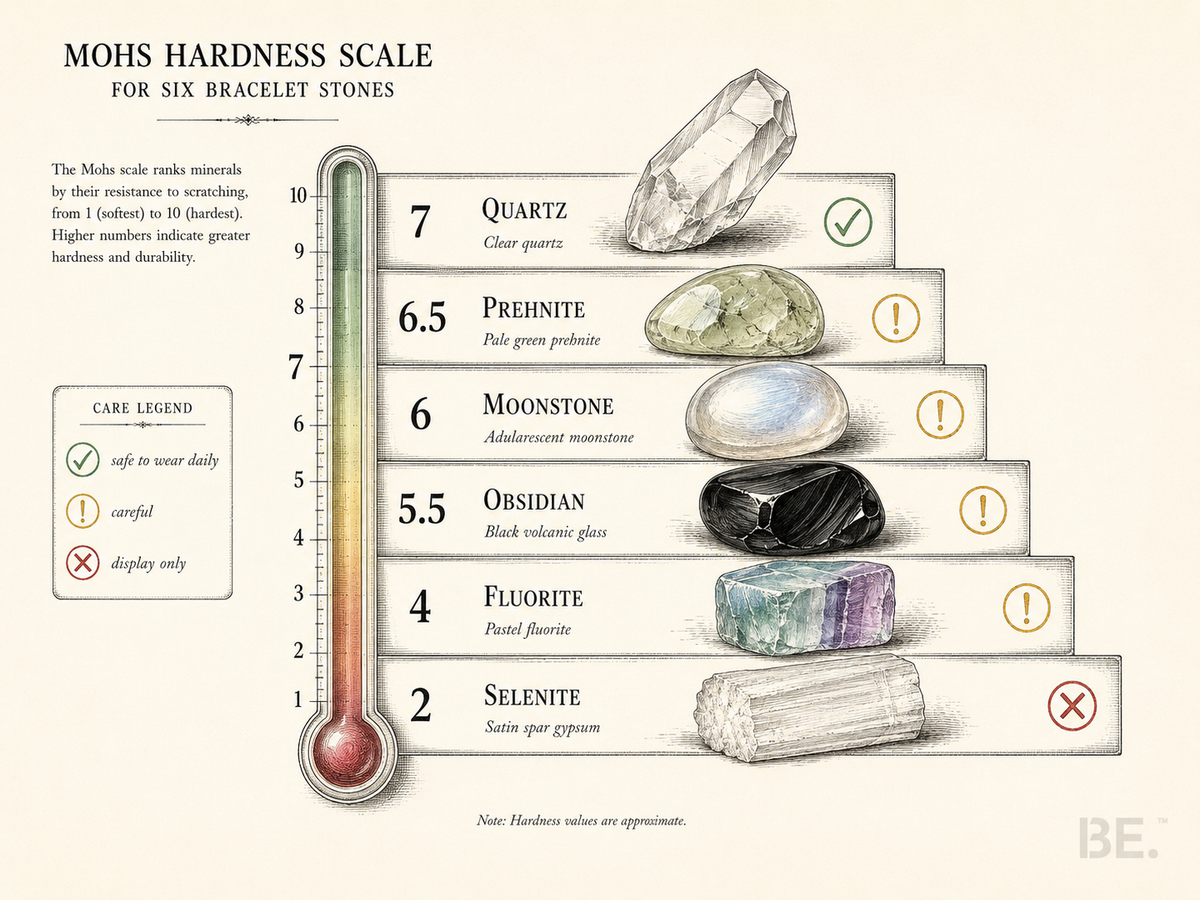
Mohs hardness: the single best predictor
The Mohs scale is a relative scratch-resistance rank from 1 (talc) to 10 (diamond). It is not linear: the gap between 9 (corundum) and 10 (diamond) is larger than the gap between 1 and 9. As a working order, though, it predicts which stones scratch which. Anything below 5.5 is softer than ordinary window glass; below 4 is too soft for unprotected daily wear.
| Stone | Mohs | Daily wear? | Notes |
|---|---|---|---|
| Diamond | 10 | Yes | Hardest; scratches everything else |
| Corundum (sapphire, ruby) | 9 | Yes | Heat-stable, durable |
| Topaz, spinel | 8 | Yes | Cleavage-prone in topaz; mind impact |
| Quartz family (amethyst, citrine, rose quartz, smoky) | 7 | Yes | UV-fades over years; otherwise robust |
| Tourmaline, garnet | 7–7.5 | Yes | Some heat-sensitivity in tourmaline |
| Peridot, kunzite | 6.5–7 | With care | Cleavage-prone; chips at facet edges |
| Moonstone, labradorite | 6–6.5 | With care | Cleavage-prone; surface adularescence sensitive to scratching |
| Opal | 5.5–6.5 | Limited | Up to 20% water content; cracks on dehydration |
| Turquoise | 5–6 | Limited | Porous; absorbs oils, lotion, perfume |
| Lapis lazuli | 5–6 | Limited | Porous; calcite veining softer |
| Apatite, fluorite | 5 / 4 | Rare | Fluorite cleaves easily; both scratch readily |
| Calcite, malachite | 3–3.5 | No | Acid-sensitive; surface scratches in normal handling |
| Pearl | 2.5–4.5 | With care | Organic; acidic skin and perfume dull nacre |
| Selenite, amber | 2 / 2–2.5 | No | Selenite dissolves in water; amber softens in solvents |
The single most useful piece of information you can carry is: quartz scratches anything below it. A quartz strand stored loose with malachite, calcite, opal, or pearl will damage the softer material within months.
Cleaning methods by material
The default cleaning method is warm water with a drop of mild dish soap, a soft brush and a microfibre cloth. It works for most hard, non-porous stones. The exceptions matter.
| Material | Best method | Avoid |
|---|---|---|
| Quartz family | Warm soapy water, soft brush, microfibre | Do not generalise across the family: for Rose Quartz jewellery, follow the material-specific care boundary; avoid steam and ultrasonic cleaning for fractured, filled, coated or assembled pieces. |
| Corundum, topaz, spinel | Warm soapy water; ultrasonic usually safe | None routine; topaz can crack on impact |
| Tourmaline, garnet | Warm soapy water | Heat; ultrasonic for fracture-filled tourmaline |
| Opal | Damp cloth, room-temperature water | Hot water, ultrasonic, prolonged dry heat (cracking) |
| Turquoise, lapis | Damp cloth, dry quickly | Soap soaking, ultrasonic, solvents (porous, will absorb) |
| Pearl | Soft damp cloth, immediately after wear | Soap, ultrasonic, vinegar/lemon, perfume contact |
| Calcite, malachite, rhodochrosite | Damp cloth only | Soap soaking, ultrasonic, anything acidic |
| Selenite, halite | Dry brush; no water | Any water (dissolves over time) |
| Amber, coral, jet | Soft cloth, very light damp wipe | Solvents, ultrasonic, heat |
Ultrasonic cleaners use high-frequency vibration to dislodge dirt. They work well on hard, solid, untreated stones; they crack opal, dehydrate pearl, fracture filled emeralds, and shake loose glued settings. The general rule: if a stone is porous, hydrated, fractured, fracture-filled, or glued, skip ultrasonic and use a damp cloth.
Storage: separate by hardness, separate by porosity
The biggest cause of visible damage to crystal jewellery is storage contact between hard and soft materials. The fix is also the simplest: separate compartments, soft pouches, or a tray with fabric dividers.
- One piece per pouch. The traditional jeweller’s solution; works for everything.
- Compartmented box with fabric dividers. Practical for daily-wear pieces.
- Hanging hooks for strands. Keeps long pieces from tangling and reduces bead-on-bead abrasion.
- Cool, dry, dark. UV fades amethyst, citrine, rose quartz, kunzite, and a handful of others over months to years. Humidity tarnishes silver and weakens elastic cord.
- Off the window sill. The combination of UV, daily temperature swings, and dust is the worst case.
Daily wear: small habits that extend a piece’s life
Most damage to jewellery happens during ordinary activity, not in storage. A short routine prevents most of it.
- Last on, first off. Put jewellery on after lotion, perfume, sunscreen, hairspray, and makeup; take it off before washing hands or face. This single habit prevents most porous-stone discolouration and most metal tarnish.
- Off for water-contact tasks. Showering, swimming, washing dishes, gardening. Soap residue dulls polish; chlorine corrodes silver; impact against pool ladders or garden tools chips beads.
- Off for sleep. Strands twist and tangle, elastic cord weakens under repeated nightlong compression, and clasps catch on bedding.
- Wipe at end of day. A quick microfibre pass removes skin oils before they accumulate.
- Inspect monthly. Check clasps, jump rings, elastic cord, and bead surface for chips or wear. Restring before a strand breaks, not after.
The quirks: stones that need their own paragraph
Opal
Opal contains 6–20% water by mass. Sudden dehydration from dry heat, direct sun or low-humidity travel can craze the surface or crack the stone. Keep opal at room temperature, away from radiators and car dashboards. A drop of mineral oil on a soft cloth, used occasionally, slows water loss in dry climates.
Pearl
Pearls are organic: layered nacre over a bead or tissue nucleus. Skin acidity, perfume, hairspray, sunscreen, and chlorinated water all degrade the surface. Wipe pearls with a damp soft cloth after every wear, never soak them, and never use ultrasonic. Restring knotted pearls every two to three years; the silk cord stretches.
Turquoise and lapis
Both are porous and absorb whatever they touch: skin oils, hand cream, perfume. Turquoise can shift colour from oil absorption (sometimes intentional in older pieces; sometimes not). Wipe dry, never soak, and apply lotion before putting them on.
Selenite
Selenite is a gypsum mineral (Mohs 2) that dissolves slowly in water. Dust with a soft brush only; never wash. Avoid humid bathrooms for storage.
Amber and jet
Both are organic and soften in solvents. Acetone, alcohol, and many jewellery dips dissolve the surface. Wipe with a soft cloth and water only.
How BE. thinks about care
BE. Crystal Jewellery’s Crystal 4T framework grades a strand at selection. After it leaves the studio, care is the wearer’s. The instruction we send with every strand is short: rinse occasionally with warm water and mild soap, store where pieces cannot roll against each other, keep out of direct sun, and inspect the cord at least once a season.
The pieces described here are listed in the BE. collection, and every strand ships with a Stone Origin Record that states its lot, its four Crystal 4T™ readings and what those readings do not claim.
Frequently asked questions
Q1.Can I shower in my crystal jewellery?
The hard stones (quartz, corundum, tourmaline) tolerate it; the metals and cords usually do not. Soap residue dulls polish, chlorine corrodes silver, and elastic weakens. Take it off.
Q2.Which stones cannot go in an ultrasonic cleaner?
Opal, pearl, turquoise, lapis lazuli, emerald (usually fracture-filled), amber, jet, malachite, and anything porous, hydrated, glued, or fracture-treated. Use a damp cloth instead.
Q3.How do I stop my amethyst or rose quartz from fading?
Keep it out of direct sunlight. UV breaks down the colour centres in both stones. A drawer or interior shelf is fine; a window sill is not.
Q4.Can I use jewellery cleaner on crystal strands?
Commercial cleaners are formulated for metal and diamond, and often contain ammonia or surfactants that damage softer stones, porous stones, and elastic cord. Stick to warm water and mild dish soap.
Q5.How often should I restring an elastic-cord strand?
Every one to two years if worn daily, longer for occasional wear. Inspect monthly; restring at the first sign of fraying or stretching.
Q6.What is the single best thing I can do for my jewellery?
Put it on last (after lotion, perfume, makeup) and take it off first (before water-contact tasks). That single habit prevents most of the damage we see.
References
- GIA: Gem encyclopaedia
- Mindat: Mohs hardness scale
- Wikipedia: Mohs scale
- GIA: Jewellery care guide
- Webster, R. (2002). Gems: Their Sources, Descriptions and Identification, 5th ed. Butterworth-Heinemann.
- Schumann, W. (2009). Gemstones of the World, 4th ed. Sterling.
Field Notes.
One stone at a time: its geology, and how to read quality. The Stone Buying Checklist comes with your first email.
By subscribing you agree to receive emails from BE. Unsubscribe anytime.
Sent. Check your inbox.