
Citrine Guide: Natural vs Heated, Origins & Jewellery
A geology-first guide to citrine — what natural and heated citrine actually are, why most market material is heated amethyst, where it comes from, and how to read a strand.
In this field note
What is citrine?
Citrine is quartz, silicon dioxide, coloured from pale yellow through golden orange and brownish orange. It shares quartz's Mohs hardness of 7, but hardness is resistance to scratching rather than a promise that every cut, drilled bead or jewellery construction will withstand impact. GIA identifies citrine as a quartz variety and records its Mohs hardness.
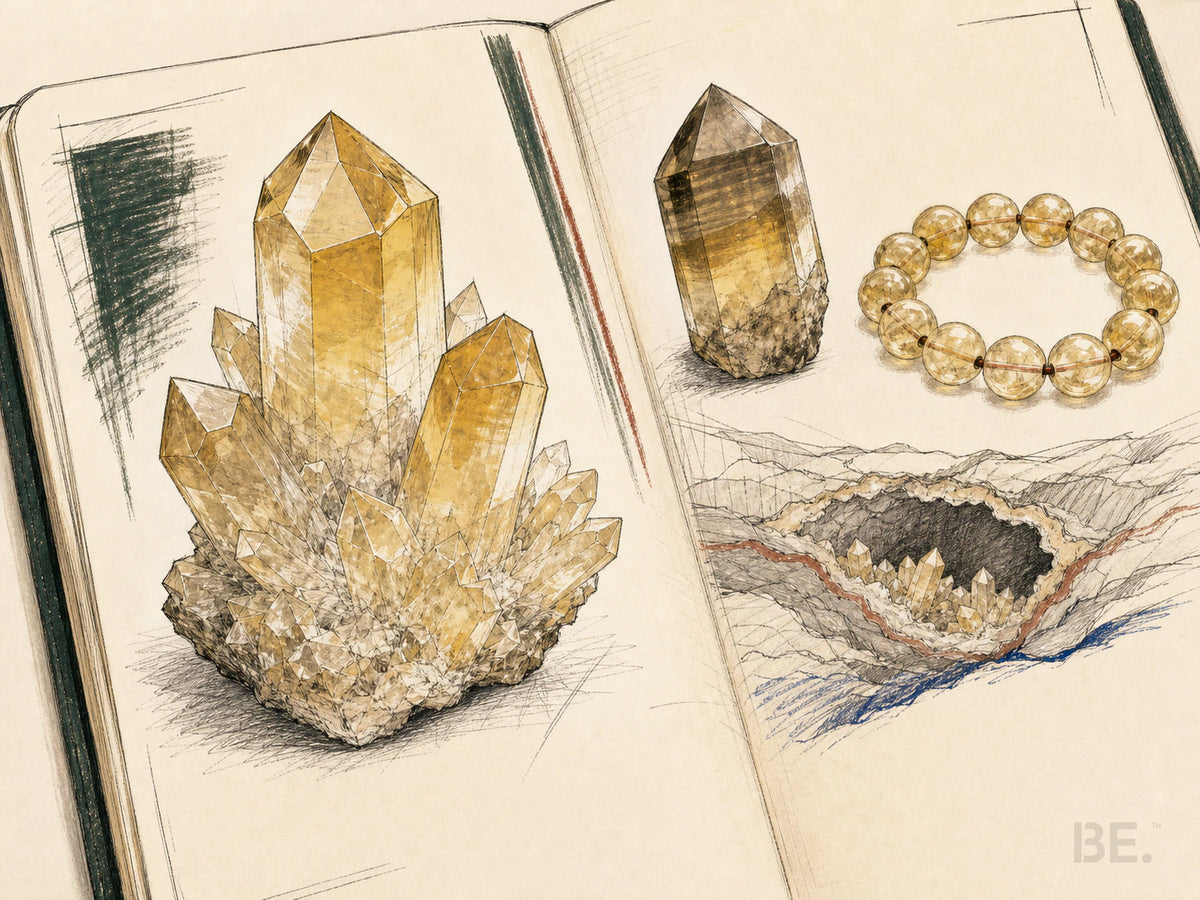
The name alone does not describe the stone's full history. A seller may be offering naturally coloured citrine, heated quartz, synthetic quartz or an imitation with a similar appearance. Those categories should not be collapsed into the words “real” and “fake”.
| Material state | What it means | What the name does not prove |
|---|---|---|
| Natural-colour citrine | Quartz whose yellow-to-orange colour developed without human treatment | A pale or even colour is not proof |
| Heated citrine | Mined quartz, commonly amethyst, whose colour was changed by human-applied heat | “Natural quartz” does not mean natural colour |
| Laboratory-grown citrine quartz | Synthetic quartz grown by people | The same chemical composition does not make it mined material |
| Imitation | Glass or another material used to imitate citrine's appearance | Yellow colour does not establish quartz identity |
CIBJO's trade nomenclature lists both untreated and heated citrine/yellow quartz, but requires the treatment to be stated as Heated in relevant commercial disclosure. Gem-A uses a stricter geology-first distinction and emphasises that heat-treated amethyst should not be presented as natural citrine. The practical consumer rule is the same: the material and the colour treatment must be described separately. See CIBJO, printed pp. 15–16 and 69; see Gem-A's discussion of natural and heat-treated material.
How is citrine formed?
Two different events need to be kept apart: first the quartz crystal grows; then yellow colour can reflect different defect, irradiation and trace-element histories. The mechanism is not one settled recipe. The yellow colour does not require every natural citrine crystal to have begun as amethyst, and natural formation should not be reduced to “the Earth heated it instead of a furnace”. Gem-A reviews quartz growth, proposed natural-colour mechanisms and their remaining uncertainty.
Researchers have proposed more than one colour pathway, including aluminium-related irradiation colour centres and iron-oxide-related charge transfer. A 2024 study of selected yellow quartz samples associated their absorption with Fe3+/Fe2+ charge transfer, oxygen vacancies and lattice oxygen; that result belongs to the samples studied and is not a universal formula for all natural citrine. Wu et al., CrystEngComm 2024.
Heat treatment is a different colour history. Suitable amethyst can be heated after mining to produce yellow, orange or brown quartz, but the outcome depends on the starting material and treatment conditions. There is no single temperature that safely explains every commercial specimen. The natural versus heat-treated citrine guide shows how naming, disclosure, visible clues and laboratory limits fit together.
Why natural-colour citrine is unusual
GIA describes natural citrine as rare and states that most market citrine is produced by heating amethyst. That supports “rare” and “most”; it does not supply a defensible global natural-versus-heated percentage. Market abundance must therefore be separated from natural geological occurrence. GIA Citrine Quality Factors.
The distinction between geological occurrence and commercial availability is examined in why citrine is rarer than amethyst.
Colour and clarity: quality, not proof
Colour, clarity, cut and carat weight are established citrine quality factors. Much faceted citrine is eye-clean, so a clear stone can be attractive and well cut without being untreated. Conversely, inclusions do not automatically prove a natural colour history. GIA separates colour, clarity, cut and carat weight as quality factors.
Deep orange, pale yellow, a white-looking area, even colour, cloudiness or an internal rainbow may each invite a closer look, but no single photograph or visual feature proves treatment, origin or authenticity. Finished beads can also remove or obscure the crystal-tip geometry used in many raw-specimen comparison guides. For a buyer-facing evidence ladder, use the finished citrine bracelet authenticity guide.
If the choice is between two yellow quartz-based jewellery materials, compare citrine with golden rutilated quartz by colour origin, inclusions, disclosure and construction rather than colour alone.
Choosing citrine jewellery without overclaiming the evidence
Before comparing polish or price, ask the seller to separate five facts:
- Is the material mined quartz, laboratory-grown quartz or an imitation?
- Is the colour represented as naturally occurring, heated, irradiated, dyed or coated?
- Is that statement based on supplier disclosure, an in-house record or an independent laboratory report?
- What exactly does the report identify, and which detectable treatments does it address?
- For a bracelet, what are the bead size, wearable length, construction, metal, drill quality, return period and repair terms?
A GIA coloured-stone report can identify a submitted stone as natural or synthetic and list detectable treatments. It should not be rewritten as a guarantee that every possible treatment history has been reconstructed. GIA Colored Stone Identification Reports.
For size, fit, bracelet type, construction, returns and a like-for-like price comparison, use the citrine bracelet buying guide.
Care
For ordinary cleaning, GIA recommends warm, soapy water. Avoid sudden temperature changes, harsh chemicals and hard impact; construction-specific care may be stricter than quartz care, especially when a bracelet includes pearls, plated components, adhesives or elastic. GIA Citrine Buyer's Guide.
Culture and symbolism
Citrine has accumulated associations with birth months, prosperity and personal symbolism. Those traditions can be discussed as culture or individual meaning, but they do not establish a medical, financial or psychological effect. The citrine Feng Shui guide places those associations in cultural context without presenting them as material properties.
Frequently asked questions
Q1.Is citrine a type of quartz?
Yes. Citrine is the transparent yellow-to-brownish-orange variety of quartz. GIA Citrine Description.
Q2.Which colours can citrine show?
Citrine ranges from pale yellow through golden orange to brownish orange. Lighting, background and photography can change how those colours appear on screen, so descriptive colour names should not be treated as calibrated measurements. GIA Citrine Description.
Q3.How hard is citrine?
Citrine has Mohs hardness 7 because it is quartz. That describes resistance to scratching, not resistance to every impact: facets, drilled beads and jewellery components can still chip, crack or wear. GIA Citrine Description.
Q4.How does natural citrine become yellow?
The colour mechanism is not a single settled recipe. Aluminium-related irradiation colour centres and iron-related processes have both been proposed, and published experimental results must be limited to the samples and conditions studied. Gem-A; Wu et al. 2024.
Q5.Is citrine durable enough for everyday jewellery?
Its Mohs hardness of 7 makes citrine reasonably resistant to ordinary scratching, but hardness is not toughness. Protect facets, drilled beads and settings from hard blows and avoidable stress. GIA Citrine Description.
Q6.How should citrine jewellery be cleaned?
Use warm soapy water with a soft cloth or brush, then rinse and dry carefully. Avoid abrupt temperature change and follow stricter instructions when a piece also contains elastic, glue, plated metal or other sensitive components. GIA Citrine Buyer's Guide.
References
- GIA — Citrine Gemstone — quartz identity, market treatment overview, synthetics and imitations.
- GIA — Citrine Description — definition, colour range and Mohs hardness.
- GIA — Citrine Quality Factors — natural rarity, market treatment, colour, clarity, cut and carat weight.
- GIA — Citrine Buyer's Guide — reports, care and consumer selection limits.
- GIA — Colored Stone Analysis and Identification Reports — natural/synthetic identification and detectable-treatment reporting scope.
- Gem-A — Understanding and Testing for Rare Natural Citrine — proposed colour mechanisms, occurrence, heat treatment and clue/test boundaries.
- CIBJO — Official Gemstone Book 2022 — printed pp. 15–16 treatment disclosure and p. 69 citrine/yellow-quartz table.
- Wu et al. — CrystEngComm 2024, DOI 10.1039/D4CE00250D — sample-limited experimental evidence for absorption mechanisms in the studied yellow quartz.
Field Notes.
One stone at a time: its geology, and how to read quality. The Stone Buying Checklist comes with your first email.
By subscribing you agree to receive emails from BE. Unsubscribe anytime.
Sent. Check your inbox.