
Real vs Fake Crystals: How to Spot Imitations
A practical guide to spotting fake or imitation crystals — glass, resin composites, dyed material, lab-grown vs natural, and what to look for.
In this field note
A century ago, the crystal trade was mostly local. Today a bracelet can travel from a Brazilian mine to a Yiwu wholesaler to a livestream haul in under a month, and somewhere along that chain almost every stone passes through hands willing to dress it up. The result is that even careful buyers end up with material that is not what its label claims.
We will look at the four common imitation families, how each is made, what visual or thermal tell separates them from the real material, and which stones are most often counterfeited. None of this requires a gemmological qualification. It requires a small torch, a 10x loupe, and the discipline to slow down.
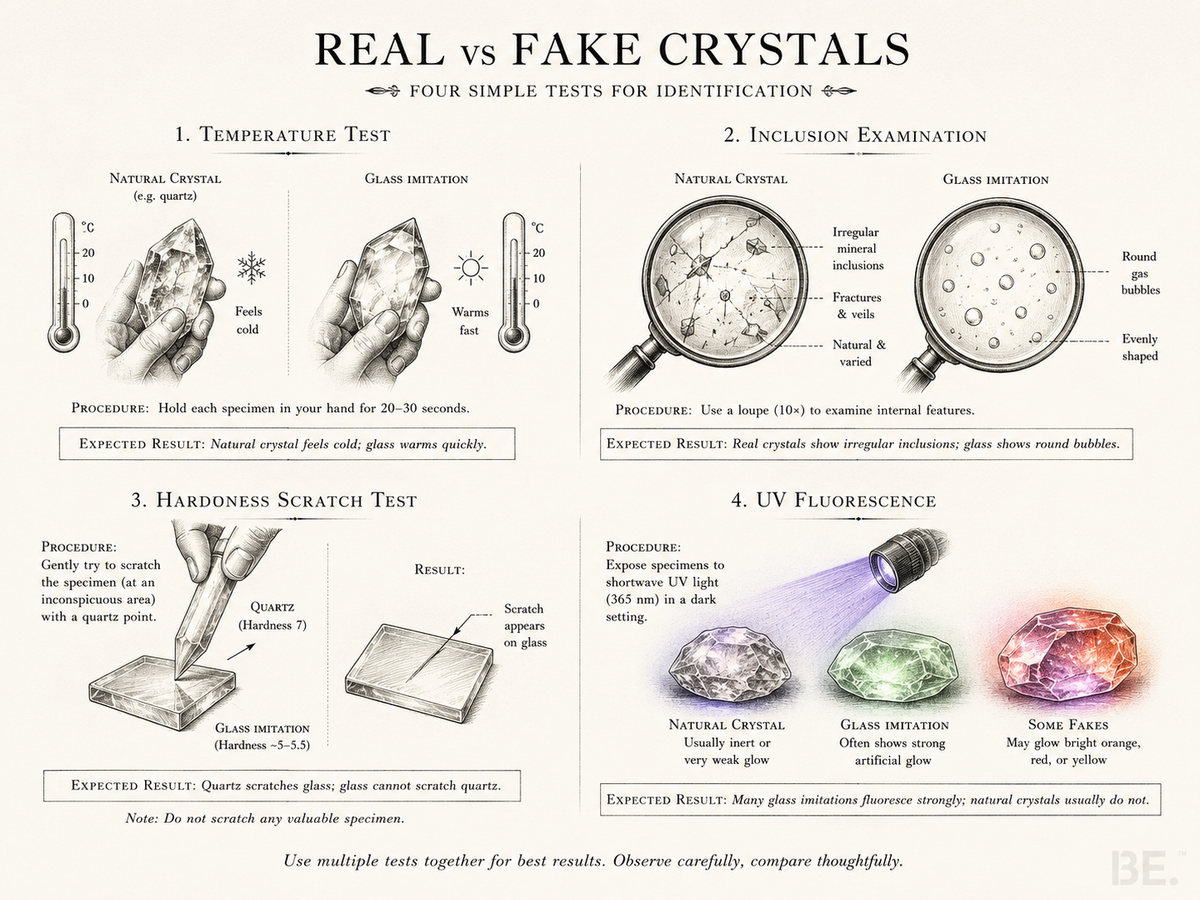
The four imitation families
Almost every crystal fake on the market belongs to one of four families. Knowing which family you are looking at narrows the test you need to run.
| Imitation type | How made | How to spot | Common targets |
|---|---|---|---|
| Moulded glass | Silica melted with metal-oxide colourants, poured into moulds and cooled | Spherical air bubbles inside, mould seams on beads, conchoidal surface chips, warm to touch | Aventurine, citrine, amethyst, rose quartz |
| Dyed natural stone | Lower-grade material (often pale agate, howlite, magnesite) soaked in coloured solution | Colour pools in fractures and along bead drill holes, white core if chipped, acetone swab lifts pigment | Turquoise (from howlite), lapis (from dyed jasper), red agate, blue chalcedony |
| Resin and reconstituted | Crushed mineral powder bound with polymer resin, sometimes with metallic flakes | Swirl marks under loupe, hot-needle releases plastic smell, lighter than expected, scratched by steel | Turquoise blocks, malachite blocks, goldstone (man-made entirely) |
| Lab-grown sold as natural | Hydrothermal or flux growth in a controlled vessel; chemically identical to natural | Lattice too perfect, no natural inclusions, curved growth striae, sometimes seed plate visible | Citrine, amethyst, ruby, emerald, alexandrite |
What each test actually tells you
The toolkit is small. None of these is conclusive on its own, but stacked together they usually settle the question.
UV torch (365 nm)
A long-wave UV light separates several common pairs. Natural amethyst is typically inert; glass amethyst sometimes glows faint green from the colourant. Hyalite opal fluoresces bright green under UV from trace uranium and is unmistakable. Many lab-grown rubies fluoresce stronger red than most natural Burmese material because they lack iron quenching. UV does not prove a stone is real, but it can prove a stone is wrong.
Hot needle (use with care)
Heat the tip of a steel needle and touch it gently to an inconspicuous spot — the inside of a drill hole works. Plastic and resin release a sharp acrid smell. Glass is unaffected. Natural mineral is unaffected unless it contains organics (amber and copal will smoke). This is the single fastest test for resin-bound turquoise and malachite blocks. For a non-destructive clue, compare how quickly quartz and plastic warm against skin.
Loupe (10x)
Under a loupe, glass shows perfectly round gas bubbles and swirl flow lines. Natural quartz shows angular two-phase inclusions, healed fractures with characteristic veil patterns, and irregular mineral guests. Dyed material shows colour concentrated in cracks and along the bead drill hole. Lab-grown stones show curved striae or chevron growth zoning instead of the irregular zoning of natural crystals.
Refractive index proxies
Real refractometer testing on beads is hard, but a proxy works: hold the bead against a printed line and rotate it. Singly refractive material (glass) shows one image. Doubly refractive material (quartz, calcite, tourmaline) shows a doubled image at certain angles. This separates glass copies of quartz from real quartz in a few seconds.
Specific stones, specific traps
Some materials are faked more aggressively than others. Here is what to watch for on the worst offenders.
| Stone | Most common fake | Quickest tell |
|---|---|---|
| Citrine | Heat-treated amethyst sold as natural; rarely glass | Natural citrine is pale lemon and even; treated material is orange-brown with white cloudy bases from the original amethyst |
| Turquoise | Dyed howlite or magnesite; resin block | Hot needle smell test; white core if chipped at drill hole |
| Lapis lazuli | Dyed jasper or howlite, sometimes with brass flakes faking pyrite | Acetone swab lifts blue dye; real pyrite is metallic and cubic, brass flakes are flat and irregular |
| Moldavite | Moulded bottle glass with etched surface | Real moldavite has lechatelierite inclusions (thin glass fibres); fakes show round bubbles only |
| Aventurine | Goldstone — copper-flecked glass marketed as a crystal | Goldstone flecks are perfectly hexagonal copper crystals in regular distribution; real aventurine fuchsite flakes are irregular |
Lab-grown versus natural
Lab-grown is its own category and deserves a clearer frame. Hydrothermally grown amethyst, citrine, and quartz are chemically and structurally identical to the natural material. They are not fakes in the chemistry sense. They are fakes in the disclosure sense — when sold without being declared. A lab amethyst still shows pleochroism, still measures the same hardness, still has the same refractive index. What gives it away is the absence of natural inclusion suites: no two-phase fluid pockets, no negative crystals, no irregular colour zoning. Under a loupe the material reads too clean.
For coloured stones grown by flux (synthetic ruby, emerald, sapphire), the tells are stronger: curved growth striae, gas bubbles, flux residue inclusions that look like fingerprints. Natural rubies show silk (rutile needles in three directions); flux synthetics rarely do.
What treatment disclosure should look like
Not every alteration is fraud. Most coloured stones on the market are treated in some way, and reputable disclosure is a tradition with rules. The line between treatment and fake is consent: did the seller tell you what was done.
- Heat treatment. Standard for citrine (amethyst heated to 470 C), aquamarine, tanzanite, and most blue sapphire. Should always be disclosed. Stable, no continuing change.
- Irradiation. Used to deepen smoky quartz, blue topaz, some diamond. Disclosed treatment is legal and stable; the safety question is closed for gem material on the market.
- Oiling and resin filling. Standard for emerald (cedar oil), increasingly applied to ruby (lead glass). Reduces value if heavy; must be disclosed.
- Dyeing. Standard for some agate and chalcedony. Acceptable when disclosed and the stone is described as dyed.
- Coating and surface treatment. Aurora borealis quartz, mystic topaz — these are coated and the coating wears. Should always be disclosed and rarely commands a premium.
A short field protocol
If you are buying a strand from a seller you have not tested before, run this sequence:
- Loupe the bead surface. Look for mould seams, bubbles, swirl flow, paint-pooled drill holes. Two minutes.
- Loupe the inclusions. Natural inclusions are irregular and varied. Identical patterns repeating across beads point to a synthetic or moulded source.
- Acetone test on a hidden bead. A cotton bud with nail polish remover, rubbed for ten seconds. If colour comes off, the stone is dyed.
- Weight in hand. Most natural minerals are denser than glass and much denser than resin. A 10 mm bead that feels suspiciously light is suspect.
- Ask for origin paperwork. Sellers vary widely on origin transparency; some publish country-level information, fewer publish district- or deposit-level information. The question is worth asking before purchase, and the answer — whatever it is — is data.
How BE. handles material verification
Every crystal and gemstone we use is natural. We do not use synthetic substitutes or laboratory-grown stones. Processing and treatment information is disclosed on the individual product page; please refer to that page for the details that apply to your piece.
Real strands are listed in the BE. collection, and every strand ships with a Stone Origin Record that states its lot, its four Crystal 4T™ readings and what those readings do not claim.
Frequently asked questions
Q1.Are bubbles always a sign of fake?
Round bubbles in a transparent stone almost always indicate glass. Natural quartz can contain two-phase fluid inclusions that look like bubbles, but they are angular, not perfectly spherical, and often have a smaller second phase inside.
Q2.If a stone is cheap, is it definitely fake?
Not necessarily. Common quartz, agate, and aventurine are genuinely inexpensive at the wholesale level. Price becomes a tell when it is far below the floor for material that has a real mining cost — natural turquoise, lapis lazuli, larimar, moldavite, and most fine amethyst.
Q3.How do I test a stone without damaging it?
Loupe, UV torch, and the doubled-line refractive test damage nothing. The hot needle and acetone tests are localised and done on hidden spots — under a clasp, inside a drill hole. None of these tests visibly mark the bead.
Q4.Is lab-grown crystal a real crystal?
Chemically and structurally yes. It is the same material as natural. The honest critique is not against lab-grown — it is against sellers who do not disclose. A clearly labelled lab citrine is a legitimate product. An undeclared one is fraud.
Q5.What stones are nearly impossible to fake?
Material with distinctive optical phenomena — labradorite, opal, moonstone with adularescence, alexandrite with strong colour change — is hard to imitate convincingly. The interference effects come from internal structure that synthesis cannot easily replicate at scale.
References
- GIA Gem Encyclopedia — treatment and identification standards
- Mindat — mineral data and inclusion references
- Wikipedia — Gemstone treatment overview
- Gem-A — gemmological identification resources
- Webster, R. (2002). Gems: Their Sources, Descriptions and Identification, 5th ed. Butterworth-Heinemann.
- Read, P. (2008). Gemmology, 3rd ed. Butterworth-Heinemann.
Field Notes.
One stone at a time: its geology, and how to read quality. The Stone Buying Checklist comes with your first email.
By subscribing you agree to receive emails from BE. Unsubscribe anytime.
Sent. Check your inbox.