
Crystals Tied to Abundance: A Material and Cultural Reading
A material-first reading of stones culturally associated with abundance — citrine, pyrite, jade, golden rutile — and what their colour, chemistry and history actually mean.
In this field note
Walk into any crystal shop and you’ll find a shelf labelled wealth, prosperity, or abundance. The same four or five stones tend to recur: citrine, pyrite, jade, golden rutilated quartz, sometimes tiger’s eye or aventurine. The grouping isn’t mineralogical. These stones share almost nothing chemically. What they share is yellow-gold colouring and a long commercial history of being marketed as lucky.
This guide reads that shelf the way a geologist would. Where does the colour actually come from? Where do the cultural associations come from? And what is the honest thing to say about wearing a yellow stone once you separate the material from the marketing claim?
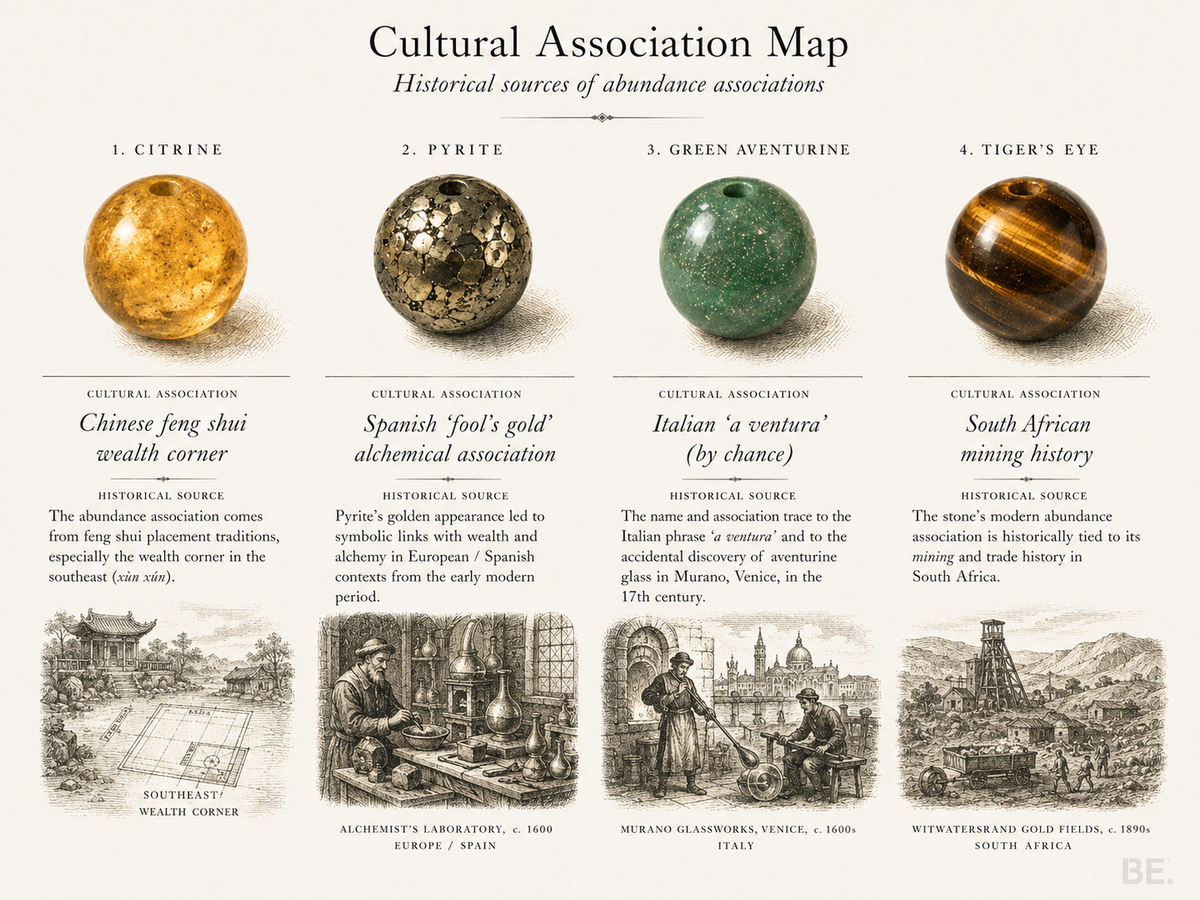
Why yellow and gold tones became cultural shorthand
Long before crystal shops existed, gold-coloured stones were rare and visually expensive. In ancient Egypt, gold itself was associated with the sun and with imperishability: tomb goods were gilded, and yellow-orange carnelian was set into pectorals worn by the elite. The colour was a marker of status because the material was scarce, not the other way round.
In Imperial China, yellow was reserved for the emperor by sumptuary law for several dynasties, and jadeite, when finally introduced from Burma in the eighteenth century, was prized in greens and pale yellows that mapped onto an existing cultural vocabulary for prosperity. In older European sources, yellow quartz and topaz were often confused under the name “topaz”, so a historical “topaz” cannot be read as citrine without further evidence. The link between gold colour and good fortune is therefore historically traceable to scarcity, sumptuary regulation and trade overlap, not to any tested property of the stone.
What this means in plain terms: stones that are commercially marketed as abundance stones today inherit a vocabulary that’s older than crystal retail, but the inheritance is cultural and decorative. It’s not a mechanism.
The mineralogy behind the marketing
Group the wealth-shelf stones by what they actually are, and the family looks like this:
Citrine is quartz, SiO2, in yellow to amber. The cause of the colour varies between specimens, with different trace elements and defects involved. Natural citrine is described as rare, and some material on the market is heated amethyst, whose colour changes at a temperature that varies from one specimen to the next. Heated citrine is a real, stable colour, but the trade often glosses the distinction.
Pyrite is iron disulphide, FeS2, crystallising in the cubic system. Its metallic lustre and pale brass colour come from electron behaviour at the surface of an ionic-covalent sulphide, nothing to do with elemental gold. The cubic habit is what gives pyrite its signature look: nearly perfect squares with striated faces, often forming intergrown clusters from Navajún in Spain or from Peruvian deposits.
Golden rutilated quartz is transparent quartz with needle inclusions of rutile (TiO2), which may carry iron. In some pieces the rutile formed first and the quartz grew around it; in others the two grew together. The golden colour reads as a forest of fine titanium-dioxide hairs suspended in clear silica.
Jadeite is a sodium-aluminium pyroxene, NaAlSi2O6, distinct from nephrite (a calcium-magnesium amphibole). Imperial green jadeite owes its colour to chromium; lavender and yellow varieties involve iron and manganese. The Burmese sources at Hpakant remain the reference deposit. Jade’s cultural weight in Chinese, Mesoamerican and Maori contexts is well documented and predates any modern wellness marketing.
Tiger’s eye is a chatoyant quartz pseudomorph after crocidolite, a fibrous amphibole. The golden silk effect comes from oxidised iron coating parallel fibre voids inside the quartz. Most market material is South African.
Aventurine is quartzite with green or yellow inclusions of fuchsite (a chromium-bearing mica) or other platy minerals that give it a glittery sheen. “Yellow aventurine” is commonly a quartzite with iron-oxide inclusions.
Stones commonly marketed as ‘wealth’: what they actually are
The table below lays out the wealth-shelf stones side by side: the mineralogy, the documented historical use, and what commercial framing tends to claim today. The third column is descriptive of how stones are marketed, not an endorsement of the claim.
| Stone | Actual material | Documented historical use | What commercial framing claims today |
|---|---|---|---|
| Citrine | Quartz (SiO2); some market material is heated amethyst | Yellow quartz and topaz were often confused under the name “topaz” in older European sources | Labelled the “merchant’s stone” in modern listings |
| Pyrite | Iron disulphide (FeS2), cubic crystal system | Used by Inca and other pre-Columbian cultures as polished mirrors | Commercially tied to financial protection |
| Golden rutilated quartz | Quartz with rutile (TiO2) needle inclusions, which may carry iron | Historically prized in European jewellery as cheveux de Vénus (Venus hair) | Often grouped with abundance stones in modern crystal retail |
| Jadeite | Sodium-aluminium pyroxene (NaAlSi2O6); imperial green from Cr3+ | Central role in Qing dynasty court regalia; pre-Columbian Mesoamerican ritual objects | Culturally tied to prosperity in Chinese tradition; modern marketing extends this association |
| Tiger’s eye | Chatoyant quartz pseudomorph after crocidolite (fibrous amphibole) | Used as ornamental stone since Roman times; “oculus belus” in classical sources | Historically associated with vigilance; often marketed today under abundance framing |
| Yellow / green aventurine | Quartzite with fuchsite or iron-oxide inclusions | Used as decorative stone in nineteenth-century European jewellery | Often labelled as an “opportunity” stone in crystal retail |
None of the column-three claims are backed by controlled study. They are descriptive of how stones get sold, which is itself a useful thing to know, both as a consumer and as someone reading shop signage critically.
What the historical record actually says
The phrase “merchant’s stone”, attached to citrine in countless modern listings, has a thin paper trail. The earliest printed sources that use the phrase date to mid-twentieth-century esoteric writing in the English-speaking market, not to medieval European lapidaries, where citrine appears under the broader “topaz” umbrella and is described as a sun-coloured ornamental gem with no specific commercial luck attached.
Pyrite was historically valued for very practical reasons. The Greek root pyr (fire) refers to its ability to spark when struck against steel, a property used in early firearms (pyrite was the original lock in some wheellock mechanisms). The link between pyrite and “financial protection” is a modern retail reframing of the older link between pyrite and physical fire-starting.
Jade is the exception. In Chinese material culture, jade (both nephrite and later jadeite) carries a documented, well-attested association with virtue, status and continuity, traceable through the Liji (Book of Rites) and into Qing dynasty court ornament. The cultural framing here is genuine, deep and worth taking seriously. But the framing is still cultural: it tells you what jade means within a specific tradition, not what wearing it does.
How to choose if abundance language speaks to you
If you find yourself drawn to the wealth shelf, it’s worth being honest about what’s happening. You’re not buying luck. You’re buying a yellow stone with cultural resonance, and the resonance itself can be valuable: colour and material affect mood and self-presentation in measurable ways, even where there is no underlying mineral mechanism. The question is whether to dress that purchase in claims it can’t carry.
A more honest framing might run like this. Choose the stone by visual and material connection, not by promised outcome. Pick the colour you actually want to wear most days: gold citrine, brick-red Bahian rutile, or the cool grey-yellow of a fine pyrite cluster. Pick the chemistry that interests you: silica with iron, silica with rutile needles, an iron sulphide cube. Pick the deposit, if you care about provenance: Anahí in Bolivia for ametrine, Bahia in Brazil for golden rutile, Navajún in Spain for collector pyrite cubes. None of those choices require a wealth claim to be worth making.
How BE. treats the abundance category
BE. does carry citrine, golden rutilated quartz, and other stones that retail trade groups under abundance framing. We sell them on their material (colour, clarity, inclusion pattern, deposit) and grade every strand against our four-axis system, Crystal 4T: Transparency, Tone, Texture, Treasure. Each strand carries a Stone Origin Record with the source country and region (and the specific deposit where the upstream supplier has disclosed it) and the lot number. We don’t put outcome promises on the card, because outcomes aren’t ours to promise.
Frequently asked questions
Q1.Does wearing citrine actually attract money?
No controlled study supports that claim. Citrine is yellow quartz with a documented colour history and a long ornamental tradition in European jewellery. Its association with prosperity is a commercial framing built on top of that history, not a tested effect.
Q2.Does a citrine label mean untreated colour?
A natural quartz material can have a treated colour. BE. uses natural gemstones, without synthetic substitutes or laboratory-grown stones. Refer to the individual product page for processing and treatment disclosure.
Q3.Why is pyrite called “fool’s gold” if it’s commercially marketed as a prosperity stone?
The “fool’s gold” nickname comes from prospectors who mistook pyrite cubes for elemental gold in stream gravels. The two are mineralogically unrelated: gold is a native metal element; pyrite is iron disulphide. Modern commercial framing tied pyrite to financial themes via its metallic colour, not via any documented historical use.
Q4.Is jade’s link to prosperity different from the others?
Yes, in a specific sense. Jade carries a documented cultural association with virtue, status and continuity across more than two thousand years of Chinese tradition, traceable in the Liji and later court practice. That association is cultural and decorative; it doesn’t constitute a tested mechanism, but it is older, deeper and better-attested than most crystal retail claims.
Q5.What’s the difference between natural and heated citrine in practice?
Natural citrine is often paler, sometimes with a slightly smoky undertone, while heated amethyst often reads as a stronger orange-yellow. These are only clues; colour alone cannot establish whether a citrine was heated. Both are stable; the price difference reflects rarity, not durability.
Q6.How should I choose a yellow-toned strand if I’m not buying it for a promised outcome?
Choose by colour preference, material interest and provenance. Decide whether you respond more to clear gold (citrine, golden rutile) or to metallic brass (pyrite). Look at the chemistry: silica with iron, silica with rutile needles, an iron sulphide. Check the Stone Origin Record for the source country of the rough. None of those choices require a wealth claim to be worth making.
References
- Mindat: Citrine (quartz variety)
- Mindat: Pyrite (FeS2)
- GIA Gems & Gemology: archive on quartz, jadeite and gemmological provenance
- Wikipedia: Citrine
- Wikipedia: Jadeite
- Webster, R. (2002). Gems: Their Sources, Descriptions and Identification, 5th ed. Butterworth-Heinemann.
- Schumann, W. (2009). Gemstones of the World, 4th ed. Sterling.
- Hansford, S. H. (1968). Chinese Carved Jades. Faber and Faber.
Field Notes.
One stone at a time: its geology, and how to read quality. The Stone Buying Checklist comes with your first email.
By subscribing you agree to receive emails from BE. Unsubscribe anytime.
Sent. Check your inbox.