
Best Crystals for Beginners: A Material-First Starter Kit
A starter guide to crystal jewellery — three materials worth starting with based on visual range, value and durability, not metaphysical claims.
In this field note
For a first strand, two things matter most: how well the stone wears every day, and how it looks on the wrist. Clear quartz, amethyst and rose quartz from the quartz family, plus black obsidian, do well on both.
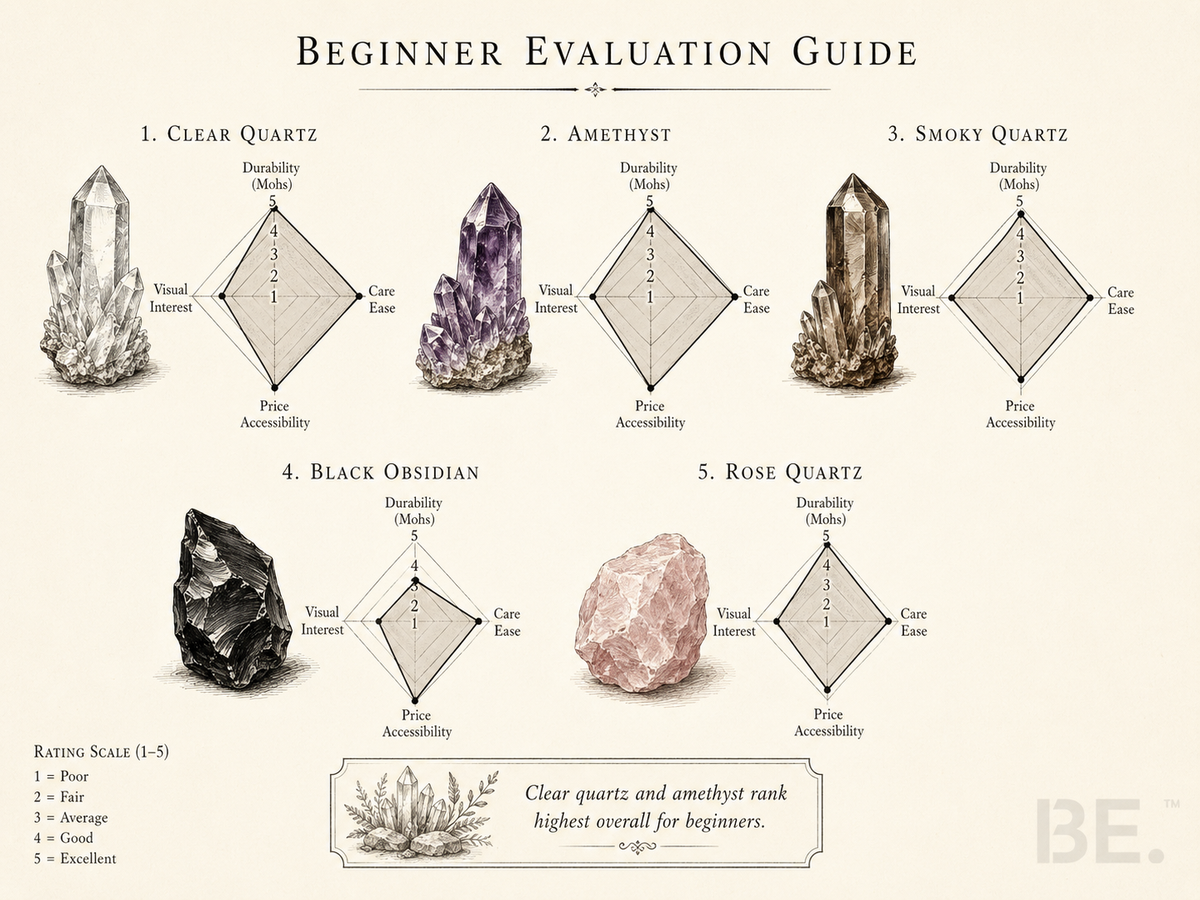
The starter shortlist
| Stone | Mineralogy | Why suitable for beginners |
|---|---|---|
| Clear quartz | SiO₂, trigonal, Mohs 7 | Transparent and architectural; goes with every wardrobe; hard-wearing |
| Amethyst | SiO₂ with iron + irradiation, Mohs 7 | Deep violet; classic colour; hard-wearing |
| Rose quartz | SiO₂ with tiny pink fibres inside, Mohs 7 | Soft pink; the gentlest look; suits most skin tones |
| Black obsidian | Volcanic glass, Mohs 5-5.5 | Dark mirror-like surface; reads as anchor jewellery; fine for daily wear |
Why durability matters
A first strand is one you will wear most days, so pick a stone that keeps its polish. The Mohs hardness scale puts most quartz family stones at 7, hard enough to keep their polish through daily wear. Softer stones scratch more easily, so keep them apart from harder beads when you put them away.
The three top picks are all SiO₂ quartz, all Mohs 7. The quartz family leads the starter market because it stands up well to everyday wear, like typing at a desk. Take it off before showering or swimming. Compare this with opal (Mohs 5.5-6.5, also fragile and water-sensitive) or turquoise (Mohs 5-6, porous), which need care most beginners do not yet know to give.
Why these four specifically
Clear quartz: the architectural choice
Clear quartz is the most transparent of the common bead stones. A good clear quartz strand reads almost glassy, edge-to-edge transparent, with internal lustre that varies subtly between beads. It pairs with every wardrobe colour because it is colourless; it pairs with every metal because it does not compete; it photographs well because the transparency catches light from many angles. As a first crystal it is the safest because there is nothing to clash with.
What to check: hold the strand up to the light. Every bead should let light through cleanly, with no haze. Crystal 4T™ reads this as Transparency.
Amethyst: the saturated colour choice
Amethyst is quartz with an iron impurity that absorbs light in the green-yellow range after natural irradiation, leaving the violet purple we see. It keeps its colour in everyday daylight if you store it out of direct sun, and its depth of violet is hard to match among other purple stones such as charoite, sugilite and lavender jade.
For beginners, amethyst is the safe coloured purchase. The colour reads as serious without reading as loud. It pairs with cool wardrobes (navy, grey, white) and adds warmth to monochrome dressing. BE. strings Bolivian amethyst in 6mm and 10mm beads.
What to check: each bead should be evenly coloured, and the colour should match from bead to bead. Crystal 4T™ reads both under Tone. A sorted strand is evenly dark or evenly mid-tone, with no pale beads mixed in.
Rose quartz: the soft choice
Rose quartz gets its pink from tiny mineral fibres spread through the quartz. The result is a soft, slightly cloudy pink, cleaner and less candy-coloured than dyed pink agate and more even than morganite.
For beginners, rose quartz is the easiest entry to coloured stones. The pink reads gentle and quiet. It works with neutrals and pastels, photographs cleanly, and wears well every day.
What to check: avoid bright candy pink, which usually means dyed material. Real rose quartz is a soft and slightly cool pink, often with faint cloudy zones. Held up to the light, it glows softly and is not fully see-through.
Black obsidian: the anchor choice
Black obsidian is volcanic glass. It forms when lava cools too quickly for crystals to grow. The result is a dense, dark material with a conchoidal fracture (the same curved fracture pattern as flint and prehistoric obsidian blades). Polished, it reads as a dark mirror: the surface catches light without colour, anchoring the rest of a stack the way black ink anchors a layout. It is fine for daily wear; at Mohs 5-5.5 it is softer than quartz, so store it apart from harder beads.
What to check: the surface should be a clean mirror polish with no chips at the drill holes and no white resin filler in fractures. Look for a glassy shine across the polished surface.
What to avoid as a first purchase
These stones need more care, so they suit a second or third strand better than a first:
- Opal. Beautiful but Mohs 5.5-6.5, water-sensitive, prone to crazing when humidity changes sharply. A high-maintenance starter.
- Turquoise. Porous, absorbs oils and lotions, colour shifts over time, easily faked. Better when you know what you are buying.
- Lapis lazuli. Mohs 5-5.5, scratches show clearly, often dyed to deepen colour. Better once you can tell dyed colour from natural.
- Malachite. Beautiful but toxic dust when broken, Mohs 3.5-4 (very soft), water sensitive. Display only for beginners.
How BE. handles starter strands
Every BE. strand is read against Crystal 4T™ (Transparency, Tone, Texture, Treasure), and the readings sit on its Stone Origin Record next to the stone identity and full treatment disclosure. BE. brings only about the top 20% of inspected material into the studio, then scores it reading by reading.
Frequently asked questions
Q1.Is clear quartz too plain for a first purchase?
Not at all. Its plainness makes the strand easy to wear with everything.
Q2.How do I know if my starter crystal is real?
Every BE. strand comes with a Stone Origin Record that names the stone and states its treatment. At home, quartz can be checked with a doubled-line test: hold the bead against a printed line and look for a doubled image at certain angles. Glass shows one line; quartz shows two.
Q3.Can I wear the bracelet in the shower?
Take it off before showering or swimming, and put it back on once your skin is dry.
Q4.What if I want a coloured stone first?
Amethyst is the safe answer. Rose quartz is the softer answer. Both wear well every day and pair with most wardrobes. Citrine works too; BE.'s citrine is untreated, with its yellow held by trace iron in the quartz.
Q5.Do I need to learn the metaphysical claims before buying?
No. Choosing by colour and by how well a stone wears is a sound way to pick a first strand.
References
- GIA Gem Encyclopedia: quartz family
- Mindat: Quartz mineral data
- Wikipedia: Quartz
- Gem-A: gemmology reference
- Schumann, W. (2009). Gemstones of the World, 4th ed. Sterling.
- Webster, R. (2002). Gems: Their Sources, Descriptions and Identification, 5th ed. Butterworth-Heinemann.
Field Notes.
One stone at a time: its geology, and how to read quality. The Stone Buying Checklist comes with your first email.
By subscribing you agree to receive emails from BE. Unsubscribe anytime.
Sent. Check your inbox.