
Prehnite: First to Arrive, Last to Be Noticed
Prehnite is a calcium aluminium silicate associated with low-temperature hydrothermal and metamorphic settings. A BE. note on colour, quality, care and jewellery.
In this field note
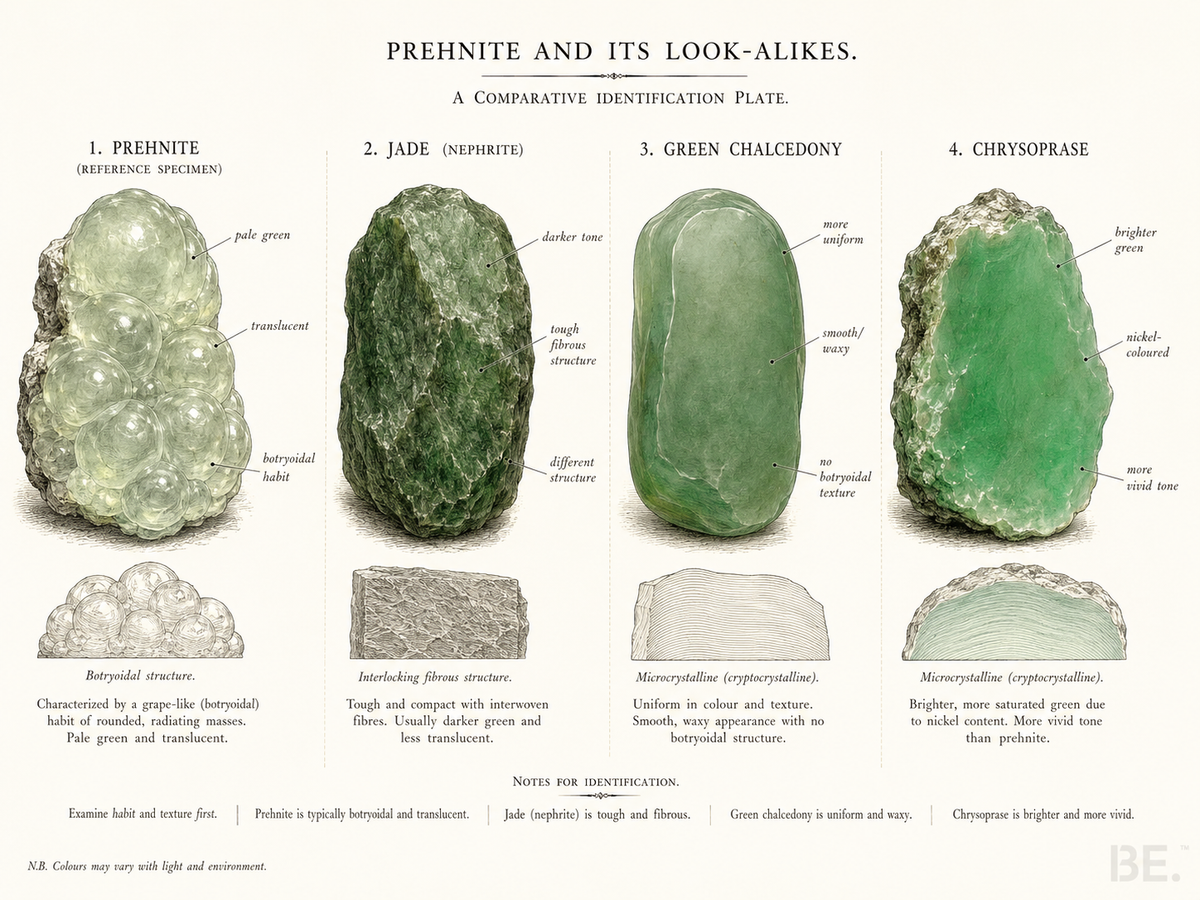
At first glance, prehnite can seem modest: translucent, yellow-green, rounded, softer in presence than quartz, obsidian or rutilated quartz. Its geological role is not modest. It is often a foundation mineral, one of the early materials to occupy an empty cavity and give later minerals a surface to build on.
The first mineral in the room
When basalt cools from lava, trapped gas bubbles can become vesicles: hollow spaces inside the rock. Over geological time, hydrothermal fluids move through those spaces and deposit secondary minerals. The sequence is not random. Minerals arrive according to temperature, pressure, chemistry and saturation.
Prehnite often belongs to the earlier part of that sequence. It can coat cavity walls in botryoidal, grape-like clusters or form tabular crystals, filling from the edges inward. Later minerals such as zeolites, calcite or quartz may become more visually obvious, but prehnite is frequently part of the structure that came first.
Named first, too
Prehnite also has a place in mineralogical history. In 1788, German mineralogist Abraham Gottlob Werner named it after Hendrik von Prehn, a Dutch military commander and governor of the Cape of Good Hope who brought specimens from South Africa to Europe. It is widely cited as the first mineral named after a person.
Important prehnite occurrences include the Karoo region of South Africa, the basalt fields around Pune in India, and metamorphic settings in Connecticut, USA. These localities matter because they show prehnite’s range: basalt cavities, hydrothermal filling, and low-grade metamorphic contexts.
Why the green feels soft
Prehnite’s yellow-green colour can come from trace Fe3+ substituting for aluminium in the crystal structure. The colour is usually not aggressive. It feels young, full and softly luminous, especially when the material is translucent enough for light to enter without turning the stone cloudy.
Geologists also use prehnite as an indicator mineral. Its presence can point to low-grade metamorphic conditions known as the prehnite-pumpellyite facies. That makes prehnite more than a soft green stone; it is a geological marker for a particular pressure-temperature history.
How to choose prehnite jewellery
Prehnite is more delicate than many quartz-family stones, so perfect clarity without internal texture is difficult to find. Strong material should be judged by fresh body colour, clean translucency, minimal distracting fractures and a design that protects the stone. A completely flawless look is rare; a lively, full, well-protected piece is the more practical standard.
| Quality point | Strong example | Why it matters |
|---|---|---|
| Colour | Soft luminous yellow-green | Creates the young, vital look |
| Translucency | Light enters without turning cloudy | Prevents the stone from feeling heavy |
| Surface and structure | Minimal distracting cracks | Important because clean prehnite is difficult |
| Care | Soft cloth, separate storage, no harsh chemicals | Protects a more delicate material |
Where BE. places it
Prehnite belongs closest to The Flow. It carries renewal without noise: fresh, open, alive and structured. It is a green for someone who wants softness, not spectacle.
For broader green stone context, see Green Crystals: Names, Types and How to Choose.
Prehnite strands are listed in the BE. collection, and every strand ships with a Stone Origin Record that states its lot, its four Crystal 4T™ readings and what those readings do not claim.
Frequently Asked Questions
What is prehnite?
Prehnite is calcium aluminium phyllosilicate, Ca2Al(AlSi3O10)(OH)2, commonly associated with low-temperature hydrothermal and low-grade metamorphic settings.
Why is prehnite historically important?
It is widely cited as the first mineral named after a person, Hendrik von Prehn, in 1788.
Is prehnite easy to damage?
It should be treated more carefully than harder quartz-family stones. Avoid impact, harsh chemicals, ultrasonic cleaning and rough storage.
What makes prehnite jewellery good?
Fresh green colour, clean translucency, minimal distracting fractures and a design that protects the stone.
References
- Gemdat — Prehnite — material profile and gemmological reference.
- Encyclopaedia Britannica — Prehnite-pumpellyite facies — indicator-mineral context.
- BE. — Our Story — the brand’s geology-first founding stance.
- BE. Crystal 4T Grading System — the four observable axes used to read a strand.
- BE. Geological Codex — material-level reference for the stones in the BE. catalogue.
Field Notes.
One stone at a time: its geology, and how to read quality. The Stone Buying Checklist comes with your first email.
By subscribing you agree to receive emails from BE. Unsubscribe anytime.
Sent. Check your inbox.