
Crystal Colour Chemistry: Trace Elements and Hue
The chemistry of crystal colour — Fe / Mn / Cr / Cu / Ti trace elements and how each shifts mineral hue across the gem spectrum.
In this field note
Most gem material is built from constituents that contribute little visible colour. A small concentration of a transition-metal ion can introduce selective absorption, while the same element in another valence or lattice site can produce a different result. That is why chromium can contribute red in corundum and green in beryl, and why iron participates in yellow, green, blue, violet and brown systems.
Those five elements are the ones BE. Crystal Jewellery names most often when explaining why two stones of the same species look nothing alike.Five elements are in scope: chromium, iron, manganese, copper and vanadium, read through oxidation state and host lattice. Defects, inclusions, coatings and physical optics belong to the colour-science pillar.
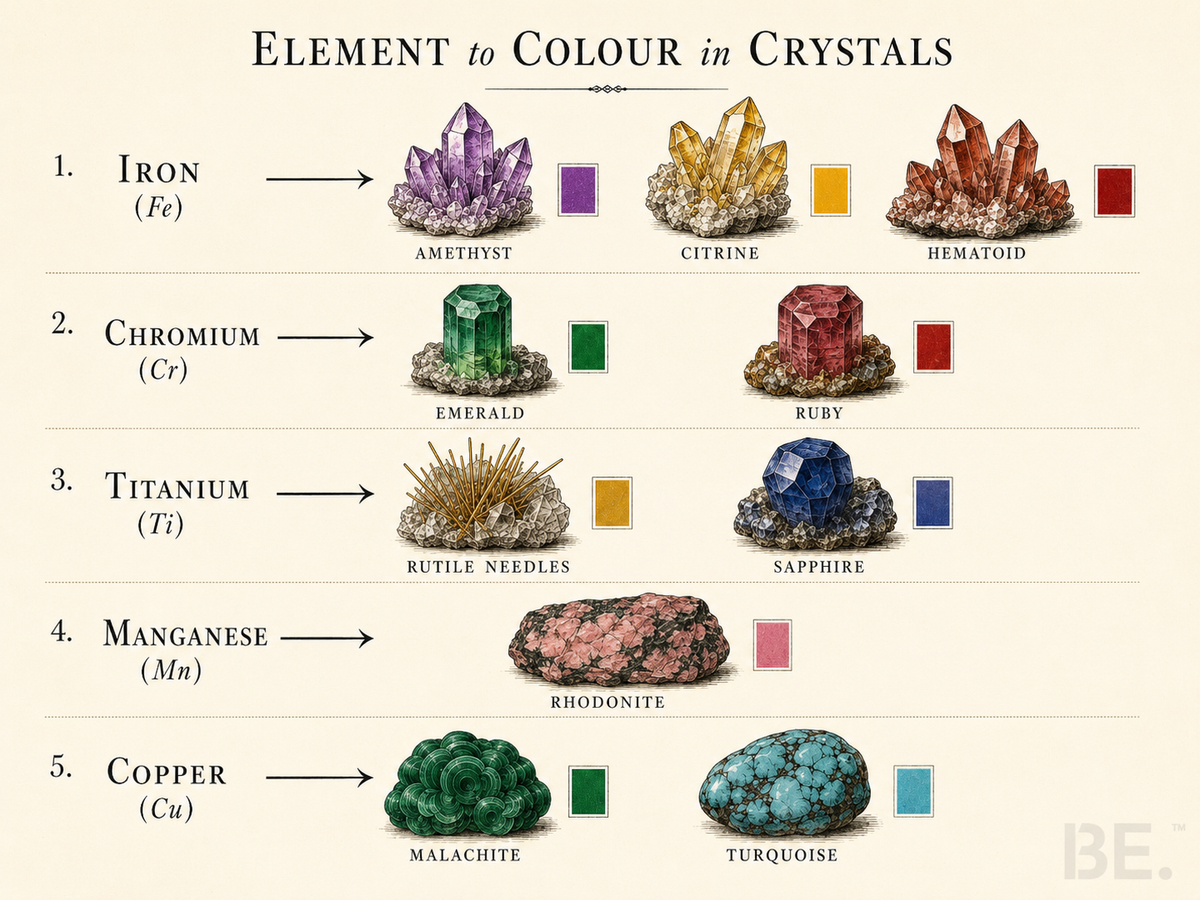
What a chromophore does
Transition-metal ions have partly filled electron orbitals. In a crystal, neighbouring atoms split the available energy levels. Visible photons with the matching energy can be absorbed as electrons move between levels; the wavelengths that remain determine the observed colour. The size of that energy gap depends on the ion, its valence, the lattice site and the surrounding geometry [1].
Substitution also has to fit the host. A minor ion may replace a host ion directly, or local charge balance may require coupled substitutions. Concentration can affect absorption strength, but saturation is not a simple concentration meter: zoning, thickness, competing absorbers, scattering and treatment can change what the eye records.
Five recurrent gem chromophores
| Element / ion | Host examples | Observed routes | What controls the shift |
|---|---|---|---|
| Chromium, commonly Cr³⁺ | Corundum, beryl, grossular garnet | Ruby red; emerald or tsavorite green | Different crystal-field strength and site geometry in each host; concentration alone is not a quality scale. |
| Iron, Fe²⁺ / Fe³⁺ | Olivine, beryl, quartz, garnet, corundum | Green, blue, yellow, violet, red-brown and dark absorption systems | Valence, site, paired ions and charge transfer; route must be shown for the material [2]. |
| Manganese, commonly Mn²⁺ / Mn³⁺ | Garnet, spodumene, beryl and carbonates | Orange, pink, red or violet contributions | Valence and host geometry; inclusions or other absorbers may modify appearance. |
| Copper, commonly Cu²⁺ | Tourmaline, turquoise and copper minerals | Blue to green absorption | Mineral class, site and associated ions; a copper-bearing label still needs identity evidence. |
| Vanadium, commonly V³⁺ | Beryl, grossular and other hosts | Green and colour-shifting systems | Host field, valence and competing chromium or iron absorption. |
Why one element does not mean one colour
Chromium provides the cleanest demonstration. Cr³⁺ substitutes for aluminium in both corundum and beryl, yet the surrounding oxygen geometry differs. The absorption bands therefore leave ruby looking red and emerald looking green. Neither result supports “more chromium = better”: tone, saturation, transparency, distribution and competing absorptions all enter the visual and quality reading [1].
Iron is more complex because Fe²⁺ and Fe³⁺ can occupy different sites and can interact with neighbouring ions through charge transfer. The dedicated iron colour guide owns those valence and pairing cases.
Reading colour like a mineralogist
- Start with the host. A colour interpretation is only meaningful after the mineral or material class is plausible.
- Separate hue from absorber. Similar hues can come from different ions, defects, inclusions or treatments.
- Record zoning and path length. A thicker area can look darker without containing a different material.
- Use pleochroism as an observation, not a verdict. Directional colour can narrow a route but does not identify a species alone.
- Escalate high-value claims. Spectroscopy and laboratory testing are required when identity, origin or treatment changes value.
Scope: chromophores only. Charge-transfer, defect, inclusion and optical routes are compared in How Crystal Colours Form.
Trade-name colour terms, decoded
- Paraiba. Copper-bearing tourmaline. The trade name once meant Brazilian only; now applies to copper-bearing material from Mozambique and Nigeria too.
- Padparadscha. Pink-orange sapphire. The colour comes from a Cr3+ and Fe3+ combination in corundum.
- Tsavorite. Chromium-vanadium grossular garnet. Discovered near Tsavo National Park in 1967.
- Demantoid. Andradite garnet with diamond-like dispersion; colour is iron-driven.
- Mandarin garnet. Spessartine with manganese-driven orange; sourced primarily from Namibia.
Caring for colour
Care cannot be assigned from the chromophore alone. A chromium-bearing ruby, emerald or garnet can have different fracture, filling and cleaning risks; an iron-bearing quartz colour may also have a treatment history. Follow the identified species and disclosed treatment in the material-specific care chart, and avoid heat, soaking, steam or ultrasonic cleaning when identity or treatment remains uncertain [3].
How BE. evaluates colour
Within the Crystal 4T framework, Tone records hue, saturation, evenness and lighting behaviour. A Stone Origin Record may record a chromophore only when mineral identity and an appropriate source or test support the assignment. Colour observation by itself cannot distinguish chromium from iron, prove origin or replace spectroscopy.
BE. Crystal Jewellery assigns a chromophore only where identity and source support it, and records colour as an observation everywhere else.Frequently asked questions
Q1. What is a chromophore?
A chromophore is an ion or electronic centre that selectively absorbs visible wavelengths. In gem minerals, transition-metal ions are recurrent chromophores, but the host and valence determine the result.
Q2. Why is emerald green but ruby red when both contain chromium?
Cr³⁺ occupies different lattice environments in beryl and corundum. The different crystal fields shift its absorption bands, leaving green in emerald and red in ruby [1].
Q3. Does more chromium mean better colour?
No. Hue and saturation also depend on valence, site geometry, path length, zoning, transparency and competing absorptions. Concentration alone is not a quality grade.
Q4. Why can iron create several colours?
Iron can occur in different valence states and lattice sites and can participate in charge transfer with neighbouring ions. The host and associated defects or treatment also matter.
Q5. Can colour reveal which element is present?
Not by itself. Similar colours can have different causes, and one element can produce several colours. Spectroscopy or other laboratory evidence is needed for a consequential assignment.
Q6. Is every gem colour caused by a trace element?
No. Charge transfer, defects, inclusions, coatings and physical optics can also create colour. Those routes are compared in the colour-science pillar.
Q7. Can colour prove geographic origin?
No. Origin determinations combine multiple observations and analytical results. Colour may be recorded as one clue but cannot establish a mine or country alone.
References
- [1] GIA Gems & Gemology: The causes of colour in gemstones. Crystal-field and host-lattice context.
- [2] GIA Gems & Gemology: Application of UV-Vis-NIR Spectroscopy to Gemology. Current primary review of absorption, chromophores and colour mechanisms.
- [3] GIA: Gem treatment. Treatment disclosure and care context.
- [4] GIA Gems & Gemology: An Update on Color in Gems, Part 1. Primary review of dispersed metal ions and host-lattice effects.
- [5] Nassau, K. (2001). The Physics and Chemistry of Color, 2nd ed. Wiley.
- [6] GIA: Tourmaline. Copper-bearing tourmaline context.
Field Notes.
One stone at a time: its geology, and how to read quality. The Stone Buying Checklist comes with your first email.
By subscribing you agree to receive emails from BE. Unsubscribe anytime.
Sent. Check your inbox.