
Gold Sheen vs Black Obsidian: Sheen Cause, Look & Choosing
A geology-first comparison of gold sheen and black obsidian — what creates the metallic shimmer, how the volcanic glass differs, and which to choose.
In this field note
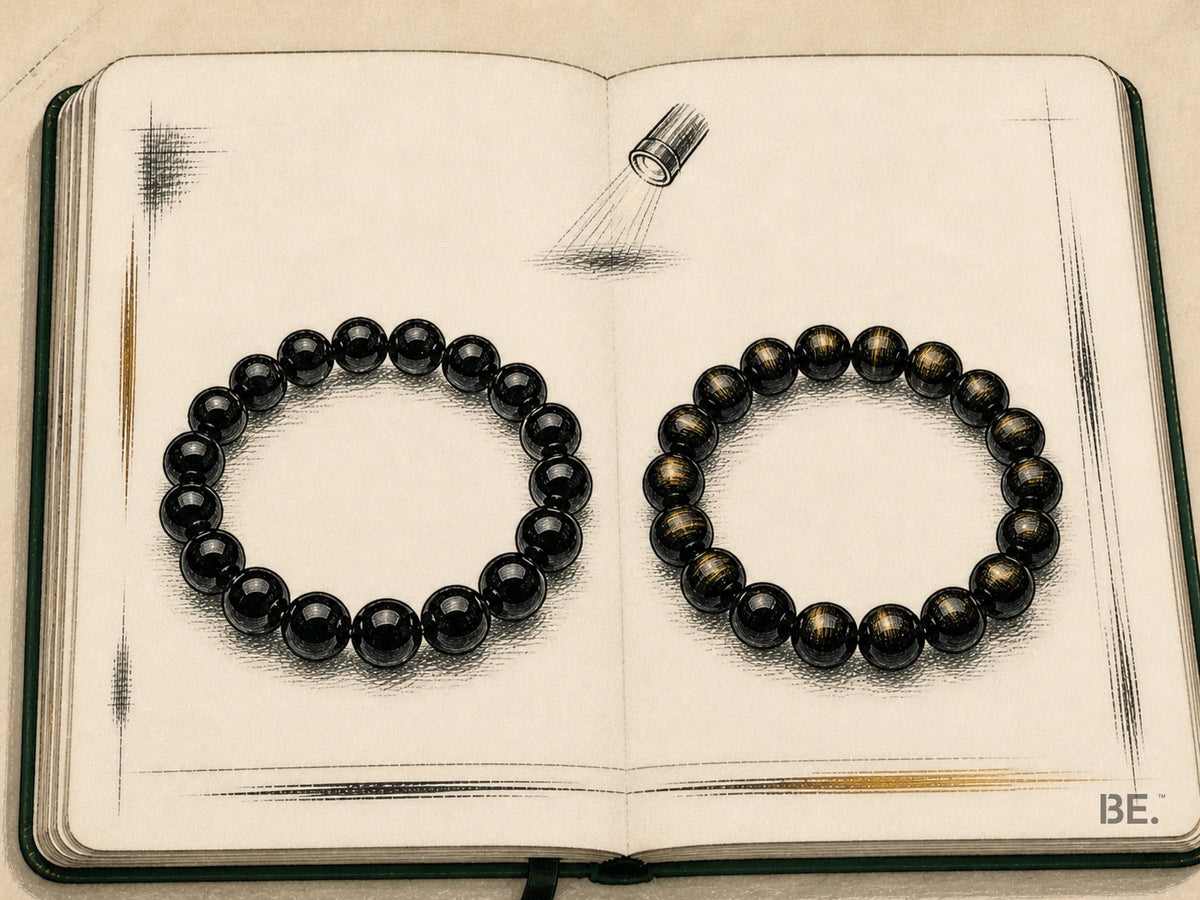
If one obsidian bead flares gold under a lamp while another stays dark, the visible difference is directional internal structure—not a different mineral species and not proof of a surface coating. The exact structure can vary by deposit, so this comparison keeps the mechanism summary short and sends the evidence detail to the Gold Sheen Obsidian Bracelet Guide.
The choice begins with what each strand does under the same light. Both share the same broad care limits; the useful difference is whether the surface stays dark or returns a moving gold-bronze flash.
What obsidian actually is
Obsidian is not, strictly, a mineral. A mineral has a defined chemical formula and a repeating crystal lattice. Obsidian has the first — it is dominantly SiO2, around 70–75%, with smaller amounts of Al2O3, Na2O, K2O and trace iron — but not the second. It is a mineraloid: a naturally occurring glass that has the chemistry of rhyolite but never had time to crystallise.
The reason is cooling speed. When felsic (silica-rich) lava reaches the surface, it is viscous and full of dissolved water. If it cools slowly, that silica organises into quartz, feldspar and other crystals; you get granite or rhyolite. If it cools fast enough — in a thick flow that hits cold rock or water, in days rather than years — the silica freezes mid-shuffle into a disordered glass. That glass is obsidian. The same chemistry, two completely different textures, decided by the cooling rate.
Because there are no crystal grain boundaries, obsidian breaks with what mineralogists call a conchoidal fracture: smooth, curved surfaces with razor-thin edges. The edges are sharp enough that Mesoamerican toolmakers used flaked obsidian as surgical blades, and modern surgeons have demonstrated obsidian scalpels that cut finer than steel. This matters for jewellery only as a warning: a chipped obsidian bead can have a genuinely sharp edge.
Why black obsidian is black
Obsidian colour depends on composition, oxidation state, microscopic phases, bubbles and thickness. A thin edge may transmit brown-grey light, but no single iron percentage or phase list can be applied to every deposit without analysis.
Plain black obsidian lacks a visible directional gold flash. Gold sheen material contains aligned internal features that return light from a narrower range of angles; the features must be identified source by source.
Why gold sheen obsidian shimmers
Gold sheen is an appearance route within volcanic glass, but published evidence does not support one universal platelet explanation. A GIA review describes limited studies of Mexican material involving aligned lenticular gas or different-glass features plus oriented mineral phases; Oregon fire obsidian follows a separately analysed magnetite-rich thin-film route.
The robust observation is directional: tilt the bead and a gold-bronze flash strengthens, moves or disappears. ‘Schiller’ can describe the appearance, but it does not identify the microstructure. Read the Gold Sheen Obsidian Bracelet Guide for the mechanism evidence and its limits.
One practical consequence is that sheen appears from certain angles. Beads on a strand may catch light unevenly, and cutters can orient the visible flash differently around a drill. Judge coverage by rotating the whole strand under the same light rather than by expecting every bead to stay bright at once.
Where each one comes from
Obsidian occurs in multiple felsic volcanic provinces, but a commercial or archaeological source claim needs provenance or compositional evidence. Do not infer Mendoza, Pachuca or Oregon from colour alone, and do not turn a source documented for one object into the default origin of a modern strand.
| Trait | Black obsidian | Gold sheen obsidian |
|---|---|---|
| Composition | Volcanic glass; commonly silica-rich, with composition varying by source | Same material class; directional internal features, source-specific mechanism |
| Optical effect | Flat, opaque dark grey-black | Schiller flash: gold-bronze reflection that moves with angle |
| Internal structure | No visible directional gold flash; internal phases vary by source | Aligned internal features; exact phases require source-specific evidence |
| Mohs hardness | 5–5.5 | 5–5.5 |
| Fracture | Conchoidal; sharp edges when chipped | Conchoidal; sharp edges when chipped |
| Source claim | Require provenance; do not infer origin from black colour | Require provenance; do not infer origin from gold flash |
How to choose between them
At the same bead size, plain black obsidian gives a dark, low-contrast line; gold sheen changes as the wrist moves and light meets its directional internal structure. Choose after rotating both strands under the same lamp, not from a single still photograph.
- If your wardrobe is graphic and quiet. Black obsidian reads as a graphic full stop, a strong dark line against skin. It pairs well with monochrome, with stark metal hardware, with anything where you want the stone to disappear except as form.
- If your wardrobe carries warm tones. Gold sheen reads as a metallic accent. The bronze flash sits comfortably alongside gold hardware, camel, oxblood, anything in the warm spectrum.
- If you want the strand to do something on its own. Gold sheen has a built-in performance: it catches every direct light source in a room. Black obsidian holds still. The first is louder, the second more disciplined.
- If you stack. Black obsidian functions as a base — it absorbs visual noise and lets other stones speak. Gold sheen wants room; it competes with anything reflective alongside it.
Care notes that apply to both
Obsidian is softer than quartz — Mohs 5 to 5.5 — which means it scratches against most household stone surfaces, against unset diamonds in stacked rings, and against any quartz or topaz it shares space with in a drawer. Store strands separately, ideally rolled in a soft cloth pouch. Avoid impact: obsidian’s conchoidal fracture means a hard knock against a tile floor can produce a chip with a working-knife edge.
Wipe the strand after contact with skin oils, perfume or sunscreen, and follow the care limits of its stringing, clasp and any mixed materials.
How BE. grades each
BE. reads both materials through identity and provenance first, then the visible object: tone, directional flash where present, polish, chips, drill finish, bead matching and construction. Gold sheen should be rotated under one controlled light so coverage can be compared without assigning a universal microscopic mechanism. A Stone Origin Record records only the source information actually disclosed for the lot.
Frequently asked questions
Q1.Is obsidian a crystal?
No. Obsidian is a mineraloid — volcanic glass with no crystal lattice. It has the chemistry of rhyolite but cooled too fast to crystallise.
Q2.What makes gold sheen obsidian shimmer?
Directional internal features return a moving gold-bronze flash. Published mechanisms differ by analysed source, so appearance alone cannot identify the phases.
Q3.Is gold sheen obsidian dyed or treated?
Appearance and quality alone do not establish treatment history. BE. uses natural gemstones, without synthetic substitutes or laboratory-grown stones. Processing and treatment details are disclosed on each product page.
Q4.Why does the sheen disappear at some angles?
Because the reflective internal features are directional. When the geometry between light, bead and eye aligns, the flash strengthens; from another angle the bead can look like plain black obsidian. That behaviour is expected, but it does not identify the microscopic phases.
Q5.Will obsidian scratch easily?
It is softer than quartz. Mohs 5–5.5 means it will scratch against most countertop stones and against most other gem materials it shares storage with. Keep it in its own pouch.
Q6.Can I wear obsidian in water?
Brief contact with water is fine. Prolonged soaking is best avoided because some obsidian carries fine flow-line fractures that can take up water and weaken over time.
References
Field Notes.
One stone at a time: its geology, and how to read quality. The Stone Buying Checklist comes with your first email.
By subscribing you agree to receive emails from BE. Unsubscribe anytime.
Sent. Check your inbox.