
How Crystal Colours Form: A Science-First Explanation
How crystal colours form — trace element substitution, electron transitions, structural colour, treatment effects, and what gives each mineral its hue.
In this field note
Crystals look coloured because their chemistry and structure remove or redirect parts of white light before the rest reaches your eye. The same ion gives different colours in different host lattices, and one mineral species can turn up in several colours through impurities, defects, inclusions or treatment. The crystal chromophore guide goes further into Cr, Fe, Mn, Cu and V. On every BE. Stone Origin Record, the Colour Source line names where that strand’s colour comes from.
How white light becomes crystal colour
White light contains a range of visible wavelengths. When it enters or strikes a material, electronic transitions may absorb selected wavelengths; particles or fine structures may scatter or diffract them; and the surface may reflect some light while the rest is transmitted. The eye records the wavelengths that remain. A transparent ruby looks red because its host-and-chromium system removes much of the complementary visible range. An opaque malachite returns green light from a copper-bearing material. Labradorite can flash blue or gold because fine intergrowths redirect light by angle. The optical path also matters: thickness, orientation, inclusions, polish, illumination and the observer can change the apparent tone without changing the mineral identity [1][2].
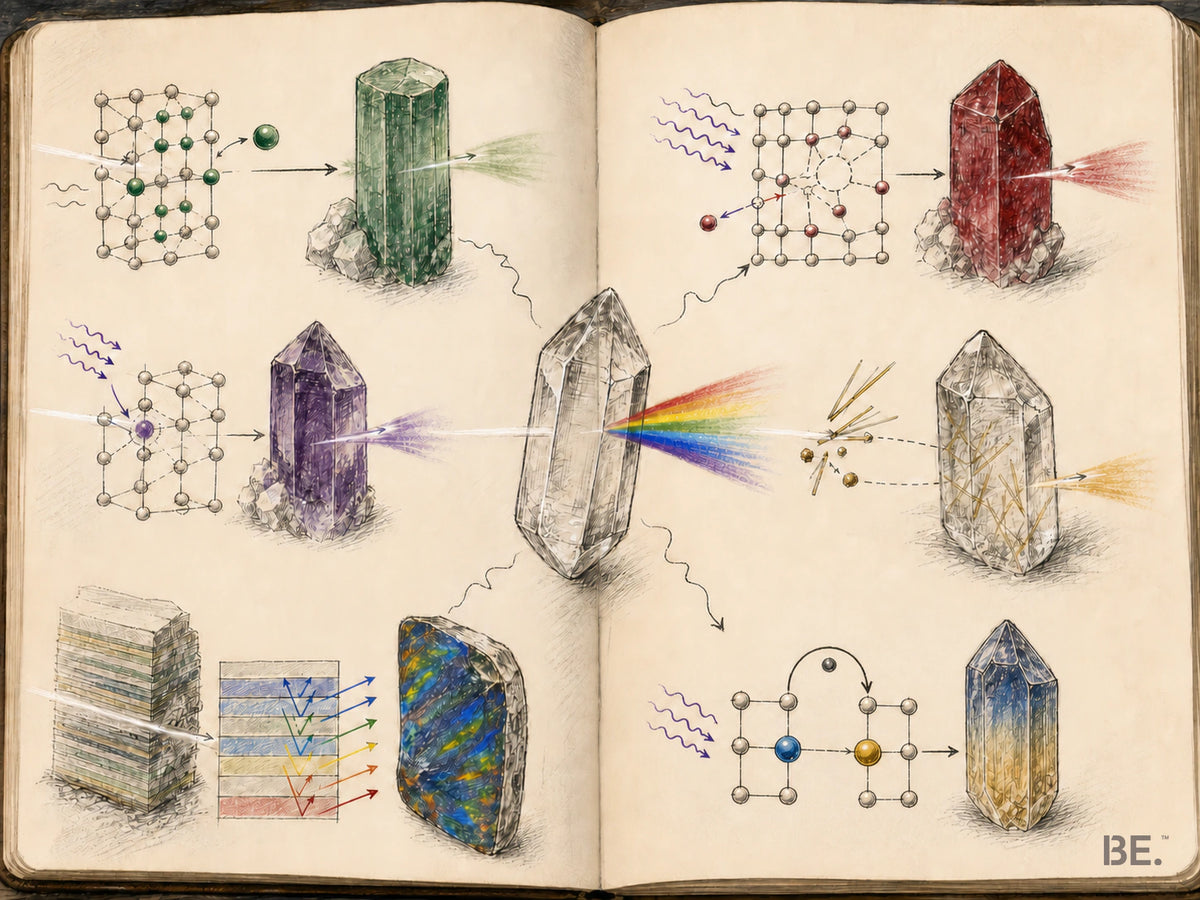
Five physical routes to crystal colour
1. Crystal-field absorption by major or dispersed ions
Transition-metal ions can absorb selected visible wavelengths when their electronic energy levels are split by the surrounding lattice. The ion may be a major constituent of the mineral or a minor substituent. Iron is part of the olivine solid solution that includes peridot; copper is essential to malachite. Chromium occurs as a substituting chromophore in ruby and emerald. The host site changes the energy spacing, so Cr3+ can contribute red in corundum and green in beryl [1][2].
2. Charge transfer
Colour can also arise when light promotes an electron between neighbouring ions or between an ion and surrounding ligand. Intervalence charge transfer involving Fe2+ and Fe3+, or Fe2+ and Ti4+, can produce broad, intense absorption. This route explains why an element list is incomplete: oxidation state, neighbouring ions, site geometry and host chemistry all matter [1][3].
3. Defects and colour centres
Vacancies, trapped electrons and other lattice defects can absorb visible light. Natural or artificial irradiation may create or modify these centres. Amethyst involves iron-related defects and irradiation in quartz; smoky quartz is associated with aluminium-related centres activated by radiation. Heating or light can change some defect-based colours, and stability and transformation temperature depend on the material and the specimen [3][5][8].
4. Inclusions and surface films
A host may be colourless while included particles, needles, plates or growth layers supply the visible hue. Golden rutile in quartz and iron-oxide material in hematoid quartz are familiar examples. A surface film can also modify reflected colour.
5. Physical optics and fine structure
Fine-scale structures can interfere with, diffract or scatter light. Ordered silica spheres create opal play-of-colour; feldspar intergrowths produce labradorescence; fine exsolution layers contribute moonstone adularescence. These effects shift with viewing angle, structure size and orientation [6][7].
Treatment works on a route that already exists
Heating, irradiation, diffusion, dyeing, filling and coating change chemistry, defects, inclusions or optical boundaries that already exist [4]. The Treatment line on a BE. Stone Origin Record states this plainly; BE. strands are recorded as untreated, with no heat, dye, coating or artificial irradiation.
Self-coloured or other-coloured?
Idiochromatic minerals are coloured by an element essential to their composition: iron-bearing peridot and copper-bearing malachite are common examples. Allochromatic materials gain colour from a minor substituent or defect not required by the ideal formula: chromium-bearing ruby and emerald, or colour varieties of quartz, fit this broader route. The terms describe where the chromophore sits in the mineral system [1][2].
Why one mineral can have many colours
Quartz can be colourless, violet, smoky, yellow, pink or green because different specimens contain different substituents, defects, irradiation histories, inclusions or treatments. Fluorite can also span many colours through trace constituents, defects and colour centres. A mineral name fixes a structural and compositional family; it does not fix one visual colour. This is why “same mineral” and “same cause of colour” are separate statements [3][8].
The five routes summarised
| Route | What interacts with light | Representative example | Main evidence need |
|---|---|---|---|
| Crystal-field absorption | Ion in a specific host site | Cr3+ in ruby or emerald | Host identity, ion, valence and site |
| Charge transfer | Electron transfer between ions or ion and ligand | Iron and titanium, or mixed-valence iron absorption | Composition and spectroscopy |
| Defect / colour centre | Vacancy or trapped charge | Amethyst or smoky quartz | Defect model, irradiation and treatment context |
| Inclusion / surface film | A distinct phase inside or on the host | Rutile in quartz | Separate host and included/coating phase |
| Physical optics | Fine structure redirects wavelengths | Opal play-of-colour or labradorescence | Structure scale, orientation and optical observation |
How colour appears in the current BE. catalogue
In the stones BE. strings, colour comes from these routes.
| Catalogue appearance | Material example | Colour route |
|---|---|---|
| Violet | Amethyst | Trace iron in the quartz lattice, activated by natural irradiation |
| Red / orange | Garnet · Hematoid quartz | Garnet absorbs light in its own structure; hematoid colour comes from iron-oxide inclusions inside the quartz |
| Gold / yellow | Rutilated quartz · Citrine | Rutile needles inside quartz; citrine carries iron-related colour in the quartz itself |
| Green | Prehnite · Green phantom quartz | Prehnite is coloured in its own body; green phantom quartz is a clear host with green chlorite layers inside |
| Dark / black | Obsidian · Smoky quartz | Obsidian is volcanic glass; smoky quartz uses a defect-based absorption route |
| Blue | Blue smoky quartz · Blue needle quartz · Kyanite | Blue inclusions inside quartz; kyanite absorbs light in its own structure |
An evidence ladder for reading colour
- Observation: record hue, tone, transparency, lustre, zoning, angle dependence and visible inclusions without naming a cause.
- Material candidate: combine habit, structure and documented physical properties to narrow the host.
- Non-destructive testing: refractive index, specific gravity, microscopy and spectroscopy can test host, chromophore and treatment hypotheses.
- Conclusion: identity, natural colour and treatment are confirmed by testing; for a BE. strand they are written on the Stone Origin Record.
What colour cannot prove
- Identity: unrelated materials and glass can overlap in hue.
- Origin: a colour stereotype is not a locality test.
- Treatment: natural and altered material can look similar.
- Quality: saturation is only part of Tone, and Tone is one of four Crystal 4T™ readings.
Crystal colour vs crystal form
Colour describes an optical result. Crystal form describes external geometry governed by structure and growth conditions; formation environment describes the geological process that produced the material. A purple quartz point, a purple quartz cluster and a purple quartz bead can share a colour route while presenting different form and fabrication histories. Continue to four geological formation paths for the growth-side framework.
Trade names that need a mechanism check
- Madeira citrine. A colour and trade descriptor. Heated material must be disclosed.
- Paraíba tourmaline. A trade name tied to copper-bearing tourmaline.
- Mystic topaz. A coated appearance: the film changes surface optics and can abrade.
- Rainbow obsidian. Obsidian is volcanic glass. Its iridescence comes from fine structures or inclusions within the glass.
- Phantom quartz. A growth-pattern description. The coloured phantom is included material, such as chlorite, laid along an earlier growth surface.
Caring for colour by material and treatment
Care follows the mineral, its fractures, porosity and inclusions, and any treatment. Look up each stone in the BE. Care Checker for how to clean and store it. For a piece you cannot identify, use a soft dry cloth and keep it away from long sunlight, heat, soaking, steam, ultrasonic cleaners and household chemicals.
How BE. records colour evidence
Crystal 4T™ Tone reads the colour the eye sees: how saturated and even it is in each bead, and how consistent it stays along the strand. The Stone Origin Record then states where that colour comes from in its Colour Source and Composition lines, and its Treatment line says whether anything was done to the stone. On the Bolivian amethyst strand, Colour Source reads trace iron in the quartz lattice, activated by geological irradiation, and Treatment reads untreated.
Frequently asked questions
Q1. What causes crystal colour?
Most examples use crystal-field absorption, charge transfer, defects or colour centres, inclusions or surface films, or physical optics from fine structure. Treatments alter one of those routes.
Q2. How does white light become a crystal colour?
The material absorbs or redirects selected wavelengths. The eye records the transmitted or reflected wavelengths that remain.
Q3. Can colour identify a crystal?
No. Colour narrows candidates but cannot by itself prove host species, origin, treatment, synthetic status or quality.
Q4. Why can one mineral have many colours?
Different specimens can contain different substituents, valence states, defects, irradiation histories, inclusions or treatments. Quartz and fluorite are familiar multi-colour examples.
Q5. Why can chromium contribute red in ruby and green in emerald?
The chromium ion occupies different host sites. Corundum and beryl split electronic energy levels differently, changing which visible wavelengths are absorbed.
Q6. What is a colour centre?
It is a defect-associated electronic state that absorbs visible light. Irradiation or heating can create, modify or remove some centres, depending on the material.
Q7. Is crystal colour the same as crystal form?
No. Colour is an optical result; form is external geometry linked to structure and growth. They can change independently.
Q8. Do all crystal colours fade?
No. Stability depends on material, defect, treatment and exposure, so care follows the stone.
References
- [1] Nassau, K. (2001). The Physics and Chemistry of Color, 2nd ed. Wiley.
- [2] Burns, R. G. (1993). Mineralogical Applications of Crystal Field Theory, 2nd ed. Cambridge University Press.
- [3] Fritsch, E. & Rossman, G. R. (1987). “An Update on Color in Gems.” Gems & Gemology, Parts 1–3.
- [4] GIA: Gem treatment. Treatment categories and disclosure context.
- [5] GIA: Amethyst. Quartz colour and care context.
- [6] GIA: Opal. Play-of-colour and structure.
- [7] GIA: Moonstone. Adularescence context.
- [8] Handbook of Mineralogy: Quartz.
- [9] BE. Journal: Crystal chromophores. Element, valence and host-lattice deep dive.
- [10] BE. Journal: Four geological formation paths. Colour versus formation boundary.
Field Notes.
One stone at a time: its geology, and how to read quality. The Stone Buying Checklist comes with your first email.
By subscribing you agree to receive emails from BE. Unsubscribe anytime.
Sent. Check your inbox.