
Crystal Birthstones: Month, Tradition & Material Truth
A geology-first birthstones guide — modern and traditional stones for each month, their mineralogy, and how the official lists were actually compiled.
In this field note
Open any jeweller’s window in May and you’ll see emerald. December gets turquoise or, since 2002, tanzanite. The twelve-month assignment feels timeless, the kind of thing that ought to trace back to Babylonian astrology or biblical breastplates. The history is shorter and more commercial than that.
This guide does two things. It tells you where the current list actually came from, and it reads each month’s stones, modern and traditional, as the minerals they are: chemistry, hardness, sources, and what to look for in a strand.
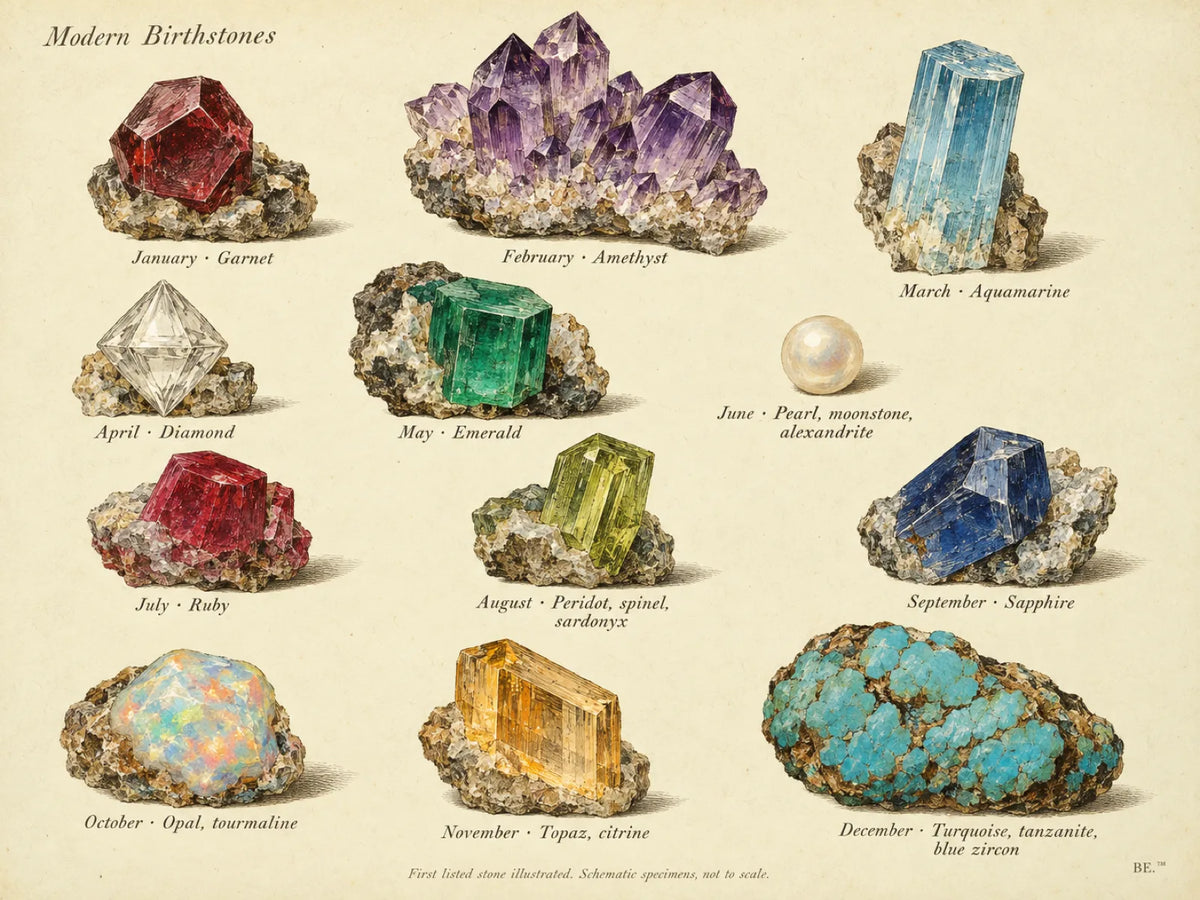
Where the birthstone list actually comes from
The idea of associating stones with months has ancient roots, but the specific twelve-stone list most retailers use today was a twentieth-century commercial standardisation. Before 1912, European and American jewellers worked from inconsistent lists drawn from a mixture of sources: the twelve stones of Aaron’s breastplate in Exodus, the twelve foundations of the New Jerusalem in Revelation, Polish folk tradition recorded in the eighteenth century, and various Indian and Tibetan calendar systems. The lists disagreed on roughly half the months.
In August 1912, at the annual meeting of the American National Association of Jewelers in Kansas City, the trade body adopted a single twelve-stone list to unify retail practice across the United States. The motive was straightforward: shop owners wanted one consistent catalogue so a customer who walked into a jeweller in Boston and one in San Francisco would be offered the same stone for their birth month. The Jewellers of America (JA) and later the American Gem Trade Association (AGTA) have continued to maintain the list, adding alexandrite (June, 1952), citrine (November, 1952), tanzanite (December, 2002) and spinel (August, 2016) as commercial supply made each viable.
None of which means the list is meaningless. A century of consistent use has given the modern stones a real cultural weight: May means emerald to a generation of customers because retailers agreed it should. But it’s worth knowing the list was assembled in a hotel ballroom in 1912, not handed down from antiquity.
Modern vs traditional birthstones, month by month
The table below sets the post-1912 modern list against the older European and Polish traditional stones, with the mineralogy and Mohs hardness for each. Where multiple stones are listed, all are legitimate within the relevant tradition, and there’s no single correct answer for any month.
| Month | Modern (JA / AGTA) | Traditional | Mineralogy | Mohs |
|---|---|---|---|---|
| January | Garnet | Garnet | Silicate group (almandine, pyrope, spessartine, grossular, andradite, uvarovite) | 6.5–7.5 |
| February | Amethyst | Amethyst | Quartz (SiO2) with Fe3+ trace and natural irradiation | 7 |
| March | Aquamarine | Bloodstone (heliotrope) | Beryl (Be3Al2Si6O18) with Fe2+ / chalcedony quartz with red iron-oxide spots | 7.5–8 / 6.5–7 |
| April | Diamond | Diamond, sapphire | Native carbon (C) / corundum (Al2O3) | 10 / 9 |
| May | Emerald | Emerald, agate | Beryl with Cr3+ or V3+ / banded chalcedony | 7.5–8 / 6.5–7 |
| June | Pearl, moonstone, alexandrite | Pearl, moonstone | Aragonite/calcite (CaCO3) / feldspar (orthoclase and albite) / chrysoberyl (BeAl2O4) with Cr | 2.5–4.5 / 6 to 6.5 / 8.5 |
| July | Ruby | Ruby, onyx | Corundum (Al2O3) with Cr3+ / black chalcedony | 9 / 6.5–7 |
| August | Peridot, spinel, sardonyx | Sardonyx | Olivine ((Mg,Fe)2SiO4) / MgAl2O4 / banded chalcedony | 6.5–7 / 7.5–8 / 6.5–7 |
| September | Sapphire | Sapphire, peridot | Corundum (Al2O3) with Fe / Ti / olivine | 9 / 6.5–7 |
| October | Opal, tourmaline | Opal | Hydrated silica (SiO2·nH2O) / complex borosilicate | 5.5–6.5 / 7–7.5 |
| November | Topaz, citrine | Topaz | Al2SiO4(F,OH)2 / quartz (SiO2) | 8 / 7 |
| December | Turquoise, tanzanite, blue zircon | Turquoise, lapis lazuli | CuAl6(PO4)4(OH)8·4H2O / zoisite (Ca2Al3...) with V3+ / ZrSiO4 / lazurite-rich rock | 5–6 / 6.5–7 / 7.5 |
Hardness matters for daily wear. A Mohs 7+ stone (quartz family, beryl, topaz, corundum, spinel) handles strand-bracelet contact without obvious surface change. Below 6.5 (pearl, opal, turquoise, moonstone) you’re looking at a stone that needs softer handling. None of the lower-hardness options is unwearable; they just ask for a different relationship with the piece.
Mineralogy month by month
A short reading of what each month’s stone actually is, geologically:
January: Garnet. Garnet is a silicate group of six end-members, and no single mineral. Pyrope is magnesium-aluminium, almandine is iron-aluminium, spessartine is manganese-aluminium. Red garnet in jewellery is almandine, pyrope or a blend of the two, and it is found in metamorphic rocks on every continent. Tsavorite (green grossular, Kenya/Tanzania) and rhodolite (pink-purple pyrope-almandine) are the same family, different chemistry.
February: Amethyst. Quartz coloured purple by trace iron plus natural background irradiation, which creates the lattice defect that absorbs yellow-green light. Amethyst is mined in many countries, including Brazil, Uruguay, Bolivia and Zambia, and material from each varies widely. Deep “Siberian” colour is now mostly an Uruguayan or Zambian grade label and does not indicate a Russian origin.
March: Aquamarine. Iron-bearing beryl, sea-blue to slightly green. Most fine material comes from Minas Gerais (the Santa Maria de Itabira deposit is the historical reference for saturated blue) and from Pakistan’s Shigar valley. Heat treatment to remove green-yellow undertones is industry standard and stable.
April: Diamond. Native carbon, the hardest natural material at Mohs 10. Strand-grade diamond beads are unusual; April-themed strands can use clear quartz, Herkimer-style quartz or white topaz as a visual stand-in.
May: Emerald. Beryl coloured by chromium or vanadium. Colombian (Muzo, Chivor) is the historical reference for saturated green; Zambian (Kagem) often runs slightly cooler and bluer. Almost all commercial emerald is fissure-filled with cedar oil or resin, which is disclosed standard practice.
June: Pearl, moonstone, alexandrite. Three different mineralogies. Pearl is biological aragonite. Moonstone is an orthoclase-albite feldspar with adularescence from sub-microscopic lamellar intergrowth. Alexandrite is chromium-bearing chrysoberyl with the famous green-to-red colour change. It is the rarest of the three and almost never seen in strand form.
July: Ruby. Corundum coloured by chromium. Burmese (Mogok, Mong Hsu) is the historical reference; Mozambican (Montepuez) now supplies a large share of the market with often-excellent material. Heat treatment is industry standard.
August: Peridot, spinel. Peridot is gem-grade olivine, the yellow-green mineral that gives basalt its colour where it’s abundant. Main deposits: Sapat in Pakistan, Mogok in Myanmar, the Arizona San Carlos Apache reservation. Spinel was the August addition in 2016; until modern gemmology distinguished it, many famous “rubies” in royal regalia turned out to be spinel.
September: Sapphire. Corundum in every colour except red. The reference blue is Kashmir (Sumjam) for the cornflower tone and Burmese for the velvety quality; Ceylonese (Sri Lankan) and Australian round out the supply.
October: Opal, tourmaline. Opal is hydrated silica with internal play-of-colour from regular silica-sphere packing. Australian black opal (Lightning Ridge) is the high reference; Ethiopian Welo opal is the market driver. Tourmaline is a complex borosilicate; pink-green watermelon zoning makes it visually distinctive.
November: Topaz, citrine. Topaz is an aluminium fluorosilicate, often colourless or blue (most commercial blue topaz is irradiated white topaz). Imperial topaz from Ouro Preto in Brazil reads peach-orange and is the historical reference. Citrine is yellow quartz; see the abundance reading for more on natural-vs-heated.
December: Turquoise, tanzanite. Turquoise is a hydrated copper-aluminium phosphate, often stabilised in commercial supply. Tanzanite is blue zoisite from a single area near Mount Kilimanjaro in Tanzania, discovered in 1967 and commercially named by Tiffany & Co. before its 2002 addition to the list. Almost all tanzanite is heated to bring out the violet-blue.
Birthstone vs zodiac stone vs lunar stone
The twelve-month birthstone list isn’t the only stone-to-time mapping in circulation. It’s worth knowing the differences so you can pick the framework that actually means something to you, whether or not it is the one the jewellery industry standardised.
The zodiac stone tradition maps stones to the twelve astrological signs, each sign standing in for a stretch of the calendar. Different sources assign different stones; one widely circulated list pairs Aries with carnelian, Taurus with rose quartz, and so on. There is no consensus version, and zodiac-stone tables in popular publications vary widely from each other.
The Indian Navaratna tradition assigns nine stones to nine celestial influences in Vedic astrology: ruby (Sun), pearl (Moon), red coral (Mars), emerald (Mercury), yellow sapphire (Jupiter), diamond (Venus), blue sapphire (Saturn), hessonite garnet (Rahu) and cat’s-eye chrysoberyl (Ketu). The system is older and more internally consistent than the Western birthstone list, but it maps stones to planets, and months play no part.
The Tibetan and Chinese traditions group stones by lunar months and elemental correspondences. The systems are real, but they don’t translate cleanly to a Gregorian calendar.
If you find yourself negotiating between two stones for the same birth month, both can be legitimate. The traditional list and the modern one are both internally consistent; they just emerged from different commercial and cultural pressures.
Choosing a birthstone strand
If you want to wear a stone that connects to a birth month, there are three honest filters worth applying before you buy.
- Pick the version that resonates. Modern, traditional, or zodiac, they’re all reasonable. A March birthday could mean aquamarine or bloodstone. A June birthday could mean moonstone or pearl. Choose the one you actually want to wear.
- Pick for hardness if it’s daily wear. Strand bracelets get knocked around. Quartz family (amethyst, citrine, agate), beryl (aquamarine, emerald, morganite), topaz, garnet and corundum all handle daily wear. Pearl, opal, turquoise and moonstone need more care.
- Pick for deposit if you care about provenance. Brazilian amethyst reads differently from Uruguayan or Zambian. Mozambican garnet reads differently from Indian. Source country and region are the most concrete things on a Stone Origin Record; specific deposit is listed only where the upstream supplier has disclosed it.
How BE. handles birthstones
BE. grades every strand against the same four-axis system regardless of whether the stone is on a birthstone list: Crystal 4T: Transparency, Tone, Texture, Treasure. The Stone Origin Record carries the source country and region (and the specific deposit where the upstream supplier has disclosed it) and the lot number. We don’t lean on the birth-month framing as a sales argument, because the framing is decorative: it’s something a wearer brings to a stone, not something the stone delivers.
Birthstone strands are listed in the BE. collection, and every strand ships with a Stone Origin Record that states its lot, its four Crystal 4T™ readings and what those readings do not claim.
Frequently asked questions
Q1.Are birthstones an ancient tradition?
The idea of associating stones with months has roots going back centuries, drawing on the breastplate of Aaron in Exodus, Polish folk tradition, and various Asian calendar systems. But the specific twelve-stone list most retailers use today was standardised in 1912 by the American National Association of Jewelers and has been revised several times since.
Q2.Why does my birth month have more than one stone?
Some months (March, June, August, October, November, December) carry multiple modern stones because the trade body added options when commercial supply made each viable. June, for instance, gained alexandrite in 1952; August gained spinel in 2016. Both the original and the addition remain on the modern list.
Q3.What’s the difference between modern and traditional birthstones?
The modern list is the post-1912 American trade standard. The traditional list pulls from European stones in circulation before standardisation, drawn from Polish, German and English sources of the seventeenth to nineteenth centuries. Both are internally consistent; they just come from different periods and motivations.
Q4.Can I wear a birthstone bracelet every day?
Quartz-family stones, beryl, topaz, garnet, corundum and spinel can handle daily wear at Mohs 7+, while softer birthstones need gentler handling. Quartz family (amethyst, citrine), beryl (aquamarine, emerald, morganite), topaz, garnet, corundum and spinel handle daily wear well at Mohs 7+. Pearl, opal, turquoise and moonstone are softer and need gentler handling: avoid contact with harder gemstones, ultrasonic cleaners, and prolonged water immersion.
Q5.Is tanzanite a real traditional December birthstone?
No. Tanzanite was discovered in 1967 near Mount Kilimanjaro and commercially named by Tiffany & Co. It was added to the December list in 2002 by the American Gem Trade Association alongside Jewelers of America. The traditional December stones are turquoise and, in some lists, lapis lazuli.
Q6.What if I prefer the zodiac stone or Navaratna instead?
That’s a reasonable choice. The Western birthstone list, zodiac stone tradition and Indian Navaratna system are all internally consistent within their own logic. The Navaratna in particular has a longer, better-attested history than the post-1912 month list. Choose the framework that means something to you; none has primacy over the others in any verifiable sense.
References
- GIA: Birthstones by month
- Jewelers of America: About JA (custodian of the modern birthstone list)
- American Gem Trade Association: AGTA, co-custodian of the modern list
- Wikipedia: Birthstone (history of the list and revisions)
- Mindat: mineralogical reference for each species
- Kunz, G. F. (1913). The Curious Lore of Precious Stones. J. B. Lippincott.
- Webster, R. (2002). Gems: Their Sources, Descriptions and Identification, 5th ed. Butterworth-Heinemann.
- Schumann, W. (2009). Gemstones of the World, 4th ed. Sterling.
Field Notes.
One stone at a time: its geology, and how to read quality. The Stone Buying Checklist comes with your first email.
By subscribing you agree to receive emails from BE. Unsubscribe anytime.
Sent. Check your inbox.