
First Time Buying a Crystal Bracelet? How to Choose Your First Strand
A decision guide for first crystal bracelet — picking by visual style, material weight, bead size, and personality without mystical promises.
In this field note
Most buying guides for crystal bracelets start with the wrong question. They ask “what are you trying to fix” — sleep, focus, anxiety, abundance — and route you to a stone whose claimed properties match the symptom. This is a marketing structure, not a buying structure. The stone does not change with the symptom; you do, slightly, because you decided something.
This guide uses the buying structure that traders use. Four axes. Pick on each. End up with a strand you will reach for.
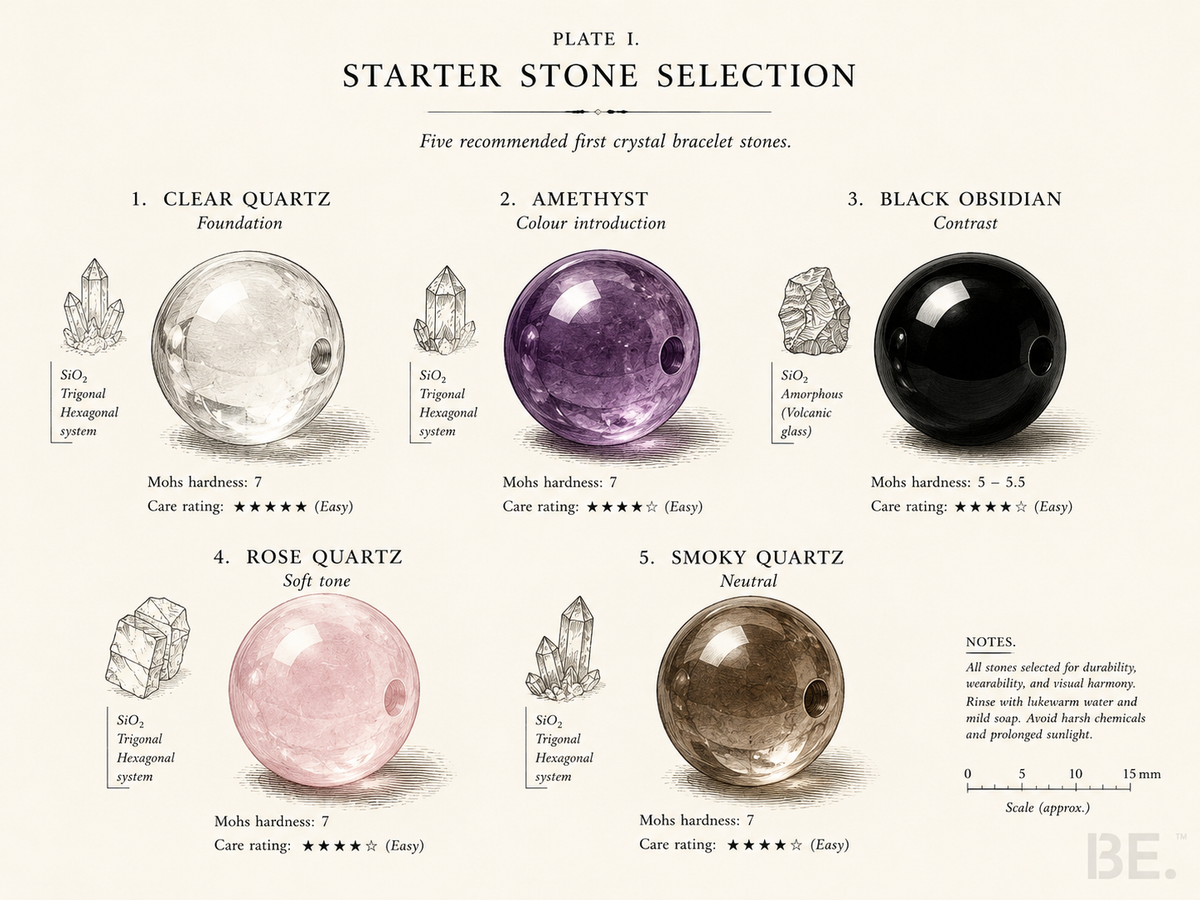
Axis 1: visual style
The first cut is what the bracelet looks like on the wrist. Crystal jewellery splits into three broad visual families.
Transparent
Light passes through edge-to-edge. Clear quartz, smoky quartz, amethyst, citrine, aquamarine, topaz. The visual reads cool and architectural — glassy, faceted-looking even on round beads. Best with monochrome wardrobes, minimalist watches, and bright skin tones. Tends to read more formal.
Translucent
Light passes but objects behind diffuse. Rose quartz, milky quartz, moonstone, opalite, prehnite. Reads soft, dreamy, less crisp. Pairs with neutral palettes, linen, knitwear. Reads more romantic.
Opaque or included
Light penetrates only at edges; the body of the bead is solid or filled with visible inclusions. Obsidian, hematoid quartz, lapis, sodalite, rutilated quartz, garden quartz, malachite. Reads heavier, more graphic, more interesting on inspection. Pairs with stronger colour wardrobes, leather, metal accessories. Reads more architectural-organic.
Axis 2: material weight
Density varies more across crystal materials than people realise. The same bead size in obsidian versus moonstone is a different wrist experience.
| Density band | Representative stones | What it feels like |
|---|---|---|
| Light (2.3-2.6 g/cm³) | Obsidian, opal, moonstone, fluorite | Soft on wrist, barely noticed, slides quietly |
| Medium (2.6-2.8 g/cm³) | Quartz family (amethyst, citrine, rose, smoky), agate, chalcedony | Present but not heavy, balanced |
| Heavy (2.8-3.5 g/cm³) | Tourmaline, jade, malachite, lapis, turquoise | Distinctly present, the wrist knows it is wearing something |
| Very heavy (3.5+ g/cm³) | Hematite, pyrite, garnet, magnetite | Substantial weight, the bracelet anchors the wrist |
Test before buying if you can. Hold the strand in your palm for thirty seconds. If you forget it is there, you may want denser. If your wrist tires, you want lighter.
Axis 3: bead size
Bead size is the most visible variable on the wrist. The standard sizes are 6, 8, 10, 12 mm. Each reads differently with skin and sleeve. If you are not sure of your wrist size, see BE.’s find your size guide before choosing bead diameter.
| Bead size | Visual character | Best for |
|---|---|---|
| 6 mm | Delicate, jewel-like, sits flat against wrist | Layering with watches and other bracelets; small wrists; formal wear |
| 8 mm | Balanced, standard size, versatile | Daily wear, all wrist sizes, most occasions |
| 10 mm | Statement, present, photographs well | Larger wrists, casual and creative dress, where the bracelet should be noticed |
| 12 mm | Bold, sculptural, dominant on the wrist | Larger frames, layered with watch face only, statement intent |
How bead size interacts with material
Clear materials gain visual interest at larger sizes — a 10 mm clear quartz bead shows transparency dramatically that a 6 mm hides. Included materials reverse this somewhat: rutilated quartz at 6 mm shows only fragments of needles; at 10 mm full inclusion patterns are visible. Opaque materials read about the same across sizes — the size choice is mostly about wrist presence.
Axis 4: colour family
Colour is the easiest to over-think. Pick what you would buy in a sweater. The same logic applies. Some practical groupings:
- Cool neutrals. Clear quartz, smoky quartz, hematite, obsidian. Goes with everything. Hardest to get wrong.
- Warm neutrals. Citrine, carnelian, sunstone, hessonite garnet. Adds quiet warmth without competing with bright clothes.
- Cool colours. Amethyst, aquamarine, sodalite, lapis, fluorite. Reads contemplative, technical, good with grey and navy.
- Warm colours. Sunstone, fire agate, red jasper, almandine garnet. Reads earthy, grounded, good with brown and rust.
- Soft pastels. Rose quartz, moonstone, prehnite, peach moonstone, lavender amethyst. Reads romantic, soft, good with linen.
A useful test: open your wardrobe. The bracelet should fit the colour palette of clothes you already own. If you would not wear a sweater in that colour, you probably will not wear the bracelet often.
Decision tree, four steps
If you want a shortcut, run this sequence:
- Step 1: pick visual style. Transparent, translucent, or opaque/included — which one matches your aesthetic today?
- Step 2: pick weight. Light, medium, heavy, or very heavy — what feel do you want on the wrist?
- Step 3: pick bead size. 8 mm is the safe default. 6 mm for layering or small wrists. 10 mm for presence.
- Step 4: pick colour. What goes with your wardrobe and what catches your eye.
Run these in order. You will end at a small handful of candidate stones, usually three or four, that fit all four answers.
Common pairings that work
These are starting points for new buyers. Each is chosen because the material fits the lifestyle context and the visual context together.
| Style profile | Recommended starting stone | Why it works |
|---|---|---|
| Minimalist office wardrobe | Clear quartz or smoky quartz, 8 mm | Reads as quiet jewellery, doesn’t compete with watches or suiting |
| Romantic, soft, knit-heavy | Rose quartz or moonstone, 8-10 mm | Soft optics match soft textures |
| Creative, layered, leather | Rutilated quartz or obsidian, 10 mm | Inclusion or sheen rewards close looking |
| Daily watch wearer | 6 mm anything that matches metal of watch | Stacks cleanly, reads as a coordinated set |
| Bold colour wardrobe | Amethyst, lapis, or carnelian, 8-10 mm | Holds its own against strong clothes |
How BE. organises its strands for first-time buyers
BE. groups every strand by the four-series naming: Anchor (heavy grounding stones), Flow (clear and translucent), Prism (internally complex with visible inclusions), and Void (deep saturated colour). Each strand carries a Crystal 4T grade so you can compare across series. For a first purchase, picking the right series is the easier framing than picking the right stone individually.
A first strand are listed in the BE. collection, and every strand ships with a Stone Origin Record that states its lot, its four Crystal 4T™ readings and what those readings do not claim.
Frequently asked questions
Q1.What bead size should I start with?
8 mm is the safe default for most wrists and most outfits. Drop to 6 mm if you wear watches or layer many bracelets. Step up to 10 mm if you want the bracelet to be the visible piece on the wrist.
Q2.Does it matter which wrist I wear it on?
Materially, no. Practically, the non-dominant wrist is usually the safer choice because it sees less friction and impact.
Q3.Should I match the crystal to my mood that day?
Match it to your wardrobe and to what you find pleasant to look at. Mood-matching is more cleanly served by the act of choosing in the morning than by the stone itself.
Q4.What if I want to wear several at once?
Stick with one tonal family per stack — either all cool or all warm. Mixing densities reads better than mixing colours. Three 8 mm bracelets in clear quartz, smoky quartz, and obsidian works visually; three in amethyst, citrine, and turquoise tends to clash.
Q5.Which stones are easiest to care for?
Quartz family (clear, smoky, amethyst, citrine, rose), agate, jasper, hematite — all robust, water tolerant, low maintenance. Avoid pearl, opal, turquoise, malachite for daily wear unless you are prepared to handle them carefully.
Q6.How many should I own?
One that you reach for daily is more than enough to start. The trap is buying multiple based on claimed properties; the result is a drawer of bracelets you do not wear.
References
- GIA Gem Encyclopedia — stone properties
- Mindat — mineral density and properties data
- Wikipedia — Bead sizes and conventions
- Gem-A — trade and material references
- Schumann, W. (2009). Gemstones of the World, 4th ed. Sterling.
- Webster, R. (2002). Gems: Their Sources, Descriptions and Identification, 5th ed. Butterworth-Heinemann.
Field Notes.
One stone at a time: its geology, and how to read quality. The Stone Buying Checklist comes with your first email.
By subscribing you agree to receive emails from BE. Unsubscribe anytime.
Sent. Check your inbox.