
Amethyst or Rose Quartz: Which Is Your First Crystal?
A geology-first comparison of amethyst and rose quartz — what gives each its colour, how the structures differ, and how to choose between them for a strand.
In this field note
Lay an amethyst strand beside a rose quartz strand and the first contrast is optical: one lets violet light through, the other diffuses a milky pink. Amethyst takes its colour from iron-related colour centres; rose quartz takes its pink from tiny fibres of a dumortierite-like mineral.
The amethyst material guide covers the violet quartz’s colour and growth record in depth. Next to rose quartz, the plainest difference is clarity: rose quartz is almost always slightly cloudy, while amethyst can be water-clear.
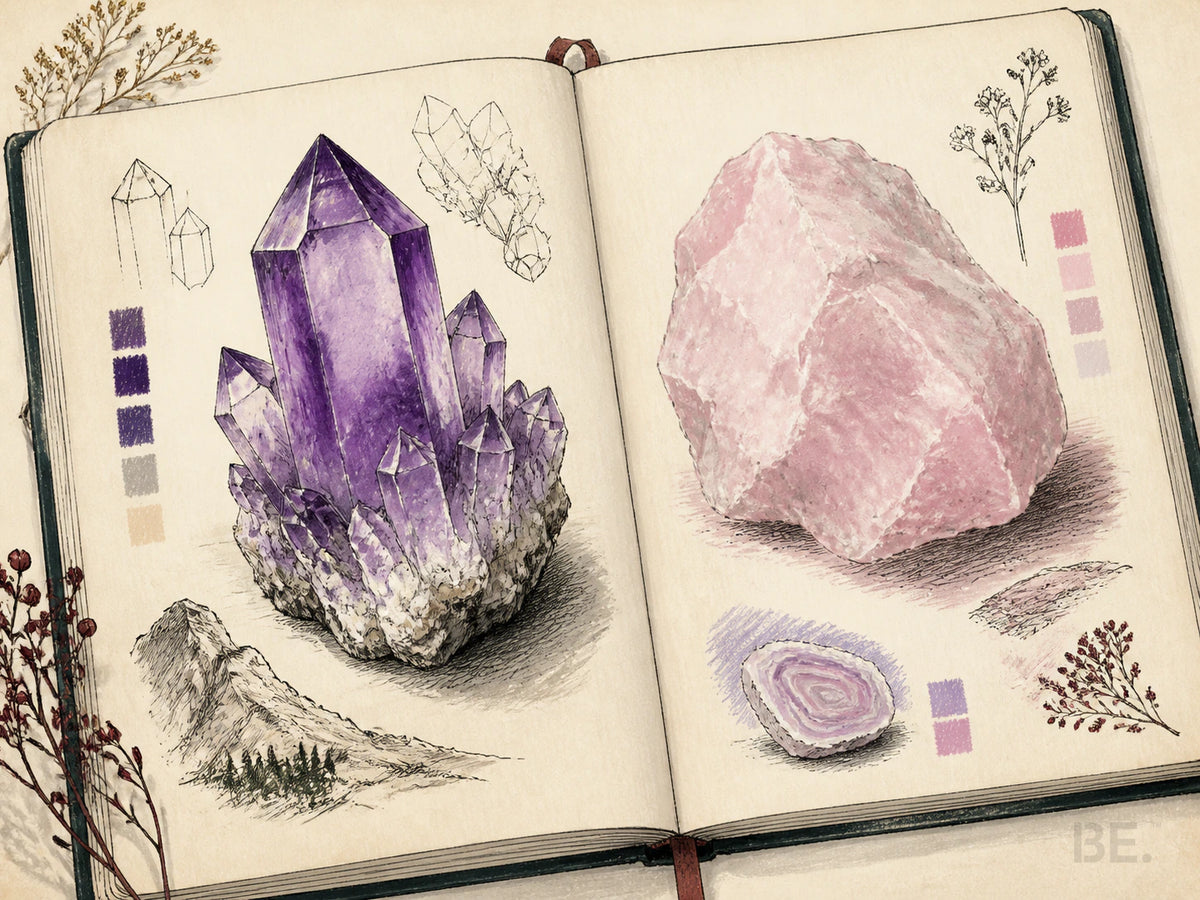
What they share, what they don’t
Both stones are quartz. Chemically that means SiO2: a continuous three-dimensional framework of silicon and oxygen tetrahedra, packed in a trigonal crystal system. Mohs 7. Specific gravity around 2.65. Refractive index 1.544–1.553. From an X-ray diffraction pattern alone, you could not tell amethyst and rose quartz apart.
What separates them is what is inside the framework, and how they grow. Amethyst forms transparent to translucent prismatic crystals whose violet colour comes from iron-related defects and natural irradiation. Common rose quartz grows massive and cloudy to translucent; under the microscope its pink sits in tiny fibres related to dumortierite.
| Amethyst | Rose Quartz | |
|---|---|---|
| Colour cause | Iron + natural irradiation → violet | Microscopic fibre inclusions → pale pink |
| Hardness (Mohs) | 7 | 7 |
| Look | Transparent, deep violet | Translucent, soft / milky |
| Cultural reading | Calm, clarity | Warmth, self-kindness |
| Fades in sun? | Yes, avoid long direct sun | Yes, avoid long direct sun |
| Best for | Depth, a violet that shows | A gentle, quiet pink |
Why amethyst is purple
Amethyst’s colour comes from a phenomenon mineralogists call a colour centre. Trace iron (Fe3+) substitutes for silicon in the quartz lattice during growth. On its own that iron does not produce purple: synthetic iron-bearing quartz grown in a lab is pale yellow. The purple only appears after the crystal is exposed to natural gamma radiation from surrounding rock, usually over millions of years. The radiation knocks an electron out of one of the iron atoms, creating an Fe4+ defect that absorbs light in the yellow-green part of the spectrum and lets purple through.
Two consequences follow. First, amethyst colour is linked to iron-related defects and irradiation history. Second, heat and prolonged intense light can alter those centres. The result depends on the starting material and exposure conditions: some material fades, becomes colourless or shifts toward green or yellow-to-orange.
Why rose quartz is pink
Rose quartz’s colour has been argued over for a hundred years. Transmission electron microscopy work published in American Mineralogist associated the pink of common massive rose quartz with microscopic fibres of dumortierite-like material. The fibres scatter light as well as carry colour, which is why rose quartz looks soft and hazy.
Common rose quartz therefore grows as a massive, cloudy-to-translucent body. Rare transparent pink quartz that forms sharp, separate crystals is treated separately in mineralogy: its colour comes from light-sensitive colour centres.
How they actually look in a strand
Side by side, amethyst often transmits violet light and may show zoning, while Rose Quartz commonly diffuses a softer pink through haze and inclusions. Bead thickness also changes what the eye sees.
Both are quartz at Mohs 7. Amethyst reads as a transparent-to-translucent violet gem; rose quartz reads as a cloudy-to-translucent pink.
| Trait | Amethyst | Rose quartz |
|---|---|---|
| Colour mechanism | Fe3+ + natural gamma irradiation (colour centre) | Nanofibrous inclusions reported in common massive material |
| Transparency | Transparent to translucent | Translucent to nearly opaque (milky) |
| Typical habit | Single prismatic crystals, often in geode cavities | Massive, granular aggregate; rarely crystalline |
| Mohs hardness | 7 | 7 |
| Fades in sunlight | Possible; keep out of long direct sun | Possible; keep out of long direct sun |
| Reacts to heat | Colour may fade or shift | Colour generally stable; fibres can degrade |
| Major sources | Bolivia, Brazil, Uruguay, Zambia | Brazil, Madagascar, Mozambique, Namibia |
How to choose between them
Choose by the strand in front of you. Compare colour under ordinary light, transparency, zoning or haze, polish, drilling and how the strand is made. Amethyst and rose quartz each have their own typical look.
- Skin tone. Cool skin reads amethyst as a clear violet and rose quartz as a clean pale pink. Warm skin shifts amethyst slightly toward red-purple and rose quartz toward peach. Both suit either skin tone.
- Stacking. Amethyst sits well next to other transparent gem materials (clear quartz, smoky quartz, citrine). Rose quartz pairs better with opaque or translucent stones (moonstone, pink opal, white agate).
- Daylight wear. Wear both in daylight as usual, and store them away from a sunny windowsill or car dashboard.
What changes after you buy
Both stones are quartz at Mohs 7. Avoid hard knocks, sudden heat and long, strong sunlight.
To clean, use lukewarm water, mild soap and a soft brush, then rinse and dry. Skip steam and ultrasonic cleaners.
How BE. grades each stone
BE. reads both stones against the same Crystal 4T™ standard: Transparency, Tone, Texture and Treasure. For amethyst, Tone leads: how saturated the violet is in each bead, and how evenly it runs along the strand. Transparency is read with amethyst’s natural colour zoning in mind; gentle banding is part of how the crystal grew. For rose quartz, Transparency and Tone lead: how even the soft haze is, and how steadily the pale pink continues from bead to bead. Each strand comes with a Stone Origin Record that states the stone, its treatment, its origin country (Bolivia for the amethyst, Mozambique for the rose quartz), its lot and its four 4T readings.
Pink amethyst vs rose quartz
“Pink amethyst” has a documented geological context in published work on pink amethyst crystals from Argentina; online, the name is used more loosely. To compare a piece with rose quartz, start with its form: massive rose quartz, a drusy crust and a free-standing crystal are different materials. Then look at it under neutral light, where rose quartz shows its even haze and amethyst its clearer body.
Frequently asked questions
Q1.Are amethyst and rose quartz the same mineral?
Yes. Both are crystalline silica (SiO2). Amethyst violet comes from iron-related colour centres, while common massive rose quartz takes its pink from tiny dumortierite-like fibres.
Q2.Why is rose quartz almost always cloudy?
Common massive rose quartz is translucent because its tiny fibre inclusions scatter light as well as carry colour. Rare transparent pink quartz does exist and forms as separate crystals.
Q3.Will my amethyst fade?
Some amethyst does fade under long, intense light. Store it away from strong direct sun and high heat.
Q4.Can I wear them together?
Yes. Both are quartz at Mohs 7 and sit well on one wrist; give each strand a little room so the beads do not knock together.
Q5.Is heated amethyst the same as natural citrine?
No. Heated amethyst sold as citrine is natural quartz whose colour was altered after formation; natural-colour citrine acquired yellow colour through geological history. The Stone Origin Record for the BE. citrine strand lists its treatment as untreated.
References
- Mindat: Amethyst data
- Mindat: Rose Quartz data
- GIA: Amethyst description & sources
- Wikipedia: Rose quartz (dumortierite hypothesis)
- Webster, R. (2002). Gems: Their Sources, Descriptions and Identification, 5th ed. Butterworth-Heinemann.
- Schumann, W. (2009). Gemstones of the World, 4th ed. Sterling.
Field Notes.
One stone at a time: its geology, and how to read quality. The Stone Buying Checklist comes with your first email.
By subscribing you agree to receive emails from BE. Unsubscribe anytime.
Sent. Check your inbox.