
Rose Quartz Guide: Colour Origin, Varieties & Jewellery
A geology-first guide to rose quartz — what gives quartz its pink colour, why some pieces show asterism, where the best material forms, and how to read a strand.
In this field note
The Rose Quartz BE. strings is the common massive kind: soft pink, cloudy to translucent, polished into 10mm spheres and recorded as Untreated on its Stone Origin Record.
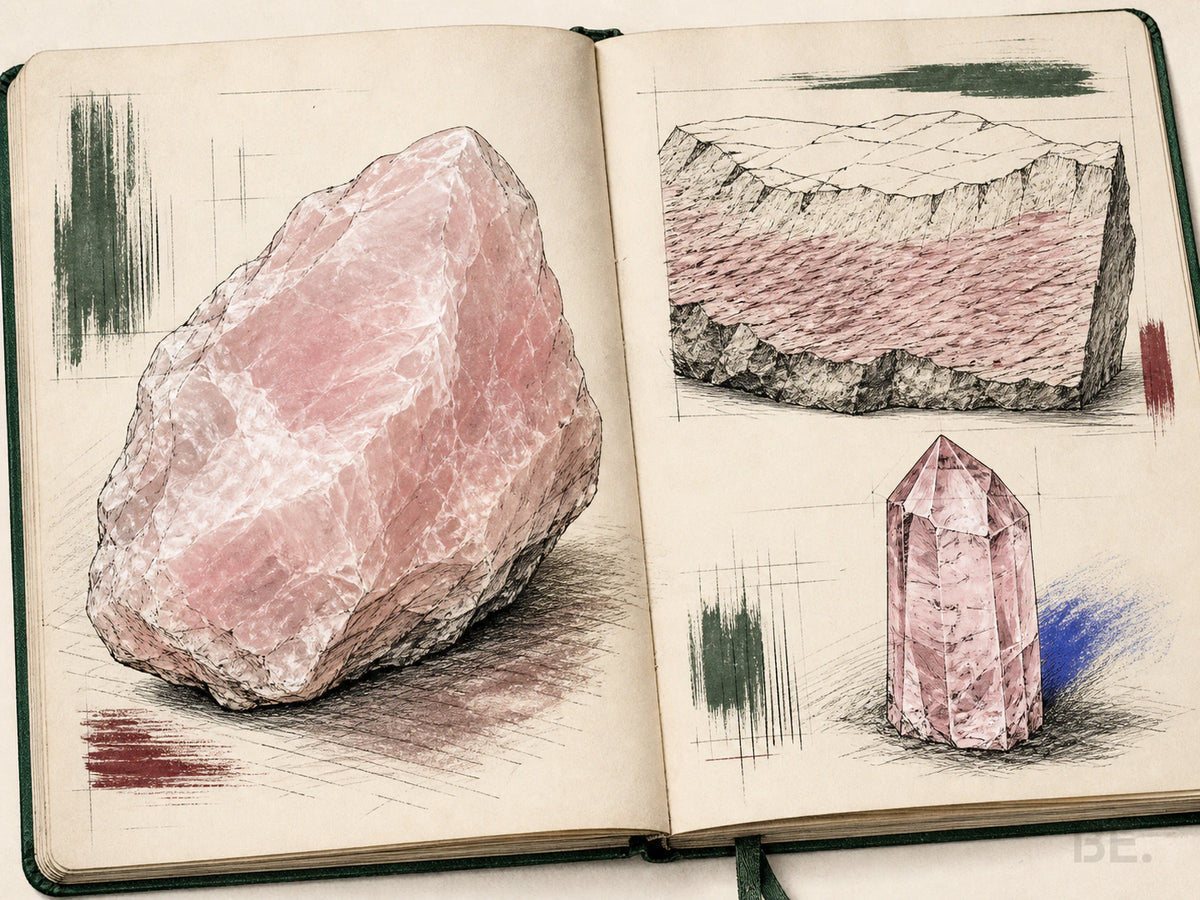
What Rose Quartz is
Rose Quartz is quartz: silicon dioxide, SiO2, in the trigonal crystal system. Like other quartz varieties it has a Mohs hardness of 7, a refractive index around 1.544–1.553 and a specific gravity near 2.65. Those shared properties identify the quartz. The pink comes from something inside it.
Most Rose Quartz is massive, without free-standing crystal faces. It is commonly cloudy to translucent and may show uneven colour, fractures or asterism when inclusions are suitably oriented and the material is cut as a dome.
Why massive Rose Quartz is pink
Goreva, Ma and Rossman examined massive Rose Quartz from 29 localities by transmission electron microscopy and related methods. They found oriented nanofibres whose diffraction and chemistry were similar to, but not identical with, dumortierite. Their optical work linked the pink colour to Fe-Ti intervalence charge transfer in that fibrous phase. In plain terms, iron and titanium inside these fibres absorb part of the light, and the quartz looks pink.
Those fibres help explain why common Rose Quartz is usually milky. Submicroscopic inclusions scatter light through the quartz host. In some material, oriented inclusions can also produce a six-rayed star under a small point light when the surface is cut as a cabochon.
Massive Rose Quartz vs transparent pink quartz
| Question | Common massive Rose Quartz | Transparent pink quartz |
|---|---|---|
| Typical form | Massive material, beads, carvings and cabochons | Uncommon transparent crystals and faceted material |
| Colour evidence | Associated with aligned dumortierite-related nanofibres in studied material | Associated with colour centres involving Al/P substitutions and irradiation history |
| Light sensitivity | Generally stable in normal light | Some studied transparent pink quartz is light-sensitive |
Where Rose Quartz occurs
Rose Quartz is widely associated with granitic pegmatites and related quartz-rich bodies. Brazil, Madagascar, India, Mozambique, Namibia, South Africa and the United States are among the places reported for Rose Quartz. The Rose Quartz in BE. strands comes from Mozambique, and its Stone Origin Record states the origin.
Identity, treatment and quality are separate
Three separate questions apply to any Rose Quartz strand:
- Identity: is the object quartz, glass, resin, another mineral or a composite?
- Treatment: was colour or surface appearance altered by dye, coating, irradiation, filling or another process?
- Quality: BE. reads this with Crystal 4T™: Transparency, Tone (the pink depth of each bead and how evenly it runs across the strand), Texture and Treasure.
Colour concentrated in fractures or around a drill hole is a common sign of dye. On a BE. strand, the Treatment line of the Stone Origin Record reads Untreated.
How to read Rose Quartz jewellery
Use neutral, diffused light and compare the whole strand before inspecting one bead at about 10×. Look at colour distribution, translucency, fractures, polish, surface coatings and drill-hole edges.
- Do not scratch a finished bead or use heat, acetone, vinegar or improvised ultraviolet tests.
- Do not identify by “cold feel”; size, room temperature and thermal contact dominate the sensation.
How to care for Rose Quartz
Rose Quartz is Mohs 7 and generally stable to light and heat. Clean it with warm soapy water and a soft brush, then rinse and dry it. Avoid steam and ultrasonic cleaning.
Store it away from long, intense sunlight and high heat. For how each stone handles light, use the stone-by-stone sunlight guide; for cleaning and storage, use the general jewellery care guide.
What Rose Quartz means to people
Rose Quartz has long been used in decorative objects. Some people read it as a stone of love, calm or compassion; those are cultural and personal meanings. Geologically, it is quartz coloured pink by fibres inside it, and what it means is up to the person who wears it.
Frequently asked questions
Q1.What is Rose Quartz?
Rose Quartz is pink macrocrystalline quartz, usually massive and cloudy to translucent. Its pink comes from tiny aligned fibres of a mineral close to dumortierite.
Q2.Is dumortierite definitely the colour source?
Close to it. The best-known microscopy study found pink fibres very similar to dumortierite in structure and chemistry, and linked the colour to iron and titanium inside them.
Q3.Is transparent pink quartz the same material expression?
It is still quartz, but mineralogical studies treat the uncommon transparent crystal material separately because its colour-centre behaviour and habit differ from common massive Rose Quartz.
Q4.Does all Rose Quartz fade in sunlight?
No. Massive Rose Quartz is generally stable in normal light; some transparent pink quartz is light-sensitive. Keeping any strand out of long, intense sun is sensible.
Q5.Can a home test prove Rose Quartz?
No. Neutral light and 10× magnification show clues such as colour spread, translucency and polish. For a BE. strand, identity and treatment are stated on its Stone Origin Record.
Q6.How should Rose Quartz be cleaned?
Use warm soapy water and a soft brush, then rinse and dry. Avoid steam and ultrasonic cleaning.
References
- Goreva, J. S., Ma, C. and Rossman, G. R. (2001). Fibrous nanoinclusions in massive Rose Quartz: the origin of Rose coloration. American Mineralogist 86, 466–472.
- GIA: Rose Quartz Care and Cleaning
- GIA: Rose Quartz Description
- Balitsky, V. S. et al. Studies of transparent pink quartz colour centres and light sensitivity.
Field Notes.
One stone at a time: its geology, and how to read quality. The Stone Buying Checklist comes with your first email.
By subscribing you agree to receive emails from BE. Unsubscribe anytime.
Sent. Check your inbox.