
How to Spot a High-Quality Rose Quartz Bracelet
A high-quality rose quartz bracelet reads an even, saturated pink with real translucency — and isn't dyed. The colour tells, plus how to spot dye.
In this field note
“Real” compresses several decisions into one word. A bracelet can be quartz but dyed, natural but poorly matched, glass but honestly disclosed, or supported by a report that belongs to another item. A useful assessment keeps those possibilities visible until evidence removes them.
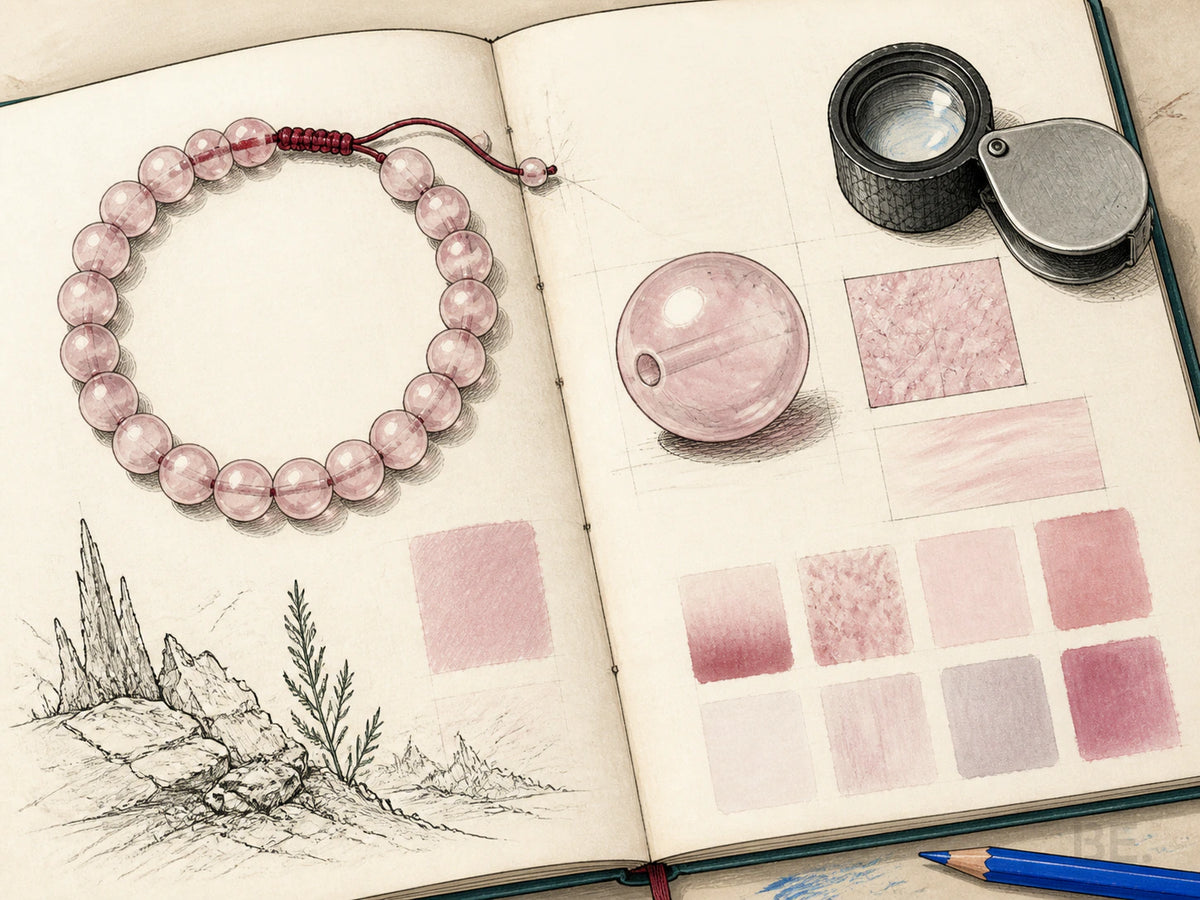
Three separate questions
| Question | Useful evidence | What not to claim |
|---|---|---|
| Identity | Refractive index, specific gravity, magnification, spectroscopy and other suitable tests | “Pink and cold means Rose Quartz” |
| Treatment or assembly | Colour concentration, coatings, filled fractures, seams, disclosure and laboratory work | “One bright drill hole proves dye” |
| Commercial quality | Colour, translucency, matching, polish, drilling, cord and exact-object documentation | “Uniform means fake” or “asterism means top grade” |
Preserve the seller’s exact wording
Save the listing, invoice, measurements, photographs, treatment statement, origin claim and report number before they change. “Natural Rose Quartz”, “Rose Quartz colour”, “pink quartz”, “quartz glass” and “Rose Quartz-style” are not equivalent descriptions. Ask whether the claim applies to this bracelet, a named lot or only a general collection.
A country name is not a treatment disclosure. “Brazilian” does not establish natural origin, colour mechanism or quality, and a Stone Origin Record does not certify an object unless its identifiers and lot continuity match that object.
Observe in neutral light
Let the bracelet reach room conditions, clean only with a dry soft cloth if needed, and use diffuse neutral light against white and mid-grey backgrounds. Record the strand as a whole before isolating one bead. Look for colour distribution, translucency, cloudy zones, fractures, surface film, polish and whether beads change character at the ends of the strand.
Vivid colour is not proof of dye, and pale colour is not proof of natural material. Natural massive Rose Quartz can range from very pale to stronger pink; glass, dyed quartz and coatings can occupy the same visual range. Photography and white balance can move all of them.
Inspect at about 10×
Use a loupe to inspect several bead surfaces and both sides of multiple drill holes. Colour concentrated in fractures, around cavities or at drill-hole edges can support a dye hypothesis. A coating may show abrasion, an edge or a different lustre. Rounded bubbles, flow lines or repeated mould features can support a glass hypothesis. Each is a clue, not a verdict.
Fractures and internal haze can occur naturally in quartz. Spherical features can be fluid inclusions rather than gas bubbles. An individual drill hole may carry polishing compound, cord colour or lighting reflections. Require several observations to agree before narrowing the material category.
Stop before destructive tests
- Do not scratch a finished bracelet. Mohs tests are destructive, technique-sensitive and poor at settling treatments.
- Do not use acetone, vinegar, bleach, flame, boiling water or a hot needle. They can damage coatings, fillers, cord and polish.
- Do not identify by cold feel, sound or weight in the hand.
- Do not treat household ultraviolet response as proof. Fluorescence can vary and requires controlled interpretation.
When a gemmologist or laboratory matters
Professional testing becomes worthwhile when the price depends on natural origin, when treatment disclosure is disputed, when the material may be glass or another gem, or when a report is used to justify value. Ask what the proposed test can and cannot answer. A standard report may identify material and detectable treatment yet remain unable to determine geographic origin.
Match any report to the exact bracelet or documented loose-stone lot through measurements, photographs, inscription, sealed packaging or another durable identifier. A genuine report for a different object is irrelevant evidence.
Judge quality after identity
Once the material and disclosure boundary are understood, evaluate the bracelet as an object. Look at whether the colour is attractive under ordinary light, whether the beads are intentionally matched, whether the polish is clean, whether drill exits are chipped, whether the cord passes smoothly and whether the fit suits the wearer. Uniformity can be a design choice; variation can be honest geology. Neither is automatically superior.
Asterism can be a compelling optical feature in suitably included and oriented Rose Quartz, but it is not a universal grade. It should be demonstrated under a small point light on the actual bead rather than inherited from a product category.
Frequently asked questions
Q1.Can colour prove that a bracelet is real Rose Quartz?
No. Natural Rose Quartz, treated quartz, glass and other materials can overlap in colour. Colour is one observation, not an identity test.
Q2.Does colour at a drill hole prove dye?
Concentrated colour can support a dye hypothesis, especially when it repeats in fractures and cavities, but one drill hole is not conclusive.
Q3.Is a uniform Rose Quartz strand fake?
No. Uniformity may come from careful matching, glass, treatment or naturally consistent material. Identity and quality require separate evidence.
Q4.Can I use acetone or a scratch test?
No. Both can damage finished jewellery and still leave an ambiguous result. Use non-destructive observation and appropriate professional testing.
Q5.Does a laboratory report prove the bracelet?
Only when the report can be tied to the exact bracelet or a demonstrably continuous lot. A report for another object does not transfer.
Q6.What makes a good Rose Quartz bracelet?
After identity and treatment disclosure are addressed, judge colour under ordinary light, bead matching, polish, drilling, cord construction, fit and exact-object documentation.
References
- GIA — Rose Quartz Description
- GIA — Rose Quartz Care and Cleaning
- Goreva, J. S., Ma, C. and Rossman, G. R. (2001). Fibrous nanoinclusions in massive Rose Quartz. American Mineralogist 86, 466–472.
- U.S. FTC — jewellery disclosure principles
Field Notes.
One stone at a time: its geology, and how to read quality. The Stone Buying Checklist comes with your first email.
By subscribing you agree to receive emails from BE. Unsubscribe anytime.
Sent. Check your inbox.