
BE. Crystal 4T Grading: Transparency, Tone, Texture & Treasure
An explanation of BE.'s Crystal 4T grading system — the four axes used to grade every strand, from optical transparency to documented origin.
In this field note
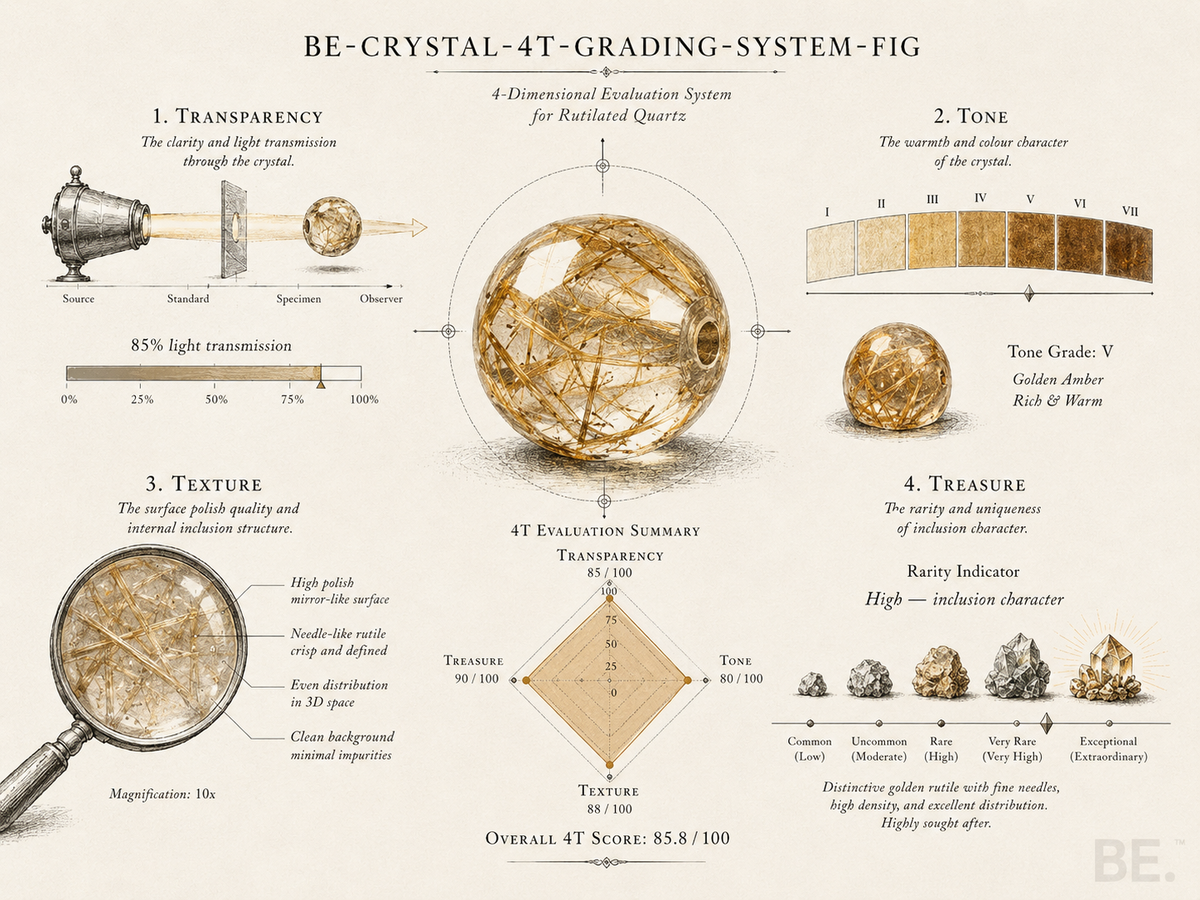
What 4T is
4T is the internal material grading framework BE. applies to every batch of strand stones before any of them reach a wrist. It is built around four axes that describe the stone itself, not the marketing copy: Transparency, Tone, Texture, and Treasure. Each axis is scored from 1 to 5, and the three material scores are combined under a weakest-link rule into one of three composite tiers, with Treasure as the extra condition for Heritage, — Studio, Signature, or Heritage — or rejected outright.
- Four axes — Transparency (how light passes through), Tone (colour saturation and uniformity), Texture (surface and internal cleanliness), Treasure (how difficult the material is to obtain at this quality).
- 1–5 scale — each axis is rated against BE.'s reference for the material, not a verbal description alone.
- Three composite tiers — Studio, Signature, Heritage. The lowest of Transparency, Tone and Texture sets the tier; Heritage also requires Treasure at 5.
- One rejection threshold — Transparency, Tone or Texture at 2 or below removes the stone from the production line.
The four axes — material questions, not marketing labels
Transparency
Transparency measures how light moves through the stone. For quartz-family material this means the visible depth of clarity — whether light passes cleanly through the bead, scatters through inclusions, or stops at a milky surface. For opaque silicates like prehnite, transparency is read as translucency: how much of an internal phantom or matrix structure becomes visible when held against a directional light source. Transparency is rated against the reference for each material type, so a 5 means the best that material can show.
Tone
Tone covers colour saturation, hue position, and uniformity within and across beads. A high-tone strand reads as a single coherent colour at arm’s length; a low-tone strand shows visible gaps in saturation or hue between adjacent beads. Tone is the axis most affected by sorting work — two strands cut from the same rough can score very differently on Tone depending on how rigorously beads were matched before stringing.
Texture
Texture is read on two layers. The surface layer covers polish quality, drill-hole cleanliness, and absence of pits, cracks, or chips. The internal layer covers structural cleanliness — fractures, cloudy zones, or sorting noise that breaks the stone’s visual continuity. Texture penalises poor finishing more heavily than minor natural inclusions, because finishing is a process choice and inclusions are usually a material reality.
Treasure
Treasure is the axis most often misread. It is not a measure of price or perceived value. It measures how difficult the material is to obtain at this quality, in this bead size and this colour: how many sources can supply it, how much of each parcel reaches the standard, and whether a sold-out lot can be replaced. Source and treatment are recorded separately on the Stone Origin Record and are not scored.
How the four readings combine into a tier
The four axes do not average. BE. applies a weakest-link rule: the lowest of the three material scores decides the composite tier, and Treasure is the extra condition for Heritage. A strand that scores 5 on Transparency, Tone and Treasure but 3 on Texture is a Studio strand, not a Signature strand; a strand at 5 on all three material axes but 4 on Treasure is Signature, not Heritage. This is intentional — it prevents a single strong axis from masking a real material weakness on another.
| Tier | Rule | What it means |
|---|---|---|
| Studio | Transparency, Tone and Texture at 3 or above, at least one below 4 | Production floor; daily working quality. |
| Signature | Transparency, Tone and Texture at 4 or above, at least one below 5 | Main line; visibly above general market quality. |
| Heritage | Transparency, Tone and Texture at 5, and Treasure at 5 | Archive-grade; replacement difficulty is part of the definition. |
| Rejected | Transparency, Tone or Texture at 2 or below | Not produced; returned to supplier or written off. |
What 4T rejects
Before a stone is scored, it has to pass an entry filter. The following conditions remove material from the 4T system entirely — they are not scored low, they are not scored at all.
- Dyeing. Any colour added by absorbed dye, including stabilised dye work on porous material.
- Heating. Heat treatment used to deepen or shift colour. Natural-form heated material (for example, heat-treated amethyst sold as citrine) is rejected for BE. strand use even when fully legal in the wider market.
- Post-mining irradiation. Reactor or accelerator irradiation used to produce colour that does not occur in the rough.
- Chemical enhancement. Acid bleaching, polymer impregnation, surface coating, and similar processes.
- Undocumented supply. Material from a vendor that cannot provide at least country- and region-level source information and a defensible record of the chain.
How to verify your piece
Every BE. strand ships with a Stone Origin Record. The card carries a Lot ID, the four T readings, the composite tier, the source country and region (and the specific deposit where the upstream supplier has disclosed it), and the treatment status. Processing and treatment information for each piece is disclosed on its product page. To verify a piece, three documents should agree:
- The card in the box — the printed Lot ID and 4T row.
- The product page — the published tier and source information for the model.
- The order record — the Lot ID logged against the order at fulfilment.
When all three lines reconcile, the piece is what the page said it would be. If any of the three disagree, the studio can be contacted with the Lot ID and the discrepancy is logged.
What 4T does not try to be
4T is a strand-grade material system run by one brand for the stones it produces. It is not a gem laboratory report, it is not a substitute for GIA, IGI, or similar institutional certifications, and it does not attempt to grade faceted gemstones, single carved objects, or fine jewellery centre stones. For coloured stones sold loose or set as fine jewellery, an independent gem lab report from a recognised laboratory remains the appropriate document. 4T sits beside those systems for a category they were not designed for — beaded strand jewellery sold direct from a single brand.
Read the full method
This page is a working summary, written so the system can be understood in a single read. The full 4T method goes further: it sets out each axis in detail, the observation conditions, and how the four readings combine. Anyone considering a BE. strand — or wanting to read BE.’s grading work against an independent standard — should read the method end to end. It is the source document; this article is the index.
Frequently asked questions
Q1. What do the four T’s stand for?
Transparency, Tone, Texture, and Treasure. Each is scored from 1 to 5 against BE.'s reference for the material. Together they decide the composite tier.
Q2. Why is the weakest score the one that decides the tier?
Because a strand is worn as a single object, not as four separate scores. A high Transparency score does not repair a low Texture score on the wrist. The weakest-link rule keeps the published tier honest about the worst visible characteristic.
Q3. Is Treasure a price grade?
No. Treasure measures how difficult the material is to obtain at this quality, in this bead size and this colour. It is not retail value and it is not a source record; source is recorded separately on the Stone Origin Record.
Q4. What happens to a stone that scores a 2?
It is rejected. It is not downgraded to a lower tier — it is removed from the production line and either returned to the supplier or written off.
Q5. Is 4T equivalent to a GIA report?
No. GIA, IGI, and similar institutions are independent gem laboratories with standards for faceted gemstones and fine jewellery centre stones. 4T is a strand-grade material system run by one brand for the beaded strand category. The two do not compete; they cover different objects.
Q6. Where is the full method?
On the 4T grading system page. The page sets out each axis, the observation conditions, and the tier rules. This article summarises the system; that page documents it.
References
- The 4T grading system — the full method.
- The Geological Codex — material entries for the stones BE. works with, scored under 4T.
- Our Story — the geology-first position the grading system sits inside.
Field Notes.
One stone at a time: its geology, and how to read quality. The Stone Buying Checklist comes with your first email.
By subscribing you agree to receive emails from BE. Unsubscribe anytime.
Sent. Check your inbox.