
The Geology of Patience: How Long Crystals Take to Form
How long crystals actually take to form — million-year timescales for quartz, decades for opal, and what time tells you about a mineral.
In this field note
People reach for "slow" as if it were a single speed. It is not. The selenite walls at Naica grew for half a million years at a steady millimetres-per-millennium. A snowflake forms in twenty seconds. Both are crystals; both have correct lattices. The difference is in the mechanism. The material can be the same. Once you know which mechanism made the stone in your hand, you also know what it can and cannot show you.
BE. Crystal Jewellery records a suspected formation environment for each lot, which is another way of recording how long the stone took.Formation time is mapped below across the main crystal families, from mantle-aged diamond at the slow extreme to ice at the fast one, with what each timescale lets the crystal preserve. Slow is not ranked above fast here. Time is read as a physical record, the same way a geologist reads it in rock.
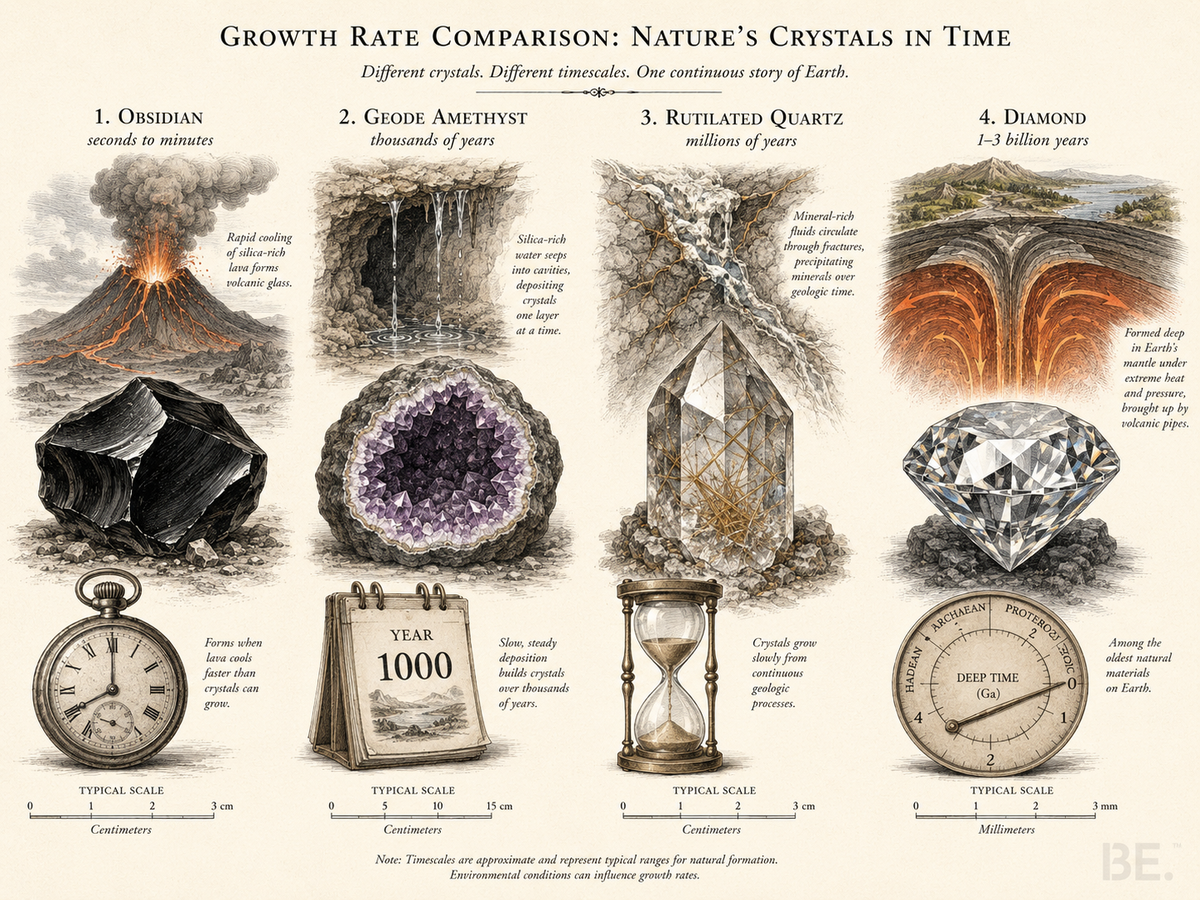
What determines how long a crystal takes
Three variables set the speed. Saturation is how concentrated the dissolved material is in the surrounding fluid. High saturation forces fast precipitation, while low saturation allows slow, ordered growth. Temperature controls how mobile atoms are: hotter fluids allow faster diffusion to the growth surface. Stability covers everything that does not change: fluid chemistry, substrate, source supply. A crystal that grows for a million years is one whose surroundings did not interrupt it for a million years.
Fast growth produces small, defect-rich crystals. Slow growth produces large, optically clear ones. Naica’s twelve-metre selenite blades exist because the cave sat within one degree Celsius of the gypsum-anhydrite phase boundary for 500,000 years. That is the slowest possible growth, in the narrowest possible window.
Formation timescales by mineral and mechanism
| Mineral / phase | Typical formation time | Mechanism |
|---|---|---|
| Diamond (mantle) | 1–3 billion years | Carbon crystallisation at 150–200 km depth, 900–1,300°C, then kimberlite-pipe transport to surface |
| Gem quartz (hydrothermal) | Millions of years | Silica precipitation from hot, mineral-saturated fluids in open fractures |
| Emerald (pegmatite / schist) | Tens of millions of years | Beryllium-chromium hydrothermal interaction during regional metamorphism |
| Opal (sedimentary) | 5–10 million years | Silica gel slowly drying and ordering within sedimentary host rock |
| Selenite (Naica giant crystals) | ~500,000 years | Gypsum precipitation in stable, hot groundwater within ~1°C of phase boundary |
| Cave aragonite / calcite | Thousands of years | CaCO3 precipitation from CO2-degassing dripwater |
| Halite (salt) crystals | Months to years | Evaporation of saline brine in playas or salt pans |
| Ice / snowflake | Seconds to minutes | Vapour-to-solid deposition in atmospheric supersaturation |
What time leaves behind in the stone
The longer a crystal grew, the more it can show you. Mantle-aged diamond carries inclusions of garnet, olivine and even other diamonds older than itself. Each one is a sealed sample of deep Earth chemistry. Hydrothermal quartz preserves phantom growth surfaces every time fluid composition shifted: chlorite phantoms in green-phantom quartz, hematite phantoms in red specimens, gas-and-liquid two-phase inclusions that record the fluid temperature at the moment they were trapped.
Fast-formed crystals preserve less but are not useless. Cave aragonite records modern climate via stable isotope ratios; halite preserves dissolved gas chemistry from the brine it grew in; even snowflakes carry a record of the atmospheric humidity profile of the half-minute that made them. A fast crystal records less detail, though it still records something.
Reading time in a crystal
- Phantom layers. Every phantom is a pause: growth stopped, foreign material settled, then growth resumed. Counting phantoms counts events.
- Two-phase inclusions. Trapped fluid bubbles within a crystal show the temperature at the moment they were trapped, sometimes accurate to within a few degrees.
- Growth zoning. Colour bands or transparent-to-cloudy transitions trace shifts in fluid chemistry over the crystal’s lifetime. Bolivian ametrine records an oxidation pulse in a single stone.
- Twinning planes. Reflective internal planes are old fracture surfaces where the lattice rebuilt itself in a mirror orientation. They show the crystal survived seismic stress without failing.
- Termination quality. Sharp, undamaged terminations mean the crystal stopped growing without interruption. Re-healed tips signal an event followed by a second growth phase.
Three time-extreme specimens worth knowing
- Naica giant selenite (Mexico). Up to 12 metres long, ~500,000 years old. Grew at 58°C in groundwater saturated with calcium sulphate, within 1°C of the gypsum-anhydrite stability boundary. Discovered in 2000 when the mine pumped out the groundwater.
- Cullinan diamond (South Africa). 3,106 carats rough, recovered 1905. Mantle-aged carbon, ~150 km depth, delivered to the surface by the Kimberley kimberlite pipe ~1.18 billion years ago.
- Bolivian ametrine (Anahí mine). Single quartz crystals zoned half amethyst, half citrine. Records an iron oxidation pulse mid-growth that cannot be reproduced by treatment.
Caring for crystals that took a long time
Slow-grown gem crystals are dense, low-defect lattices, and hard to break. The risk is cosmetic. Phantom inclusions in quartz, fluid bubbles in tourmaline, and surface etching on natural terminations can all be obscured by careless cleaning. Warm soapy water with a soft brush is safe for almost all stones; ultrasonic cleaners are not safe for inclusion-rich material. Store separately to avoid abrasion against harder species.
How BE. thinks about time in a stone
The Crystal 4T standard treats time-related features as a quality signal. Tells covers diagnostic inclusions that pin formation history; Texture covers polish over those features without removing them. The Stone Origin Record notes suspected formation environment (hydrothermal vein, pegmatite, contact metamorphic or sedimentary), so the wearer knows roughly what timescale produced what they are wearing.
The timescale is part of what a buyer is being sold, and BE. Crystal Jewellery logs it on that basis.Frequently asked questions
Q1.How long does it take a crystal to form?
Anywhere from seconds to billions of years, depending entirely on mechanism: atmospheric ice crystals form in seconds. Cave aragonite forms in thousands of years. Hydrothermal quartz takes millions. Mantle diamond takes 1–3 billion. "Slow" is not one speed.
Q2.Why does slow growth produce better crystals?
Atoms have time to occupy correct lattice sites rather than freezing into defects. Slow growth in stable conditions produces large, optically clear single crystals. Fast growth produces small, defect-rich aggregates.
Q3.What is the oldest crystal on Earth?
Zircon crystals from the Jack Hills in Western Australia have been dated to ~4.4 billion years, only ~150 million years younger than Earth itself. They are too small for jewellery use but record the earliest continental crust chemistry.
Q4.How were Naica’s giant crystals dated?
Through uranium-series dating of small calcite inclusions and modelling of the silica precipitation rate at the cave’s measured temperature. The 500,000-year figure assumes the temperature stayed within ~1°C of the gypsum stability boundary throughout.
Q5.Does a slower-grown crystal cost more?
Usually yes, because slow growth produces fewer defects and rarer specimens. Size, colour saturation and provenance also matter. A fast-grown crystal from a depleted historic deposit can outprice a slow-grown one from current production.
Q6.Can you tell formation time from looking at a stone?
You can tell formation mechanism. Mechanism implies a typical timescale. Hydrothermal phantoms imply millions of years; sedimentary banding implies tens of thousands to millions; volcanic glass implies seconds. Looking at the features tells you the order of magnitude.
References
- Mindat: Quartz mineral data
- Wikipedia: Cave of the Crystals (Naica)
- Wikipedia: Diamond formation
- Nature: Hadean zircons from Jack Hills
- Hazen, R. M. (2012). The Story of Earth. Penguin.
- Klein, C. & Dutrow, B. (2007). Manual of Mineral Science, 23rd ed. Wiley.
- BE. Our Story: the brand’s geology-first founding stance.
- BE. Crystal 4T Grading System: the four observable axes used to read a strand.
- BE. Geological Codex: material-level reference for the stones in the BE. catalogue.
Field Notes.
One stone at a time: its geology, and how to read quality. The Stone Buying Checklist comes with your first email.
By subscribing you agree to receive emails from BE. Unsubscribe anytime.
Sent. Check your inbox.