
Why BE. Avoids Crystal Claims
BE. avoids medical and metaphysical promises because crystals are material objects. The value is geological, visual, tactile and personal, not a guaranteed outcome.
In this field note
Most crystal copy is built on a single move: attach a fixed claim to a stone, and sell the object as a route to the claim. Rose quartz attracts love. Citrine brings abundance. Amethyst calms the mind. The grammar is straightforward, and the model works for many readers and many brands.
BE. has chosen a different model. The stones described on BE. pages are presented with their species, their formation, their optics, their grading record, and their Lot ID. They are not presented as carrying a defined emotional outcome, and they are not described as doing anything to the wearer once worn. This article explains why that choice has been made — what is being kept separate, what is being protected by the silence, and why the four-series structure does not undercut the position.
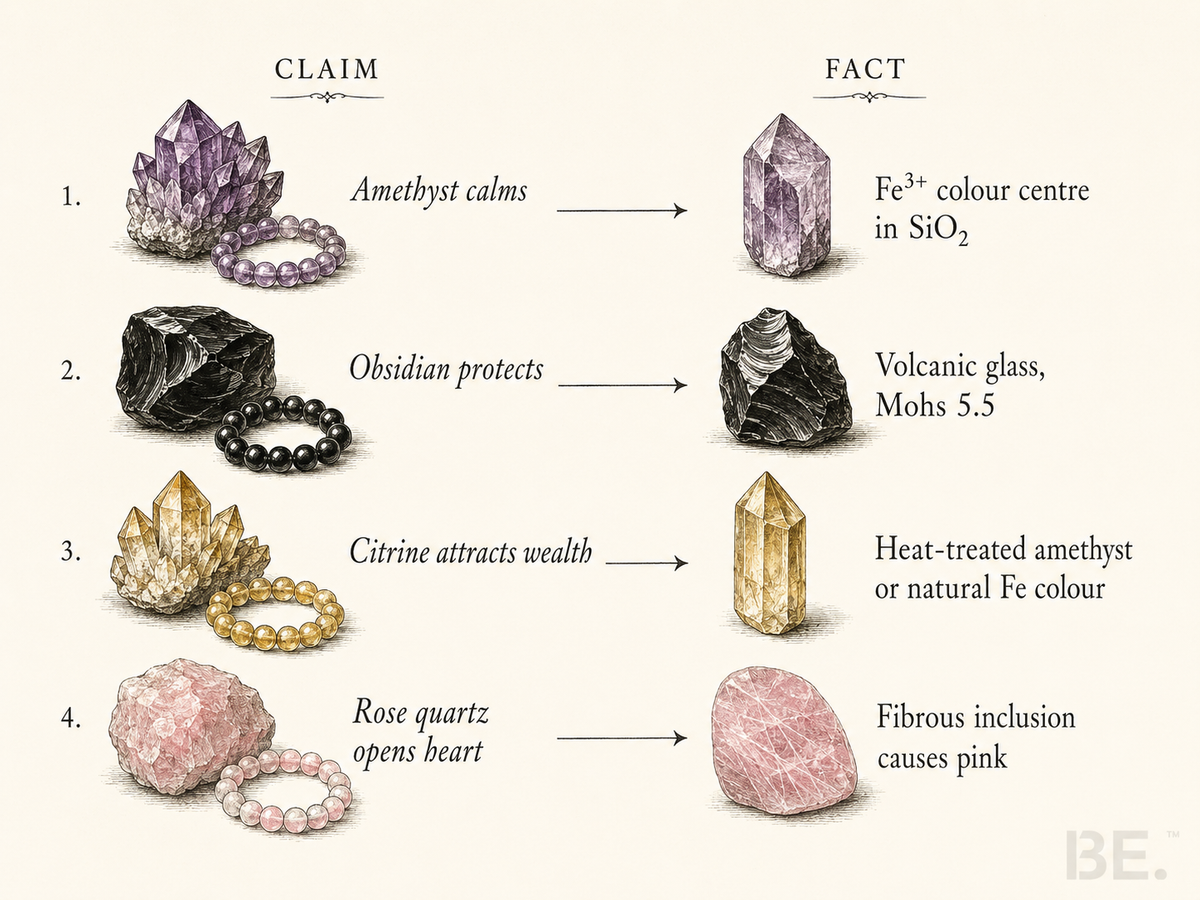
The two layers BE. keeps separate
The whole structure rests on a single distinction. There are two layers in a person’s relationship with an object, and they belong to two different owners.
- The material layer. What the object physically is — chemistry, formation, internal structure, optical behaviour, weight, finish. This layer is public and verifiable. It does not change depending on who is reading. BE. is responsible for getting it right.
- The meaning layer. What the object signifies to a particular wearer — a date, a phase, a person, a state, a memory, a hope. This layer is private and unrepeatable. It does not generalise across wearers, and it cannot be installed from the outside. The wearer is the only one who can write it.
BE. is willing to do a great deal of work on the first layer. The Geological Codex exists to document it; the 4T Grading System exists to quantify it; the Lot ID exists to trace it. On the second layer, the brand stays out of the way. Not because the second layer is unimportant — it is often the most important layer — but because it does not belong to the brand. The wearer’s meaning is not a category BE. is qualified to write copy in.
The reason the brand keeps the two separate is not a refusal to take a position. It is the recognition that the second layer cannot be honest if it is dictated. A meaning supplied by a marketing team is a meaning that does not belong to the wearer; it belongs to the marketing team. BE. would rather leave the room than write that copy.
Why “charge / cleanse / heal / manifest” is rejected language
Inside the BE. vocabulary, certain verbs are not used: charge, cleanse, activate, heal, manifest, awaken, attune. These words are common in the wider category and they are not unfamiliar to most readers. They are absent from BE. pages on principle, not on accident.
Each of these verbs makes the same kind of claim: that the stone does something to or for the wearer, in a register that cannot be measured. A stone that is said to cleanse is doing work on the wearer’s interior; a stone that is said to manifest outcomes is acting on the world on the wearer’s behalf; a stone that is said to charge is treated as a battery for a force that has no instrument to detect it. The grammar of these verbs requires that the object be more than material. It requires the object to be an agent.
BE. does not describe its stones as agents. A piece of clear quartz on a BE. page is a piece of silicon dioxide in a trigonal lattice, with measurable refractive properties and a recorded formation path. It is not a battery, not a tool, not a worker. It is a stone. Removing the agent-verbs is the simplest way to keep the material layer honest. If a word implies the stone is doing something, and the doing cannot be measured, the word does not belong on a BE. page.
This is not a stance against the readers who use those verbs in their own lives. People relate to objects in many ways, and the verbs that make sense to a private wearer are not BE.’s business. What is BE.’s business is the language the brand itself uses, in copy the brand itself signs.
The emptiness premise
Behind the two-layer model is a philosophical position that BE. holds explicitly: the object is empty.
“Empty” here does not mean worthless. It means free of fixed, intrinsic significance. A piece of stone, considered as an object in the world, does not arrive carrying a single meaning that all observers will read the same way. It carries its material facts — its chemistry, its formation, its optics — and no more. Significance is added by an observer, and different observers add different significance. The stone is the same stone in either case.
This is not a hard or unusual claim. It is how most physical objects work. A glass of water carries no fixed meaning; it can be a morning drink, a peace offering, a stage prop, or a chemistry experiment, depending on who is holding it and why. A wedding ring is metal until two people decide it is something else. A handwritten letter is paper and ink until the reader knows whose handwriting it is. The object is the stable part; the meaning is the part that moves.
BE. treats stones the same way. A strand on the wrist is what it physically is — measurable on every axis BE. cares to grade — and what it means is what its wearer privately decides it means. The wearer’s decision is not authored by BE., not corrected by BE., and not catalogued by BE. The brand has no opinion on whether a strand should remind its wearer of a person, a year, a project, a discipline, or nothing at all.
The emptiness premise is the source of the brand’s restraint. Once the brand accepts that meaning is added by the wearer, it has no remaining argument for adding meaning itself.
What people do with objects in practice
None of this prevents wearers from forming powerful relationships with their pieces. People reliably and universally attach significance to objects — a parent’s watch, a grandmother’s ring, a stone bought on the morning a hard decision was made. This is not superstition; it is how human memory works in relation to material. Objects are excellent storage media for the parts of a life that text cannot hold.
A reader who has had this experience does not need a brand to validate it. The experience is already real, already private, and already in operation regardless of what is printed on a product page. What the reader does need is for the brand not to overwrite it. A BE. page that arrived with a fixed emotional label attached to the stone would, in the most literal sense, get in the way — by placing the brand’s interpretation between the wearer and the object.
The cleanest way to leave space for the wearer’s relationship is to not write into that space at all. BE. describes the stone; the wearer describes the rest. The result is that a BE. piece can carry whatever a particular wearer needs it to carry, including nothing, without contradicting anything the brand has said.
Why four series does not violate this
A reasonable reader might ask: if BE. is committed to leaving meaning to the wearer, why does the catalogue use four named series — Anchor, Flow, Prism, Void — that sound like positions and states? Does not the act of naming a series already insert meaning?
The answer is no, and it is worth being precise about why.
The four series are a material classification. Each name describes the optical and structural behaviour of the stones in the series, measurable in laboratory conditions:
- Anchor classifies stones by opacity, density, and surface absorption of light.
- Flow classifies stones by translucency and directional optics from internal structures.
- Prism classifies stones by full transparency and refraction.
- Void classifies stones by amorphous structure, no crystal lattice, and light-blocking surfaces.
These are facts about the stones, not facts about the wearer. A clear quartz is a Prism stone because of how light passes through it, not because of who is wearing it. The classification is true before any human is in the room.
The same four names also describe four human positions — those are documented in Our Story and in BE. Four Series. The shared naming is structural: the way a stone meets light and the way a person meets the world share the same topology of input handling (absorb, redirect, transmit, reflect). The names hold the structure on both sides at once.
What BE. does not do is tell the wearer which series belongs to them. A reader is not assigned to Anchor or Flow. A reader who feels nothing about the four-position language is welcome to use the series purely as a material guide — Anchor for the opaque, dense stones; Prism for the transparent ones; and so on. A reader who recognises the four positions in their own life is welcome to read the structure both ways. Both readings are complete. The series labels the material; the meaning, if any, stays with the wearer.
This is analogous to a familiar pattern in technical product copy: a camera body can be specified by sensor size, lens mount, ISO range, and shutter speed without anyone deciding for the buyer whether the camera is for weddings or for street photography. The specifications are accurate regardless of use. The four BE. series operate on the same principle — accurate material classifications, neutral about what the wearer will do with them.
What a “claim-free” PDP looks like in practice
The position translates concretely into how a BE. product page is written. A typical PDP includes:
- Species and chemistry. The mineral name, formula, and crystal system.
- Formation path. Where this kind of stone forms in the lithosphere, over what time scales, under what conditions.
- Optical and structural notes. Transmittance, refraction behaviour, internal features visible to the naked eye.
- Series classification. Anchor, Flow, Prism, or Void, with a one-line note on why this stone sits where it sits.
- 4T grading record. The four-axis quality measurement under the BE. Crystal 4T Grading System.
- Lot ID and provenance. The batch identifier that ties the finished piece back to the raw material record.
What is absent is equally important:
- No statement about what the stone will do for the wearer.
- No statement about what the wearer should feel.
- No statement about life outcomes — wealth, love, calm, focus, sleep, abundance.
- No invocation of unmeasurable forces.
The result is a page that reads like the documentation of a graded natural object, because that is what it is. The wearer brings the rest, in whatever direction the wearer chooses. BE. does not need to know.
Frequently asked questions
Q1. Does BE. think crystal meanings are wrong?
No. BE. has not made a judgement about whether private meanings, traditions, or cultural readings of stones are right or wrong. The position is narrower: BE. as a brand does not write those meanings into its own copy, because the brand is not in a position to author them on the wearer’s behalf.
Q2. Is “the object is empty” a religious claim?
It is a philosophical position, not a religious one. It draws on several traditions that have arrived at similar conclusions about objects and significance, but BE. uses the position descriptively — as the simplest accurate account of how meaning attaches to material — without affiliating with any specific tradition.
Q3. If the brand says nothing about meaning, how does the wearer know what to feel?
The wearer already knows. People form private relationships with objects independent of any brand’s instructions, and they do this competently. BE.’s job is to make sure the object is worth the relationship — graded, traceable, well finished. The meaning side runs on its own.
Q4. Is this position compatible with selling jewellery?
Yes. The case for buying a BE. piece is the material case: a graded natural stone, finished as wearable jewellery, with a verifiable record. A reader who values material truth has a complete reason to buy. A reader who additionally builds private meaning around the piece has a second reason that BE. does not need to engineer.
Q5. Why use the series names at all if they sound emotional?
Because they are accurate material descriptions, and the alternative — sorting by species or by colour — would be less accurate. The names sound emotional because they happen to also describe human positions; that shared naming reflects a structural alignment between the two sides, not a marketing decision to add feeling to the catalogue.
Q6. What if a wearer wants the stone to do something for them?
That belongs to the wearer. BE. is not in a position to confirm or deny what a stone does inside a private relationship. The brand stops at the material record; what happens after the piece leaves the studio is the wearer’s domain.
References
- BE. — Our Story — the founder’s account of the brand’s two-layer position.
- BE. Crystal 4T Grading System — the measurable axes that replace emotional claims on every BE. page.
- BE. Geological Codex — the material reference behind every PDP and every series classification.
- A Brand That Asks Nothing of You — the position on why BE. makes no demand on the reader.
- BE. Four Series: Anchor, Flow, Prism, Void — the long-form treatment of the four series as material classifications.
Field Notes.
One stone at a time: its geology, and how to read quality. The Stone Buying Checklist comes with your first email.
By subscribing you agree to receive emails from BE. Unsubscribe anytime.
Sent. Check your inbox.