
A Brand That Asks Nothing of You
BE. is built without self-improvement pressure. The brand asks for no performance, no transformation and no proof, only a clearer relationship to material objects.
In this field note
Most jewellery brands operate on a request. The request can be loud — buy this so you transform — or quiet — buy this so you belong — but the structure is the same. The object is presented as a route out of a current state into a better one, and the reader is positioned, gently or not, as someone who needs the route.
BE. is built the other way around. The brand makes no request of its reader, and treats the reader as already complete before the page loads. There is no transformation on offer, no missing piece to install, no scarcity to resolve. The object on the page is a piece of stone, cut and finished, with a clear material history. What the reader does with it is the reader's own business.
This article is the long-form version of that position — what it means in practice, what BE. is not, and what stays in the frame once the marketing pressure is removed.
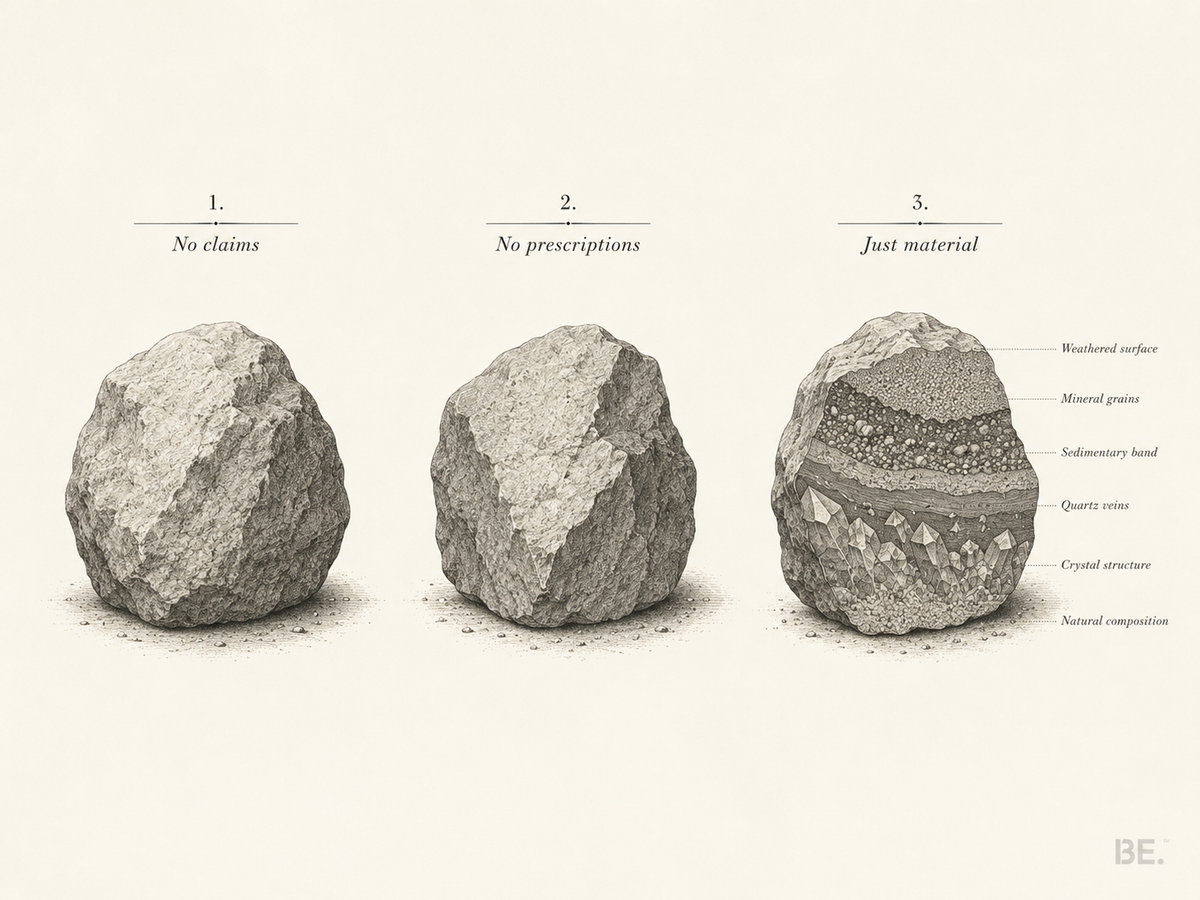
What "asks nothing" means
A brand that asks nothing is not a brand without a point of view. BE. holds a strong position about geology, about material truth, and about the difference between a stone and the language wrapped around it. The point about "asking nothing" sits one layer above that, and concerns the relationship between the brand and the reader.
Three things BE. does not do:
- It does not ask for self-improvement. No version of the reader is treated as incomplete or as needing repair. The page does not propose a "better you" once the object is purchased.
- It does not ask for belief. No claim is made that requires faith — no claim about emotional outcomes, life outcomes, or invisible forces. The reader is not asked to take anything on trust beyond the material record.
- It does not ask for performance. Wearing a BE. piece is not a signal the reader needs to project, justify, or live up to. A strand sits on the wrist as an object, not as a statement.
What is left, once those three are subtracted, is a quieter mode: the brand presents a stone with its facts, and stops talking.
What BE. is not
It helps to be specific about what the brand has chosen not to be. None of what follows is an attack on other approaches — those approaches work for their audiences, and BE. is not interested in litigating them. The point is only to mark where BE. stands by contrast.
BE. is not a talisman brand
A talisman brand sells the object as a carrier of intention or protection: wear this and a force will follow you. The model has a long cultural history and a working market. BE. does not work this way. A BE. stone is not described as carrying intention, transmitting a force, or doing anything to the wearer once worn. It is described by what it is — its species, its colour mechanism, its formation path, its grading record.
BE. is not a trend-chasing brand
A trend-chasing brand is built on the present moment: whatever silhouette, motif, or bead style is in circulation this season becomes the catalogue. The model produces quick traction and quick obsolescence. BE. is built on the opposite logic. The four collections are defined by optical and structural behaviour that does not change with the season, and the catalogue is meant to read the same way three years from now as it does today. Trend-cycle brands are doing something legitimate; it is just not what BE. is doing.
BE. is not running the scarcity-marketing playbook
The scarcity-marketing playbook works by manufacturing a sense of lack — wealth, health, love, calm, focus — and then offering an object as the route to closing it. Crystal copy is full of versions of this: this stone attracts abundance, that stone removes anxiety, this one improves sleep. The mechanism is effective and well documented. BE. has chosen not to use it. No BE. page tells the reader that they are lacking anything, and no BE. page positions a stone as the cure for a state. The reader does not need to be in deficit for the object to make sense.
What stays when the marketing is removed
If a brand stops promising outcomes, the question becomes what is left to talk about. For BE. the answer is straightforward: the object and its history.
A piece of clear quartz on a BE. product page is described by its chemistry — silicon dioxide, SiO2, trigonal crystal system. By its formation path — slow growth from silica-rich solution, often over millions of years, sometimes in pegmatitic conditions, sometimes hydrothermal. By its optical behaviour — full transparency, refractive index near 1.54, the way light passes through and exits as a clean column. By its grading — colour saturation, transparency, structural integrity, surface finish, all recorded under the BE. Crystal 4T Grading System. By its identity — a Lot ID that ties the finished piece to a documented batch, so a buyer years later can still ask which stone is this and get a real answer.
None of this requires belief. It is verifiable. A geologist looking at a BE. specification sheet sees the same thing the buyer sees. The brand is not asking the reader to accept a private language; it is using the public one.
What stays, in other words, is the part of the object that is true regardless of who is reading.
The four positions as evidence, not as identity tags
BE.'s catalogue is organised into four collections — Anchor, Flow, Prism, Void. They are sometimes mistaken for personality categories. They are not. Each name describes the physical behaviour of the stones it contains, and the human position that shares that physical behaviour. The collections are evidence of how BE. classifies material; they are not labels for the reader.
- Anchor — stones with opacity and density. Light is absorbed rather than transmitted. The material does not move when handled; the wrist feels the weight before the eye reads the colour.
- Flow — stones with translucency and directional optics. Light enters, scatters along internal structures, and exits softened. The stone reads as moving even when it is still.
- Prism — stones with full transparency and refraction. Light passes through and emerges altered. Internal features remain visible at any angle.
- Void — amorphous, glass-like forms, often volcanic. No crystal lattice in the conventional sense. Light is blocked rather than transmitted, and the surface returns the room rather than its own colour.
The reader does not need to "be" any of these to wear them. The collections describe stone behaviour first, and a human position second, and the two are deliberately kept in the same frame because they share a structure — not because one is a metaphor for the other. The longer treatment of how the mineral logic and the human logic align is in a separate article: BE. Four Series: Anchor, Flow, Prism, Void.
What a quieter object looks like in practice
Removing the marketing request changes how a product page is written, and therefore how a piece of jewellery is encountered.
On a BE. PDP, the first information is geological: species, formation type, optical behaviour. The second is structural: bead diameter, strand length, finish. The third is provenance: Lot ID, batch grading, the 4T record. Emotional framing — what wearing this should make the reader feel — is absent. The reader is trusted to do that work themselves, in whatever direction it goes.
This produces a particular kind of object relationship. A BE. piece is not a statement the wearer is making to themselves about who they are becoming. It is a piece of geology, finished and worn. If the wearer later builds private meaning around it — a date it was bought, a phase it accompanied, a person who gave it — that meaning belongs entirely to the wearer, and BE. has no claim on it.
The brand stays small in the frame on purpose. A stone outlasts a season, and outlasts a brand voice. The role of the brand, in BE.'s reading, is to source carefully, grade honestly, finish well, and then step back. The object is what continues.
"Asks nothing" is, in the end, a position about restraint. BE. has decided that the most respectful thing a jewellery brand can do for its reader is to present the material accurately, refuse to script the meaning, and leave the room. The name of the brand is the position: BE. — present, stable, unrequiring.
Frequently asked questions
Q1. If BE. doesn't promise anything, what is the reason to buy?
The reason is the object. A BE. piece is a graded, traceable stone, finished as jewellery, with a verifiable material record. The reader who values material truth, durability, and a quiet design language has a reason without needing any promise attached.
Q2. Is BE. against brands that talk about crystal meanings?
No. Those brands are doing something coherent for their audiences. BE. has simply chosen a different position — material first, meaning left to the wearer. The choice is about what BE. is, not about what other brands should be.
Q3. Does "asks nothing" mean BE. has no point of view?
BE. has a clear point of view, expressed in Our Story and the Geological Codex. The point of view concerns geology, grading, and language. It does not, however, get turned into a request directed at the reader.
Q4. Why are the four collections kept if BE. is not making personality claims?
The four collections classify stones by their optical and structural behaviour — opacity and density (Anchor), translucency and directional optics (Flow), full transparency and refraction (Prism), amorphous and light-blocking (Void). They describe the material. Whether a wearer reads themselves into any of these positions is a separate, private question.
Q5. Is "asks nothing" the same as "says nothing"?
No. BE. has a lot to say about geology, formation paths, optics, grading, and the difference between material truth and decorative language. What it does not do is convert that material into a demand on the reader.
Q6. What does the brand expect from the reader, then?
Nothing in particular. A reader can read the article, close the tab, and never return — or buy a strand and wear it for a decade. Either is a complete outcome. The page is not engineered to produce a single behaviour.
References
- BE. — Our Story — the long-form origin of the brand position, in the founder's first-person voice.
- BE. Crystal 4T Grading System — the four-axis grading framework that replaces emotional framing with measurable material criteria.
- BE. Geological Codex — the brand's mineral reference and the source of formation, optical, and structural descriptions.
- BE. Four Series: Anchor, Flow, Prism, Void — the detailed treatment of the four collections as material classifications.
- Why BE. Avoids Crystal Claims — the philosophical companion to this piece, on why metaphysical language is left out.
Field Notes.
One stone at a time: its geology, and how to read quality. The Stone Buying Checklist comes with your first email.
By subscribing you agree to receive emails from BE. Unsubscribe anytime.
Sent. Check your inbox.