
Do Crystals Affect the Human Body? An Honest Scientific Answer
An honest scientific assessment of whether crystals affect the human body — the placebo evidence, the physical-property evidence, and what we actually know.
In this field note
Crystals do not heal. They do affect the body, in ordinary ways. The controlled studies are below, and so is what wearers describe; most of it matches mechanisms that have nothing to do with mineral metaphysics.
BE. Crystal Jewellery sells these stones, which is worth knowing before you read the rest.Crystal healing has been tested. The best-known test is twenty-five years old and nothing since has overturned it.
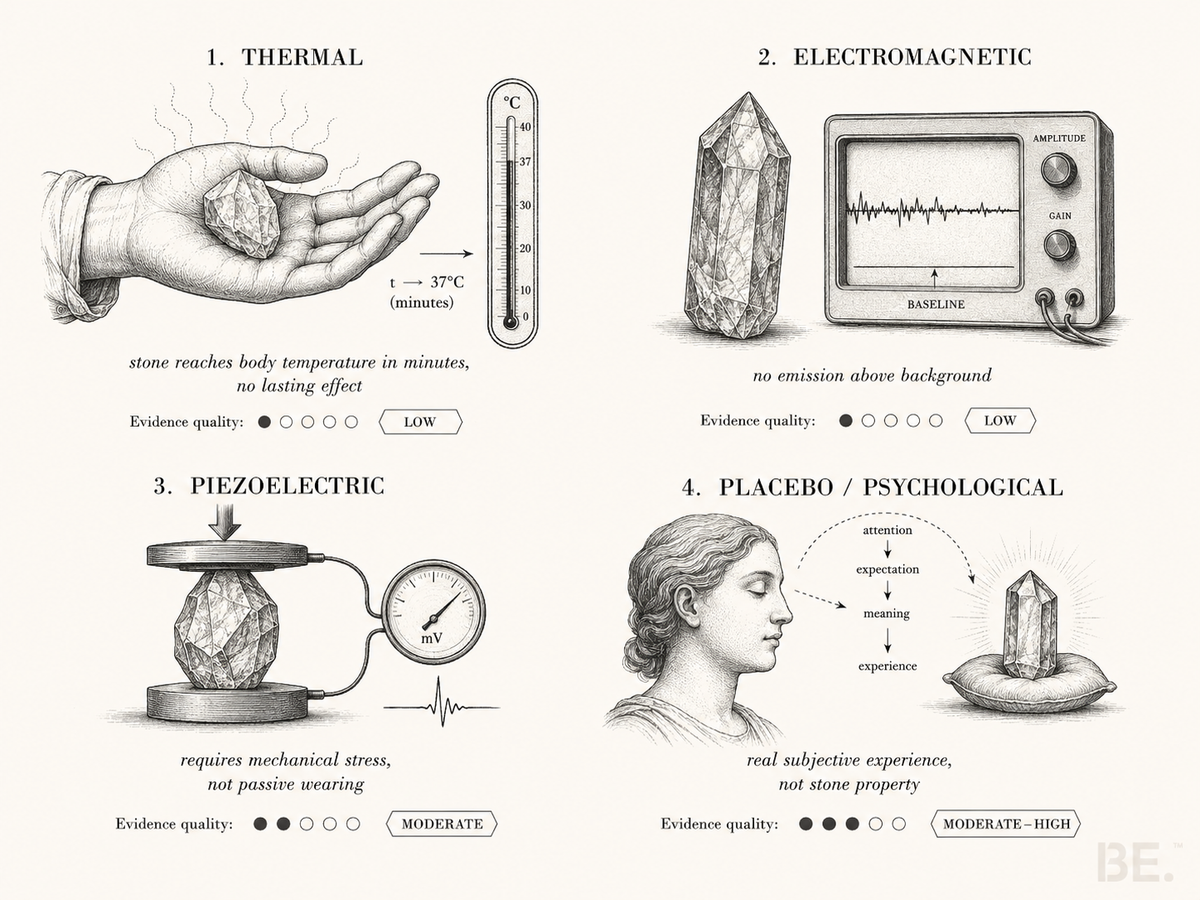
The scientific framing
The strongest direct study on this question is Christopher French and Lyn Williams' 2001 work at Goldsmiths, University of London. Eighty participants were given either real quartz crystals or plastic replicas, told to hold them and report any sensations during a guided meditation. Both groups reported the same range of warmth, tingling, calmness, and concentration shifts. The participants who believed in crystal effects reported stronger sensations regardless of whether their stone was real or plastic. Belief set the strength of the sensation.
Subsequent reviews have reached the same conclusion. There is no peer-reviewed evidence for any of the more specific claims: modulating biofields, releasing trapped vibrations, balancing chakras, drawing out illness. The proposed mechanisms are not measurable with any instrument we currently have. The reported subjective effects are real. They come from placebo and from ritual.
Claim by claim: what science finds
| Claim | Scientific evaluation | Real mechanism (if any) |
|---|---|---|
| Wearing a stone calms anxiety | Effect is real and consistent in self-report | Ritual + tactile grounding + placebo |
| A stone clears negative thoughts | Effect is real in self-report | Habit-cue + intention-setting + colour psychology |
| A stone improves sleep when worn | Mixed self-report; no controlled effect | Bedtime ritual + reduced screen time |
| A stone balances bodily systems | No measurable effect found | None physical; belief effect only |
| A stone treats illness or pain | No clinical evidence; should not replace medical care | Placebo at best; do not delay treatment |
| A stone changes the wearer's mood through colour | Plausible; colour psychology is well-documented | Visual perception of saturated hues affects mood |
| A stone gives a sense of focus or presence | Effect is real in self-report | Attention anchor on physical object |
| A stone protects against negative people | No measurable effect | Self-permission to set social limits |
The pattern is consistent. Where the claim involves a measurable biological outcome, the studies find no effect beyond placebo. Where the claim involves a subjective state, the effect is real because the mechanisms producing it are real: ritual, habit, attention, colour perception, social meaning.
What crystals do
- Physical weight on the wrist. A 12 mm stone bracelet sits at 20 to 40 grams. That weight is a constant low-level proprioceptive signal. It heals nothing. It does cue the wearer to notice the wrist through the day, which is a useful anchor for mindfulness practice and attention work.
- Tactile presence. Polished beads have a cool, smooth surface that warms slowly to body temperature. The cool-to-warm sensation requires contact, but the bracelet itself does not need to touch skin. Many people find the tactile contrast calming. Worry stones, fidget tools and prayer beads have appeared in dozens of cultures across thousands of years for the same reason.
- Colour perception. A saturated stone in the field of view does change mood, briefly, in well-documented ways. Warm colours raise arousal; cool colours lower it. The effect is small, real, and not specific to crystals. It works for any saturated colour patch.
- Ritual habit. Putting on a specific object before a meeting, a workout or a meditation creates a behavioural cue. The cue itself can shift state. This is how athletes use lucky socks; it is how religious practitioners use rosaries; it is how anyone uses any object that means something.
- Aesthetic satisfaction. Holding a beautiful mineral specimen is pleasurable. That pleasure counts: a small daily increment of positive affect, the same as wearing a well-cut shirt or drinking tea from a favourite cup.
Common myths versus facts
| Myth | Fact |
|---|---|
| Crystals emit measurable healing fields | No instrument has detected any such field. Studies controlling for belief find no effect. |
| Different stones target different organs | This is a metaphysical framework, not a biological one. No physiological pathway connects a mineral on the wrist to a specific internal organ. |
| Crystals replace medical treatment | They do not. Do not delay or replace medical care with crystal use. Placebo cannot treat infection, fracture or chronic disease. |
| The effects you feel from a crystal are imaginary | Also wrong. The subjective effects are real. Ritual, attention and aesthetics produce them. |
| Crystals work only if you believe in them | Partly true. Placebo is strongest in believers, but tactile and colour effects work on non-believers too at smaller magnitude. |
Where BE. stands
BE. exists because stones are interesting on their own terms. They are old. They formed in specific places under specific conditions. They look beautiful. They carry cultural meaning across thousands of years. None of that requires them to be medicine, transmitters of subtle fields, or organ-balancing devices. We do not describe them as such.
Our position is consistent across the catalogue: stones are real materials that carry real cultural and aesthetic weight. They are not medical treatments. The benefits people report from wearing them, a sense of calm, a moment of focus, a daily ritual, are real and worth taking seriously, because the mechanisms behind them are real. Naming those mechanisms takes nothing away from the wearer.
How BE. grades the question
BE.'s grading framework, the Crystal 4T Grading System, applies four observable axes (transparency, tone, texture and treasure) so that every strand can be read from its material.
The BE. Geological Codex provides the deeper material reference: formation path, mineral family, and typical inclusions for each stone in the catalogue. Together they replace energetic claims with a traceable material record.
Every BE. strand is described in mineralogical and geological language because that is what we can verify. The Crystal 4T measures transparency, tone, texture and treasure. Those properties are recorded and compared on every Stone Origin Record. The Stone Origin Record documents the source country and region (and the specific deposit where the upstream supplier has disclosed it), the species and the inclusions. We do not list claimed metaphysical properties because there is no way to grade them. What we can grade, we grade carefully. What we cannot, we do not pretend to.
That is the whole of what BE. Crystal Jewellery is willing to claim, and it is deliberately less than the category usually claims.Frequently asked questions
Q1.Do crystals have any measurable effect on the human body?
No measurable effect beyond placebo has been demonstrated in controlled studies. Subjective effects are real but are produced by ritual, tactile presence, colour and habit, not by properties of the mineral itself.
Q2.What did the Christopher French 2001 study find?
Participants holding real quartz crystals and participants holding plastic replicas reported identical sensations. Belief in crystal effects predicted the strength of reported sensations regardless of which object was held.
Q3.If crystals do not heal, why do people feel better wearing them?
Because ritual, tactile contact, colour perception, attention anchoring and aesthetic satisfaction are real mechanisms that produce real subjective changes. The mineral is the trigger, not the cause.
Q4.Can crystals treat anxiety or depression?
No. They should not replace medical treatment for any mental health condition. They can be a useful adjunct as a grounding object or ritual cue, in the same way as any meaningful personal object.
Q5.Is colour psychology a real effect?
Yes. The mood-shifting effects of saturated colour are well-documented in perception research. The effect is small but real, and it applies to any saturated visual surface including coloured stones.
Q6.What is BE.'s position on metaphysical claims?
We do not make them. Our descriptions stay in mineralogy, geology, cultural history and aesthetics. We believe these dimensions are more interesting than metaphysical labels and do not require any unverifiable mechanism to be meaningful.
References
- French, C. (2001). Crystal study, Goldsmiths University, reported in The Guardian
- The Skeptic's Dictionary: Crystal power
- Wikipedia: Crystal healing (research summary)
- Wikipedia: Placebo effect
- Hyman, R. (1989). The Elusive Quarry: A Scientific Appraisal of Psychical Research. Prometheus Books.
- Beyerstein, B. L. (1996). Distinguishing Science from Pseudoscience. Centre for Curriculum and Professional Development.
Field Notes.
One stone at a time: its geology, and how to read quality. The Stone Buying Checklist comes with your first email.
By subscribing you agree to receive emails from BE. Unsubscribe anytime.
Sent. Check your inbox.