
Are Crystals Radioactive? Science, Risk & Safe Stones
A science-first answer to whether crystals are radioactive — which minerals contain uranium or thorium, measured emission levels, and which stones are safe to wear.
In this field note
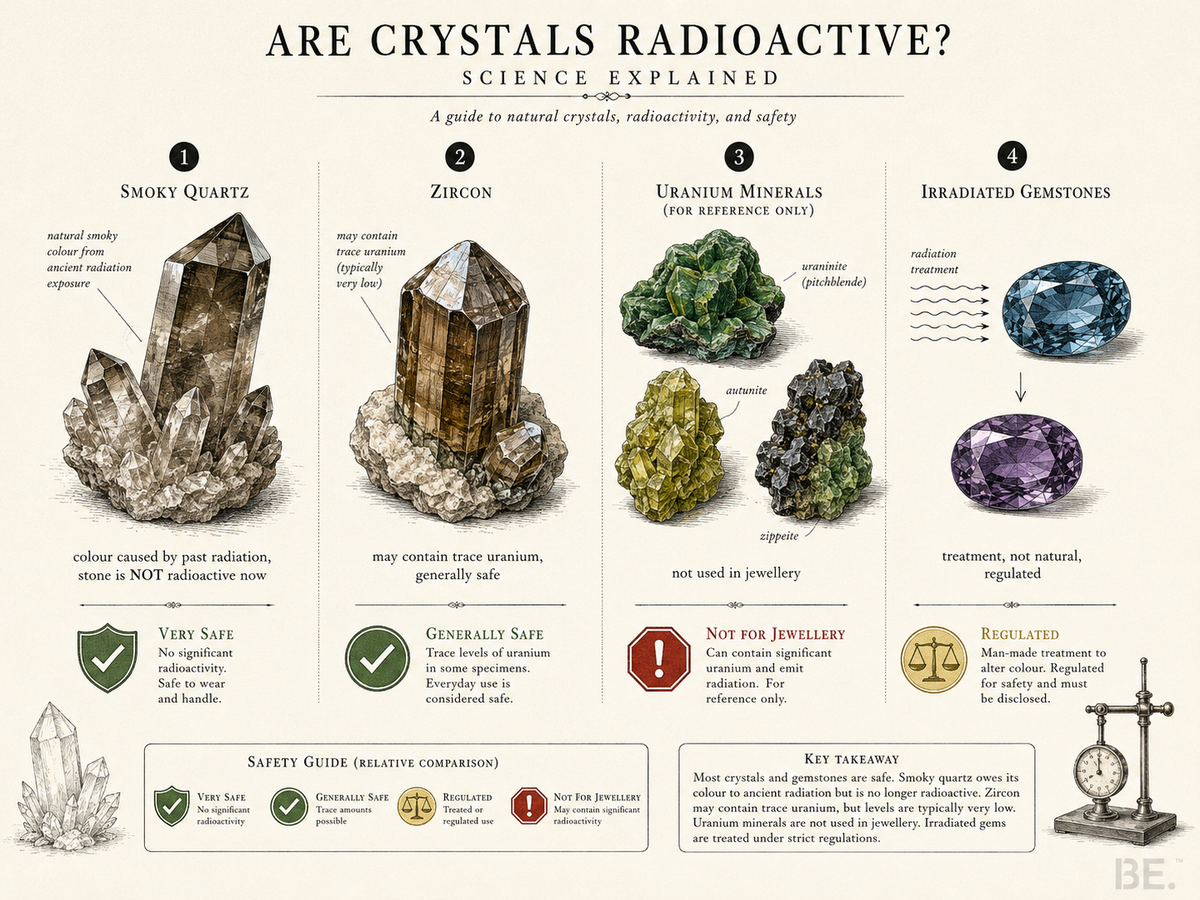
Some minerals are genuinely radioactive: their crystal lattices contain uranium or thorium, and they emit alpha, beta and gamma radiation that a Geiger counter will register from across a room. Almost none of those minerals ever end up cut and polished for jewellery, for reasons that are about both safety and material behaviour.
The scientific framing
Radioactivity is measured in becquerels per gram (Bq/g) for activity and millisieverts (mSv) for the dose absorbed by a living tissue. Average natural background radiation in a temperate country sits around 2.4 mSv per year, mostly from radon gas, cosmic rays, and the potassium-40 inside our own bodies.
Crystals become measurably radioactive only when their lattice incorporates uranium-238, thorium-232, or potassium-40 above trace level. These elements decay slowly through long chains, releasing alpha and beta particles and gamma photons. Most rock-forming minerals, including quartz, feldspar, calcite, beryl and garnet, contain so little of these isotopes that emission is indistinguishable from background.
Stones, claims and evaluation
| Stone / mineral | Radioactive? | Risk level for wear | Recommendation |
|---|---|---|---|
| Quartz, amethyst, citrine | No, at or below background | None | Safe for daily wear |
| Smoky quartz | No (product of past irradiation, not emitting) | None | Safe for daily wear |
| Garnet, jade, agate, jasper | No | None | Safe for daily wear |
| Zircon | Trace; some samples contain U/Th | Low for cut stones | Generally safe; metamict crystals emit slightly more |
| Monazite | Yes, thorium-bearing | Specimen only | Do not wear; store away from living spaces |
| Autunite | Yes, uranium phosphate | High | Specimen only; sealed display |
| Torbernite | Yes, uranium phosphate | High | Specimen only; ventilated storage |
| Uraninite (pitchblende) | Yes, primary uranium ore | High | Never wear; lead-shielded specimen storage |
| Euxenite, samarskite | Yes, rare-earth oxides with uranium and thorium | High | Specimen only |
| Vintage uranium glass | Mildly, U-doped silicate glass | Low at typical exposure | Safe to display; not for prolonged skin contact |
Common myths versus facts
| Claim | Reality |
|---|---|
| All natural crystals emit radiation | Almost none do. Common rock-forming minerals sit at or below natural background. |
| Smoky quartz is radioactive because it was irradiated | No. A colour centre records irradiation history; it is not radioactive decay. |
| Black tourmaline absorbs radiation from electronics | No physical mechanism. Tourmaline is pyroelectric and has no radiation-shielding property. |
| Lava stone and obsidian are radioactive because they come from volcanoes | No. Volcanic glass contains trace amounts of K, U and Th, but emission is at or below background. |
| Wearing crystal jewellery exposes you to harmful radiation | For all standard jewellery stones, the dose is below detectable variation in natural background. |
| Uranium glass beads are dangerous to wear | Vintage uranium glass emits low levels. Brief decorative wear is below health-significance thresholds; constant skin contact is best avoided. |
Obsidian is volcanic glass that cooled too fast to crystallise, and in jewellery it reads at background like the other everyday stones.
How to read a radioactive mineral safely
- Colour can be a tell. Bright fluorescent yellow (autunite), apple green (torbernite), and pitch-black metallic (uraninite) all flag uranium minerals. None should be cut for jewellery.
- Fluorescence under UV. Strong yellow-green fluorescence on a long-wave UV light is the autunite-torbernite signature. Uranium glass beads fluoresce the same colour for the same reason.
- Density. Uraninite specific gravity sits at 10.5, unusually heavy in the hand for its size. Monazite is around 5.2, also notable.
- Source disclosure. Reputable mineral dealers label specimens with both species and radioactivity status. If a piece is sold as uraninite, autunite, torbernite or monazite, treat the label as a warning.
- Measurement. A survey meter compares a specimen with local background. Uranium- or thorium-bearing specimens read well above it; quartz and the other everyday jewellery stones read at background.
The smoky quartz question
Smoky quartz takes its colour from defects that natural radiation left in aluminium-bearing quartz underground. The defect changes how the crystal absorbs light; it adds no radioactive material, so a smoky quartz strand gives off nothing. The Smoky Quartz colour and radiation guide goes into the colour in detail.
Marketing sometimes confuses the irradiation that formed the colour with radioactive material inside the finished stone. The radiation came from the surrounding rock; the quartz kept the colour and nothing else.
Caring for safe-stone jewellery
None of the safe stones in this guide require radiation-specific care. The general jewellery rules apply: clean with a damp microfibre, dry immediately, store separately to prevent surface scratching, and avoid ultrasonic cleaners on fracture-filled material. Vintage uranium-glass beads should be stored in a ventilated case, away from skin and food. Genuine radioactive specimen minerals should be stored separately from living spaces, in sealed displays, with documentation.
How BE. handles this question in sourcing
Every stone BE. strings is an ordinary jewellery material: quartz in its many colours, garnet, moonstone, prehnite, kyanite and obsidian among them. None of them is a uranium- or thorium-bearing mineral, and wearing them every day involves no radiation question. The Stone Origin Record for each strand names the stone and its origin country, and lists its treatment as untreated: no heat, dye, coating or artificial irradiation.
The stones in this guide are listed in the BE. collection, and every strand ships with a Stone Origin Record that states its lot and its four Crystal 4T™ readings.
Frequently asked questions
Q1.Are quartz crystals radioactive?
No. Quartz holds no meaningful uranium or thorium, and the colour in amethyst and smoky quartz comes from defects in the crystal, which carry no radioactive material. Quartz jewellery reads at natural background.
Q2.Why is smoky quartz coloured by radiation but not itself radioactive?
The radiation that created the colour came from surrounding rocks during the stone's formation. The interaction left stable colour centres in the lattice. Once the colour is formed, no emission continues.
Q3.Is zircon safe to wear?
Most cut zircon is safe. Some zircon samples contain trace uranium and thorium; older metamict specimens emit slightly above background. Modern jewellery-grade material from Sri Lanka and Cambodia tests at very low levels.
Q4.Are vintage uranium glass beads dangerous?
Uranium glass emits low-level radiation, typically 0.1 to 0.5 µSv/h at the surface. Brief decorative wear is below health-significance thresholds. Constant skin contact and ingestion (eating from uranium-glass plates) are best avoided.
Q5.What is the most radioactive mineral?
Uraninite (pitchblende) is the highest-activity natural mineral commonly encountered. Its uranium content can reach 88% by weight. It is a specimen mineral only: never cut for jewellery, and stored in shielded cabinets.
Q6.Can quartz become radioactive after exposure to uranium?
No. Radiation can change the colour of quartz without making the quartz radioactive. Uranium-bearing dust on a specimen collected beside uranium ore is a separate question for mineral collectors.
Q7.Are radioactive gems and crystals safe to wear?
No. Uranium- or thorium-bearing specimens such as uraninite, autunite, torbernite and some monazite belong in sealed display cases. Everyday jewellery stones are not in this group.
Q8.Is amethyst radioactive?
No. Amethyst is quartz. Natural radiation underground created its iron-related violet colour, and the stone holds no radioactive material; an amethyst strand reads at background.
References
- Mindat: Uraninite
- Mindat: Autunite
- Wikipedia: Smoky quartz
- Wikipedia: Background radiation
- Webster, R. (2002). Gems: Their Sources, Descriptions and Identification, 5th ed. Butterworth-Heinemann.
- Eisenbud, M. & Gesell, T. (1997). Environmental Radioactivity, 4th ed. Academic Press.
- US NRC: Backgrounder on irradiated gemstones
- US EPA: Exposure versus radioactive contamination
- IAEA: Radiation Safety for Consumer Products
- GIA: Gemstone irradiation and radioactivity
Field Notes.
One stone at a time: its geology, and how to read quality. The Stone Buying Checklist comes with your first email.
By subscribing you agree to receive emails from BE. Unsubscribe anytime.
Sent. Check your inbox.