
Crystal Bracelet Size Chart: Wrist cm → Bead Count Calculator
Enter your wrist measurement and bead diameter — get your exact bead count instantly. Includes stacking rules, how to measure without a tape, and the BE. sizing method used on every Strand.
In this field note
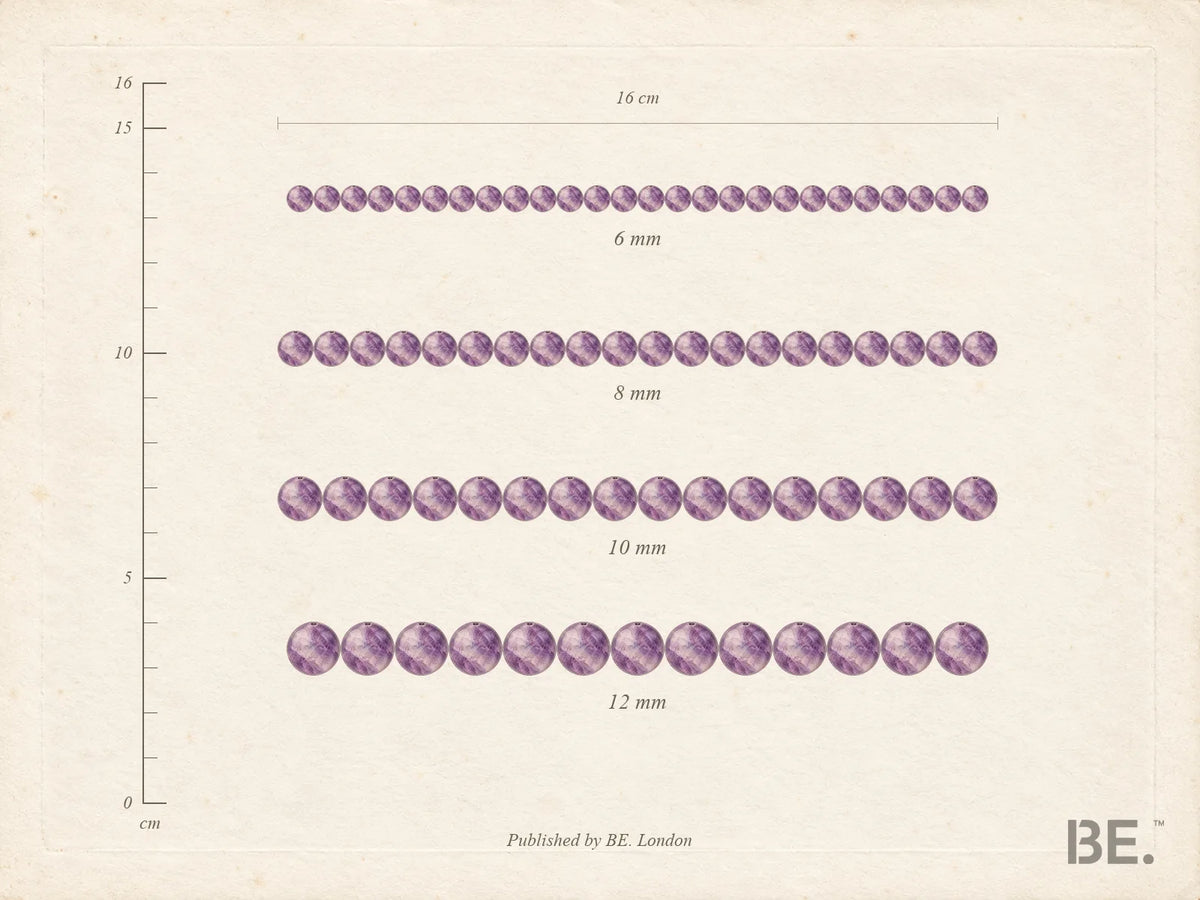
The most common question that arrives at the studio is which size?, ahead of which stone? A bead bracelet that looks correct in product photography can sit too loose, dig in, or read as the wrong scale on the wearer's wrist. The difference is almost always a few millimetres. When wrist size changes through pregnancy or postpartum, remeasure before wearing a previously fitted strand again.
How to measure your wrist (three ways)
Wrist circumference is measured at the narrowest point, just behind the wrist bone. Three methods, in order of accuracy:
- Soft tape, snug, no slack. The seamstress method. Wrap a flexible tape around the wrist, pull just snug enough that the tape touches skin all the way round, read the millimetre mark. This is the reference measurement.
- String or paper strip, then ruler. Wrap a length of cotton string or a thin paper strip around the wrist, mark where it overlaps, lay flat against a ruler. Adds about 2 mm of error from the wrap thickness.
- Existing bracelet, measured inside. If a current bracelet fits the way you want a new one to fit, lay it flat, measure inside circumference of the loop with a tape. This captures the tension you already like wearing, which a bare wrist measurement leaves out.
BE. recommends measuring twice on the dominant hand (which usually runs slightly larger) and choosing fit based on that number.
Wrist measurement and bead size: visual character
| Wrist (cm) | 6 mm | 8 mm | 10 mm | 12 mm | Stack-friendly |
|---|---|---|---|---|---|
| 13-14 | Discreet, slim | Balanced | Statement, dominates | Oversized | 6 mm + 8 mm |
| 14-15 | Delicate | Balanced, all-purpose | Statement | Reads heavy | 6 mm + 8 mm + 10 mm |
| 15-16 | Reads as accent | Balanced | Confident statement | Heritage scale | 8 mm + 10 mm |
| 16-17 | Disappears unless stacked | Discreet | Balanced | Statement | 8 mm + 10 mm + 12 mm |
| 17-18+ | Only as stack filler | Reads as accent | Balanced | Confident statement | 10 mm + 12 mm |
Bead count calculator: how many beads fit your wrist
For a finished bracelet to sit at comfortable working tension (snug, neither loose enough to spin nor tight enough to mark the skin), total bead length should equal wrist circumference plus roughly 1.5 cm for stretch and finger clearance. The formula:
Bead count = (wrist cm + 1.5) / bead diameter cm. Round to the nearest whole bead.
| Wrist | Target length | 6 mm count | 8 mm count | 10 mm count | 12 mm count |
|---|---|---|---|---|---|
| 13 cm | 14.5 cm | 24 | 18 | 14-15 | 12 |
| 14 cm | 15.5 cm | 26 | 19-20 | 15-16 | 13 |
| 15 cm | 16.5 cm | 27-28 | 21 | 16-17 | 14 |
| 16 cm | 17.5 cm | 29 | 22 | 17-18 | 14-15 |
| 17 cm | 18.5 cm | 31 | 23 | 18-19 | 15-16 |
| 18 cm | 19.5 cm | 32-33 | 24-25 | 19-20 | 16 |
How each bead size reads on the wrist
6 mm: discreet. Sits close to the skin, low visual mass, often disappears under a sleeve. Reads as quiet accent. Works as a stacking layer or for wearers who want the stone present but not visually loud.
8 mm: balanced. The all-purpose default. Visible without dominating, comfortable for daily wear, photographs well at arm-distance. Most BE. Strands are built at 8 mm because the size accommodates the widest range of wrists and the widest range of dress codes.
10 mm: statement. Reads from across a room. Adds visible weight on the wrist, slows the line of the arm. Suits larger wrists, or anyone wearing a single confident piece on its own.
12 mm: dominates. Heritage scale, often used for collector-grade stones where each bead is a finished object. Less suitable for stacking; on wrists under 16 cm the bead can read oversized.
Stacking: the maths of two or three strands together
Stacking changes the equation. Each added bracelet adds a small amount of tension and consumes wrist real estate. Three rules of thumb:
- Vary the bead size. Two strands at the same diameter compete; one larger and one smaller establish hierarchy.
- Total stack mass should match wrist scale. A 14 cm wrist can carry two 8 mm or one 8 mm and one 6 mm. Three 10 mm strands on a 14 cm wrist overload the line of the arm.
- Each strand should sit at its own tension. Pairing a snug strand with a loose one looks accidental.
For BE. Strands, the working stack pattern is one statement strand plus one accent, sized so both sit at comfortable tension and the contrast in bead size is visible without being abrupt.
How BE. sizes Strands
BE. Strands are offered in two standard inner lengths, 6.5 inch (16.5 cm) and 7.5 inch (19 cm), measured as the inside circumference of the closed loop. These two lengths cover the bulk of adult wrist circumferences (roughly 14-18 cm) at working tension. Bead diameter (8 mm, 10 mm, or specific to the stone) is set per piece based on what reads correctly with that material. Bolivian amethyst at 10 mm sits differently from rutilated quartz at 8 mm because the stone's optical character is different at different scales.
For specific wrist measurements between sizes, or for stacking, see the full size guide.
A complete sizing walkthrough with photos and the full BE. fit philosophy lives on the Find Your Size page.
Frequently asked questions
Q1.What is the most common wrist size for a crystal bracelet?
For women the global median sits around 14.5-15.5 cm; for men around 16.5-17.5 cm. Most off-the-shelf crystal bracelets are built at roughly 18-19 cm inside circumference because that length works at comfortable tension on the median female wrist with 8 mm beads and on a slightly larger male wrist with 10 mm beads.
Q2.How do I know if my bracelet is too tight or too loose?
Too tight: the cord shows visible strain between beads when the wrist is held still; the bracelet marks the skin after an hour. Too loose: the bracelet rotates a full turn unaided, or slides over the wrist bone when the hand drops. Correct fit sits at the wrist, can be rotated by hand without resistance, and does not slide off the wrist bone.
Q3.Should I size up if I plan to stack?
No. Each strand should still sit at its own correct tension. Sizing up causes the lower strand to slide and the stack to misalign. Stack by varying bead diameter and keep each fit as it is.
Q4.Do 6 mm and 8 mm beads need different bracelet lengths for the same wrist?
The finished inside circumference can be similar; the bead count differs to fill it. A 15 cm wrist needs roughly 16.5 cm finished length whether the beads are 6 mm (27-28 beads) or 8 mm (21 beads). What changes is the visual character and the comfortable working tension band. The total length stays about the same.
Q5.What if my wrist size sits exactly between two BE. lengths?
Between 6.5 inch (16.5 cm) and 7.5 inch (19 cm), choose by intended wear. For everyday wear where the bracelet will move with the wrist, choose the smaller size for a snug fit. For layering with a watch or another strand, choose the larger size so the strands sit comfortably side by side without bunching.
Q6.How does bead diameter affect how the stone reads visually?
Each stone has a bead size at which its optical character shows best. Translucent stones (rutilated quartz, amethyst with light tone) gain depth at 10 mm and above because more light passes through the sphere. Dense, opaque stones (garnet, hematoid) often read better at 6-8 mm because the smaller bead concentrates the colour saturation. BE. sets bead size per stone for this reason.
Sizing is check 10 of 10 in the BE. Stone Buying Checklist.
References
- BE. Crystal 4T grading system
- BE. Geological Codex
- BE. Find Your Size
- Wikipedia: Bracelet construction and sizing
- Untracht, O. (1982). Jewellery: Concepts and Technology. Doubleday.
Field Notes.
One stone at a time: its geology, and how to read quality. The Stone Buying Checklist comes with your first email.
By subscribing you agree to receive emails from BE. Unsubscribe anytime.
Sent. Check your inbox.