
Why Some Crystal Bracelets Cost EUR 50 and Others EUR 500: A Breakdown
Crystal bracelet pricing reflects six material variables: raw rough, cutting yield, polish, sorting, origin documentation, and brand model.
In this field note
A common question — and a fair one — is why two crystal bracelets that look superficially similar can sit a full order of magnitude apart on price. EUR 50 and EUR 500 strands occupy the same shop window, the same category page, sometimes the same Instagram grid. The bead diameter is the same. The stone species is the same. The visible difference, at first glance, is small.
The visible difference is not where the price is. This guide breaks down the six material variables that drive crystal bracelet pricing, with conservative wholesale numbers for 2026, and explains what a buyer actually gets at each tier.
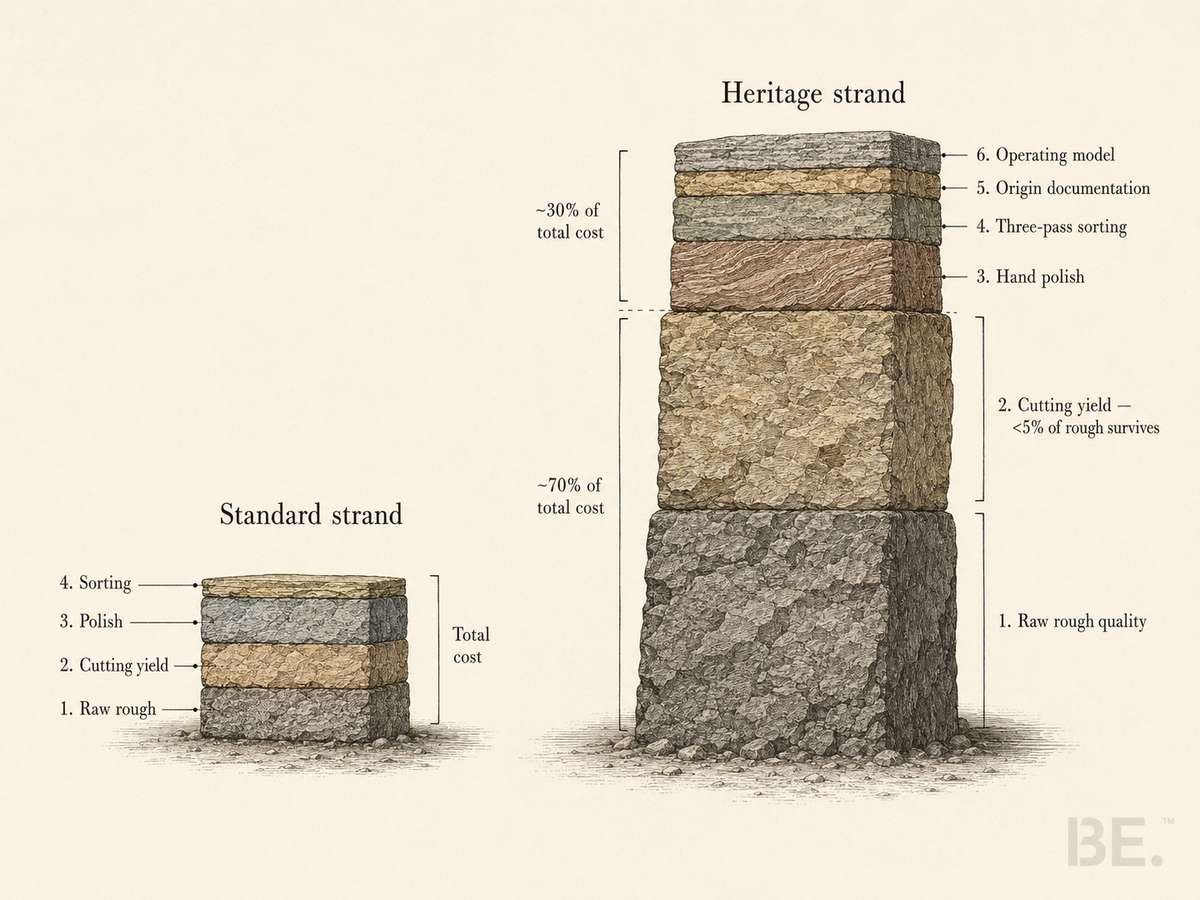
Why are crystal beads so expensive?
Crystal beads become expensive when high-rejection rough, low cutting yield, precise finishing, repeated hand sorting and documented material identity compound in one strand.
At €200–500, compare what can be seen or verified: exact mineral identity, bead diameter, polish and drill finish, bead-to-bead matching, construction, and whatever origin detail is actually recorded. Choose the lowest-priced strand that clears those checks; pay more only when the additional matching, material character or documentation is visible in the object or supplied with it.
The six variables
Crystal bracelet cost stacks from raw material to finished strand through six independent multipliers. Each variable can roughly double the per-strand cost without changing the bead shape:
- Raw rough cost per kilogram. The wholesale price of the uncut stone, sorted by colour grade.
- Cutting yield. The percentage of raw rough that survives cutting and shaping into premium-bead stock with no cracks, no surface flaws, and even geometry.
- Polish precision. Whether beads are tumbled at speed, machine-polished to standard tolerance, or hand-finished bead by bead.
- Sorting passes. How many separate hand-sort passes the beads go through before being strung — colour-match, inclusion-match, geometry-match.
- Origin documentation. Whether the stone's country and region of origin is recorded and disclosed, and whether the supply chain back to that region can be re-traced.
- Brand operating model. Whether the brand operates vertically (cutter direct to consumer, single margin) or through distributors (multiple margin layers between cutter and shop).
Variable 1 — raw rough cost
Conservative 2026 wholesale ranges for clean rough, sorted by visible quality, FOB origin:
| Stone | Commercial rough (USD/kg) | Clean rough (USD/kg) | Premium / collector (USD/kg) |
|---|---|---|---|
| Clear quartz | 2-8 | 15-60 | 120-400+ |
| Amethyst (Bolivia) | 8-30 | 60-180 | 300-1,200+ |
| Rose quartz (Mozambique) | 5-20 | 40-120 | 200-800+ |
| Citrine (natural) | 30-90 | 150-400 | 600-2,000+ |
| Rutilated quartz (Brazil) | 40-120 | 200-600 | 800-3,500+ |
| Garnet (almandine) | 15-50 | 80-200 | 300-900+ |
| Hematoid quartz | 20-60 | 100-280 | 400-1,200+ |
Ranges are estimates from open trade reports; specific lots vary by season, mine activity, and political stability in the source region. The point is that the multiplier between commercial and collector rough is typically 50x to 100x.
Variable 2 — cutting yield
Rough does not convert one-to-one into premium beads. A typical yield breakdown:
- Commercial bead stock yield. Roughly 30-40% of clean rough becomes any bead. The rest is dust, scrap, off-cuts, and rejected pieces.
- Premium bead stock yield. Roughly 5-20% of clean rough becomes premium beads — well-formed spheres, even colour, no surface flaw, matched diameter tolerance.
- Heritage / collector stock yield. Often under 5% — beads with optical character that survives the bead shape.
A low-tier strand can be built on 30-40% yield material. A Heritage strand is built on 5% yield material, which means the per-finished-bead raw cost is 6-8x higher before any other factor is added.
Variable 3 — polish precision
Three broad finishing tiers:
- Tumble-polish. Beads tumbled in a barrel with grit and water. Fast, cheap, uneven. Polish reads as a soft sheen rather than a mirror.
- Machine polish to standard tolerance. Beads finished on automated polishing rigs to a published diameter tolerance (often plus or minus 0.1 mm). Polish reads mirror, geometry is round.
- Hand finishing. Each bead held against the wheel by a finisher. Used for collector material or stones where the inclusion geometry requires the bead to be oriented before polishing.
The cost difference between tumble and machine polish is small. The cost difference between machine and hand finishing is large — hand finishing adds roughly 4-10x the labour cost per bead.
Variable 4 — sorting passes
After polishing, beads sit in bulk lots. A finished strand requires hand-sorting:
- One pass — colour match. Beads sorted by overall colour into broad bands. The bead diameter is checked against tolerance.
- Two passes — colour and inclusion. Within a colour band, beads are sub-sorted by inclusion character so the strand reads as one stone, not eighteen variants.
- Three or more passes — colour, inclusion, geometry. The strand is sorted again for sphere quality and bead-to-bead transition before final stringing.
Each sort pass is a labour multiplier. A low-tier strand typically gets one. A Heritage strand typically gets three.
Variable 5 — origin documentation
Origin documentation has two layers:
- Country and region disclosure. The brand records and publishes where the rough came from, at minimum country and region. This adds modest cost — supplier paperwork, internal record-keeping.
- Specific deposit disclosure. The brand records a specific deposit when the upstream supplier discloses it. Not always possible; many deposits move material through aggregators where deposit-level traceability is lost upstream of the brand.
BE. records country and region on each strand; specific deposit only when the upstream supplier discloses it.
Variable 6 — brand operating model
Two broad models, each with a defensible logic:
- Distributor model. Stone moves cutter to exporter to importer to wholesaler to retail brand. Each layer takes a margin. The final shop carries inventory risk and customer-facing cost. Common, sustainable, and produces predictable supply.
- Vertical model. Brand works directly with the cutter (or operates a cutting partner). Fewer margin layers, but the brand carries inventory risk earlier, finances the cutting bench, and absorbs season-to-season material variation directly.
Neither model is inherently better. The vertical model usually shows a wider gap between like-for-like material and retail price (because fewer hands took a cut). The distributor model usually shows broader stone variety per shop (because the distributor aggregates across cutters).
What is included at each price tier
| Price tier | Stone | Polish | Sorting | Origin | Brand model |
|---|---|---|---|---|---|
| EUR 20-50 | Commercial rough, 30-40% yield | Tumble or basic machine | 1 pass | Not disclosed | Distributor, 3-4 layers |
| EUR 60-150 | Clean rough, 20-30% yield | Machine, plus/minus 0.2 mm | 1-2 passes | Country if asked | Distributor, 2-3 layers |
| EUR 180-350 | Premium rough, 10-15% yield | Machine, plus/minus 0.1 mm | 2 passes | Country + region | Mixed; sometimes vertical |
| EUR 400-700 | Premium rough, 5-10% yield | Machine + selective hand finish | 2-3 passes | Country + region; specific deposit when disclosed | Vertical or near-vertical |
| EUR 800+ | Heritage / collector rough, <5% yield | Hand finishing | 3+ passes | Region + deposit when disclosed | Vertical, single-margin |
Before you pay more
- Ask for the material name in full. Species and variety, natural or synthetic, in place of the word “crystal”.
- Ask what was done to it. Heat, dye, irradiation, coating, stabilisation.
- Ask what the grade means. An internal letter with no published method is a label, and no measurement stands behind it.
- Look at bead matching under one light in the listing photographs. Uneven tone across a strand is the fastest read on selection cost.
- Check the return window before the price. A usable return policy is worth more than a grade letter.
Where BE. sits
BE. Strands start around EUR 300 and run higher for Signature and Heritage tiers. The model is vertical (working directly with cutting partners), origin is recorded at country and region (with specific deposit recorded when the supplier discloses it), polish is machine-finished to plus/minus 0.1 mm with hand finishing on heritage pieces, and sorting is two or three passes depending on tier. The 4T framework decides which tier each finished strand sits in.
Frequently asked questions
Q1.Why does the same stone vary 10x in price across shops?
Six independent variables compound: raw rough quality, cutting yield, polish precision, sorting passes, origin documentation, and brand operating model. Each can roughly double the per-strand cost. A 10x spread between similar-looking strands typically reflects two or three of these variables stacked, not pure markup.
Q2.Is a EUR 500 bracelet actually 10x better than a EUR 50 one?
A EUR 500 bracelet is not automatically ten times better than a EUR 50 one. Its advantage may be visible in Transparency, Tone, Texture and Treasure, while its basic function is the same. The higher price pays for inputs that drive visible quality, not an abstract premium.
Q3.Can I get a high-tier stone in a low-tier strand?
Occasionally, if the rough lot happened to include a few high-tier beads that did not get sorted into a higher-tier strand. This is rare in a well-sorted shop because sorting passes catch most of these. In a one-pass shop, single high-tier beads sometimes appear in a commercial strand.
Q4.Why is rutilated quartz more expensive than clear quartz?
Rough cost (rutile-bearing material is rarer per kilo), cutting yield (cutting to preserve needle visibility is harder), and Treasure value (needle character is part of why people buy the stone). All three drive cost above plain clear quartz.
Q5.Are entry-price strands always low quality?
Not necessarily. They are typically built from commercial-tier rough with one sorting pass, tumble polish, and no origin disclosure. That can be a fair value for clean daily-wear pieces. The entry-price strand is not deceiving anyone — it just sits at a different point on the input ladder.
Q6.How can I tell what tier a strand actually is?
Look at the inputs the brand publishes: stone origin, yield language, polish description, sort process. Then check the four observable axes — Transparency, Tone, Texture, Treasure — yourself against the price. A higher-priced strand without clean inputs and weak on two of the four axes is overpriced. An entry-tier strand strong on all four is rare but possible.
References
- Mindat — Quartz mineral data
- GIA Gems & Gemology — Trade reports
- Wikipedia — Gemstone value factors
- BE. — Crystal 4T grading system
- BE. — Geological Codex
- Webster, R. (2002). Gems: Their Sources, Descriptions and Identification, 5th ed. Butterworth-Heinemann.
- Schumann, W. (2009). Gemstones of the World, 4th ed. Sterling.
Field Notes.
One stone at a time: its geology, and how to read quality. The Stone Buying Checklist comes with your first email.
By subscribing you agree to receive emails from BE. Unsubscribe anytime.
Sent. Check your inbox.