
Why Is Amethyst Associated With Calm? A Material & Cultural Reading
Amethyst's calm association traces to violet colour psychology, Roman and ecclesiastical heritage, and modern wellness aesthetics. Not mineral chemistry.
In this field note
Walk into any wellness shop and amethyst sits in the same display zone as eye masks and beeswax candles. Walk into a Renaissance painting and amethyst sits on a bishop's ring. Walk into a Greek symposium and amethyst is buried in a wine cup as a charm against drunkenness. The association with composure is old. What is interesting is that none of it comes from anything the stone is doing chemically.
This is a reading of how a particular violet quartz became a cultural shorthand for calm — through colour psychology, through Roman and ecclesiastical use, and through modern wellness aesthetics — and what that reading means for the stone in a contemporary jewellery box. The mineralogy is the starting point but not the explanation.
What amethyst is, mineralogically
Amethyst is macrocrystalline quartz (SiO2) coloured violet by trace iron (Fe3+ or Fe4+) in defect sites in the lattice, activated by background ionising radiation over geological time. It is Mohs 7, water-stable, with no special thermal or electrical signature in the visible-light or radio range. There is no published peer-reviewed mechanism by which contact with amethyst produces a measurable physiological response in the human nervous system. Whatever the stone does for the wearer, it does through some path other than chemistry on the body.
So the question shifts. Not what does amethyst do? but why has this particular violet, of all the violet things in the world, been read as calm for two and a half millennia?
Violet — the colour psychology angle
Violet sits at the cool end of the visible spectrum, just below ultraviolet, at the highest-frequency end of what the human eye sees. In published colour psychology literature (Frank Mahnke, Faber Birren, and others), cool colours — blue, violet, green — are repeatedly associated with self-reported lower arousal, slower respiration, and reduced reported stress in controlled studio settings. These findings are statistical and depend heavily on context (lighting, saturation, surrounding colour), but the broad pattern is consistent across studies.
Within violet, deeper, lower-saturation tones (the muted purples used in Renaissance ecclesiastical dress) read as restrained; brighter, higher-saturation violets read as ceremonial. Amethyst as worn most often — Signature-tier Bolivian violet — sits in the deep, low-saturation register. It is, on the colour psychology axis alone, the side of violet associated with restraint.
Roman and ecclesiastical heritage
| Era | Use of amethyst | Association |
|---|---|---|
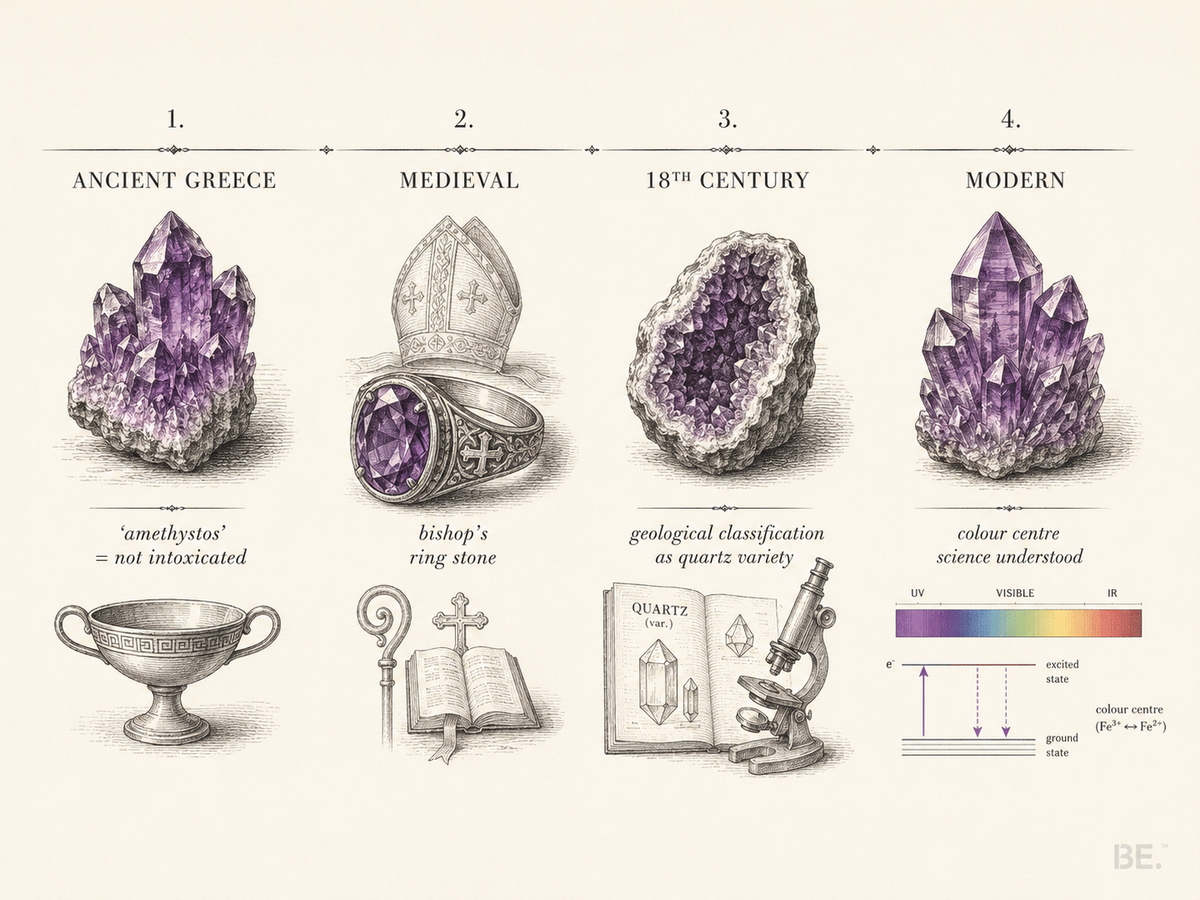
| Ancient Greek (5th-4th c. BCE) | Name interpreted as “not intoxicated”; later lore linked the stone with sobriety | "Amethystos" — not drunk; protection against intoxication |
| Roman Imperial | Set in signet rings; favoured in elite jewellery | Sobriety, clear judgement, status |
| Medieval / ecclesiastical (5th-15th c.) | Bishop's rings; cathedral inlay; monastic devotion stones | Spiritual restraint; humility before God; monastic discipline |
| Renaissance and Early Modern | Royal and ducal jewellery; pectoral crosses | Sovereign self-mastery; piety; sober wealth |
| Modern (1960s onward) | Wellness retail; meditation spaces; sleep aesthetics | Calm; relaxation; bedtime; introspection |
The Greek etymology is the seed. The Roman elite adopted the stone as a marker of clear-headed status (a senator who could afford amethyst and chose not to be drunk). The medieval church inherited it as a stone of monastic reserve — bishops wore it because purple was reserved for high office and amethyst's violet was the precise high-office violet. By the Renaissance, the stone carried four overlapping meanings: anti-intoxication, sobriety, ecclesiastical authority, and royal restraint. All four point in the same broad direction — composure, not excitement.
Why violet became the calm colour of bedrooms
Modern wellness culture inherited the heritage without the church. The mid-20th-century human-potential movement and the late-20th-century commercial wellness industry adopted soft violets, muted purples, and amethyst-toned palettes for meditation rooms, yoga studios, and sleep aesthetics. The reasoning was a layering of colour psychology (cool tones read as calm) plus the cultural memory of amethyst as a contemplative stone (inherited from ecclesiastical and royal use) plus marketing — soft violet photographs well in low-light bedroom and spa contexts.
None of this required amethyst to be doing anything chemically. The colour did the work. The cultural memory did the work. The marketing finished the job. By the 2010s, "amethyst" in mainstream wellness retail was indistinguishable from a tone — a violet that signals "wind down" the way muted green signals "garden" and warm beige signals "spa". The mineral and the tone had partly fused in popular usage.
What this means for buying amethyst
If amethyst's calm association is cultural rather than chemical, what should that change about how the stone is bought and worn?
- Choose the tone that reads to you, not the one promised to others. A wearer who experiences deep Bolivian violet as composed and pale Brazilian lavender as light has accurate self-perception. Both are amethyst; the colour psychology operates on the wearer's reading, not the mineral's chemistry.
- Match the tone to the context of wearing. Deep violet reads as evening, contemplative, sovereign. Pale lavender reads as daytime, light, social. Both are correct for amethyst; they belong in different parts of the wardrobe.
- Treat the cultural association as one input among several. Amethyst has 2,500 years of being read as a composed stone. That history is part of what you wear when you put it on. It is not, however, a substitute for the stone doing something measurable. Both can be true at once.
What the mineral does not do
Amethyst does not measurably lower the wearer's pulse, alter brain rhythms detectable on EEG, balance any biological system, or interact with the nervous system through any known mechanism. Studies that have looked for such effects under controlled conditions have not found them. The cultural association is real; the chemical claim is not.
This is not a deficiency of the stone. It is the correct frame for understanding it. Amethyst is one of the most beautiful violet objects the planet produces. Its history of being read as composed is a real part of how it is worn. The job of a stone is not to do work on the body — the job of a stone is to be a stone, and to carry whatever meaning the wearer decides to bring to it.
Frequently asked questions
Q1.Does amethyst actually help with calm or sleep?
No reliable evidence shows that amethyst contact directly improves calm or sleep. The association is cultural and personal, shaped by colour, history, design and expectation. A wearer can still value those meanings, but they should not be presented as a chemical or medical effect of the mineral.
Q2.Why is purple specifically associated with calm?
Violet is often used to signal quiet, ritual or luxury, but responses vary with saturation, brightness, lighting, surrounding colours, culture and context. Deep violet may read as restrained in one design and ceremonial in another. Amethyst's link with calm is therefore a recurring interpretation, not a universal physiological rule.
Q3.Where does the name "amethyst" come from?
The name comes through Greek amethystos, commonly interpreted as “not intoxicated”. Later lore linked the stone with resisting drunkenness and helped shape subsequent sobriety associations. The etymology and repeated tradition, however, do not prove that Greek goldsmiths routinely made amethyst wine cups.
Q4.Why did bishops wear amethyst?
Amethyst appears in episcopal rings and other ecclesiastical jewellery, where violet could carry associations of office, devotion, restraint or authority. The meaning varied by period, institution and object, so the stone should not be reduced to one universal rule about why every bishop wore it.
Q5.Is wellness amethyst the same stone as historical amethyst?
Mineralogically identical — violet quartz coloured by trace iron in defect sites. The difference is cultural framing. Historical amethyst was framed as sobriety, sovereignty, and ecclesiastical reserve. Modern wellness amethyst is framed as relaxation, sleep, and meditation. Same mineral, different meanings attached.
Q6.Should I buy amethyst even if it doesn't chemically affect the body?
The mineralogy and the meaning are separate questions. Amethyst is one of the most beautiful violet stones the planet produces, with 2,500 years of being read as a stone of composure. Both are reasons to wear it. The stone does not need a chemical mechanism to be worth owning.
References
- Mindat — Amethyst variety of quartz
- GIA — Amethyst gem encyclopedia
- Wikipedia — Amethyst (history and etymology)
- BE. — Crystal 4T grading system
- BE. — Geological Codex
- BE. — Our Story
- Mahnke, F. (1996). Color, Environment, and Human Response. Wiley.
- Birren, F. (1978). Color and Human Response. Wiley.
- Webster, R. (2002). Gems: Their Sources, Descriptions and Identification, 5th ed. Butterworth-Heinemann.
Field Notes.
One stone at a time: its geology, and how to read quality. The Stone Buying Checklist comes with your first email.
By subscribing you agree to receive emails from BE. Unsubscribe anytime.
Sent. Check your inbox.