
Black Rutilated Quartz: Inclusions, Origins & How to Read a Strand
Black rutilated quartz explained — tourmaline vs rutile needles, origin fingerprints, 5-point strand reading guide, and trade-name decoder.
In this field note
Hold a black rutilated quartz bead up to a lamp and tilt it slowly. Those dark filaments running through the interior look, at first glance, like cracks. New buyers sometimes worry that the stone is damaged, fractured in transit or poorly cut. Look closer. The lines are too precise, too deliberately oriented, too consistently dark to be fractures. They are individual mineral crystals, fully formed, locked inside the quartz lattice millions of years before anyone polished the stone into a bead. Those filaments are what BE. Crystal Jewellery grades when it reads this material.
Once you know what those needles are and how to read their quality, you evaluate a strand differently. The sections below cover the mineralogy, the origin localities, the trade-name confusion and the grading criteria that matter when you are choosing rutilated quartz jewellery.
This page stays on the material: what the needles are, where they form, and how to judge them in a finished strand. If you have already settled on rutilated quartz and are deciding between the dark and the golden needle type, black vs golden rutilated quartz handles that choice.
What Black Rutilated Quartz Is
The host mineral is always quartz: silicon dioxide (SiO₂), trigonal crystal system, Mohs hardness 7. What makes a specimen "black rutilated" is its inclusion suite: dark, elongated crystals trapped inside the quartz matrix.
In strands labelled black rutilated quartz, two minerals are the main candidates for the dark needles:
- Schorl tourmaline. NaFe²⁺₃Al₆(BO₃)₃Si₆O₁₈(OH)₄. A common black tourmaline species; in confirmed specimens it can appear as dark prismatic inclusions.
- Iron-rich rutile. TiO₂ with Fe substitution. Needles are typically thinner, straighter, and may show a faint sub-metallic lustre under direct light.
Dark inclusions may pre-date, overlap with or be enclosed during later quartz growth, depending on the specimen. A polished bead usually does not reveal the complete sequence or formation temperature. Use direct observations first and reserve timing language for material with supporting petrographic or analytical evidence.
The quartz host preserves the inclusions from ordinary surface wear, while their shape, density and orientation remain useful descriptive features.
For comparison, consider blue needle quartz (dumortierite quartz), where the included mineral is dumortierite, an aluminium borosilicate. The growth mechanism is similar (protogenetic inclusion in a hydrothermal environment), but the included mineral's chemistry makes the needles blue.
Why the Needles Look Different: Tourmaline vs Rutile
The trade term "black rutilated quartz" is applied loosely. Needle shape, thickness and lustre can help screen possibilities, but these features overlap and are not conclusive. For the testing boundary, use the black rutile vs tourmalinated quartz comparison.
| Feature | Schorl Tourmaline | Iron-Rich Rutile |
|---|---|---|
| Needle colour | Opaque black, occasionally very dark brown | Black to dark reddish-brown; may transmit dark red at thin edges |
| Needle shape | Prismatic, sometimes slightly curved or kinked | Acicular (hair-thin), straight, often parallel bundles |
| Cross-section | Roughly triangular (trigonal system) | Square to rectangular (tetragonal system) |
| Typical width | 0.3–2 mm | 0.05–0.5 mm |
| Surface lustre | Vitreous to resinous | Sub-metallic (adamantine in textbook specimens) |
| Termination | Blunt or ragged ends common | Sharp, tapered terminations |
| Associated trace elements | Fe, Na, Al, B | Ti, Fe, occasionally Nb or Ta |
In practice, many strands contain both minerals in the same bead. A mixed inclusion suite is not a defect. It records a more complex hydrothermal history. For a broader look at how different inclusion types compare, see rutilated quartz vs clear quartz.
Where Black Rutilated Quartz Forms
Quartz with rutile or schorl inclusions is documented from several mineral districts. The examples below are occurrence context, not a way to assign an untested strand to a country or mine.
| Origin | Key Locality | Typical Inclusion | Character Notes |
|---|---|---|---|
| Brazil | Bahia state; Minas Gerais pegmatite fields | Schorl tourmaline dominant | Thick, well-defined prismatic needles. High-clarity host quartz is common. The global benchmark for tourmalinated quartz. |
| Madagascar | Antsirabe to Ambositra corridor | Mixed tourmaline & rutile | Often shows a warmer body tone in the quartz (slightly smoky). Needles can be densely packed. |
| China | Guizhou province; Yunnan | Iron-rich rutile dominant | Finer, more acicular needles. Strands from Guizhou often show parallel needle alignment. |
Needle habit alone does not establish geographic origin. Provenance requires supply-chain records or analytical context; where those are absent, record the origin as unknown. The structure still has a story worth observing, as explored in every strand has a geological story.
Reading a Black Rutilated Quartz Strand
When you evaluate a strand of black rutilated quartz beads, five factors matter more than any marketing label:
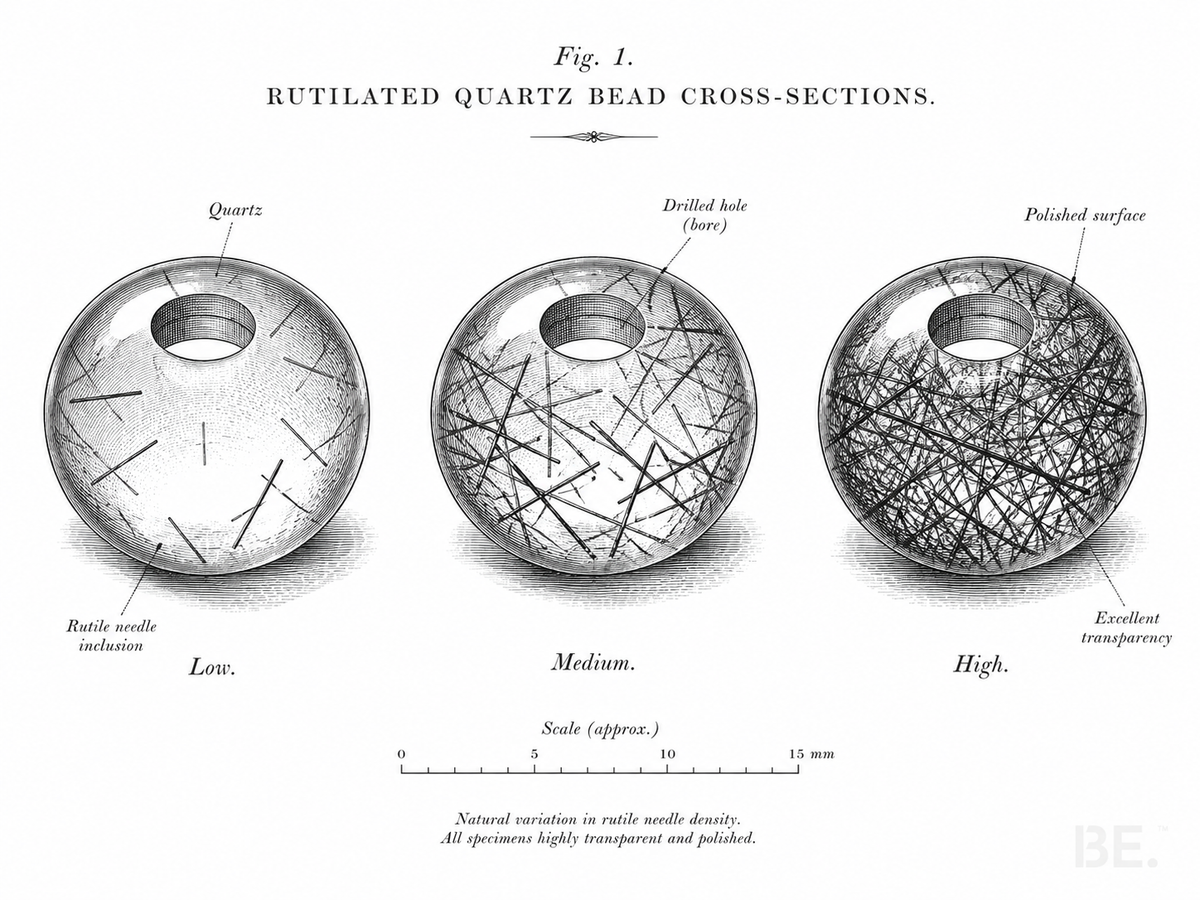
- Needle density. How much of each bead's interior is occupied by inclusions? Sparse needles let more light through and emphasise individual crystal forms. Dense inclusions create a dramatic, high-contrast look but reduce transparency. Neither is better on its own. It depends on what you want the strand to do visually.
- Distribution uniformity. Are the needles evenly distributed across the strand, or do some beads carry heavy inclusions while others are nearly clear? A well-matched strand has consistent visual weight from bead to bead. Mismatched density across a strand suggests the beads were pulled from different rough lots.
- Host transparency. The quartz body should be transparent enough to let you see the inclusions clearly. Milky or heavily clouded quartz obscures the needles and reduces the visual contrast that gives this stone its appeal. Hold the strand against a light source: you should be able to trace individual needles through the bead.
- Needle integrity. Look for complete, unbroken needles with visible terminations. Fractured or truncated inclusions (cut off abruptly by the bead's surface) are inevitable in round beads, but the best strands show at least some fully intact crystals suspended entirely within the quartz.
- Cut and polish. The bead surface should be smooth and uniformly polished. Inclusions that reach the surface can create tiny pits or rough patches where the tourmaline or rutile polishes differently from the quartz. Run your fingernail across the bead: any catching suggests incomplete finishing.
Trade Names, Decoded
The naming around this stone is messy. Here is what the most common trade names mean, and where they overlap:
Black Tourmalinated Quartz
The most mineralogically precise name when the inclusions are confirmed schorl tourmaline. "Tourmalinated" specifies the included mineral. If you see this term used by a seller who provides mineral identification, it is a good sign.
Black Rutile Quartz / Black Rutilated Quartz
Strictly, "rutilated" should mean the inclusions are rutile (TiO₂). In practice, the trade applies this term to quartz with several dark needle types. Compare verified rutile colours in black vs golden rutilated quartz; keep an untested dark-needle specimen provisionally described.
Black Hair Quartz
A colloquial name used mainly in East and Southeast Asian markets. "Hair" refers to the visual texture of fine, thread-like inclusions. The term carries no mineralogical specificity. It could describe tourmaline, rutile or actinolite needles.
The practical takeaway: do not assume the trade name tells you which mineral is inside. If the distinction matters to you, look for sellers who specify the inclusion mineral or, better, provide a Stone Origin Record with sourcing details.
What “black rutilated quartz meaning” can mean, materially
In a mineral-first reading, the “meaning” of black rutilated quartz is not a promise about protection or grounding. It is a visible record of growth: needle direction shows the stress field around the host quartz, needle thickness reflects growth rate, and needle colour points to the inclusion mineral’s chemistry. Dark needles sold as black rutile can be schorl tourmaline or ilmenite, so the useful question is which mineral the needles actually are.
Caring for Black Rutilated Quartz
Quartz at Mohs 7 is harder than most materials it will meet in daily wear. Steel, glass and most common dust particles sit below it on the scale. This makes black rutilated quartz practical for jewellery that gets worn regularly.
- Cleaning. Lukewarm water, a few drops of mild soap, and a soft cloth. Wipe the beads gently, rinse under running water, and pat dry. Avoid ultrasonic cleaners: the mechanical agitation can stress inclusions that reach the bead surface.
- Storage. Store separately from softer stones (fluorite, calcite, pearl) to prevent scratching them. A fabric-lined pouch or individual compartment works well.
- Chemicals. Keep the strand away from perfume, hairspray, and chlorinated water. The quartz itself is unaffected, but residues can dull the polish over time.
- Temperature. Avoid sudden thermal shocks (e.g., moving from a cold car to a hot dashboard in summer). Quartz has low thermal conductivity, and rapid temperature changes can, in rare cases, propagate micro-fractures along inclusion boundaries.
How BE. Grades Black Rutilated Quartz
Every BE. strand ships with a Stone Origin Record that records the origin locality, inclusion type, and lot identifier. It is a traceability tool that lets you verify what you are wearing.
Grading follows the Crystal 4T™ framework:
- Transparency. How clearly the host reveals the inclusion pattern without treating clarity as proof of identity.
- Tone. The colour and saturation of both the inclusion and the host quartz. A high-grade strand has strong contrast between dark needles and a transparent body.
- Treasure. The strength of the lot evidence: documented source, disclosed treatment and analytically confirmed identity where testing exists.
- Texture. The surface finish and internal consistency of the strand: needle distribution, bead matching and polish quality.
The Lot ID on each card links back to our sourcing records, so the provenance chain from rough parcel to finished strand is documented. This matters because, as the trade-names section above illustrates, labelling in the bead market is inconsistent. A card that says "Schorl tourmaline in quartz, Bahia, Brazil" is more useful than a marketplace listing that says "natural black hair crystal A-grade."
A black rutilated strand from BE. Crystal Jewellery carries its lot number, its grading on each Crystal 4T™ axis and an explicit note on what that grading does not establish.
Frequently Asked Questions
Q1. What is black rutilated quartz?
Black rutilated quartz is a loose trade term for quartz with dark needle-like inclusions. The needles may be rutile, schorl or another mineral; the trade name does not prove species, origin or growth sequence.
Q2. Is black rutilated quartz the same as tourmalinated quartz?
They overlap but are not identical. "Tourmalinated quartz" specifically describes quartz with tourmaline inclusions. "Black rutilated quartz" is a looser trade term applied to any quartz with dark needle inclusions, whether those needles are tourmaline, rutile, or both. If the distinction matters, look for a seller who identifies the inclusion mineral.
Q3. How can I tell if black rutilated quartz is genuine?
Use magnification and changing light only as screening for three-dimensional inclusions, surface-reaching colour and condition. Avoid scratch tests. Positive quartz and inclusion identification may require refractive-index, Raman or other gemmological testing.
Q4. What exactly are the black needles inside the quartz?
They are dark mineral inclusions that may be rutile, schorl tourmaline or another species. A finished bead does not establish the species, temperature or growth sequence from appearance alone; state those details only where documented evidence supports them.
Q5. Is black rutilated quartz rare?
The material itself is not geologically rare. Tourmaline-in-quartz and rutile-in-quartz occur in many pegmatite and hydrothermal vein systems worldwide. Gem-quality specimens with high host transparency, well-formed needles and consistent bead-to-bead matching in a strand are much less common.
Q6. Can I wear black rutilated quartz every day?
Yes. Quartz sits at Mohs 7, which is above the hardness of most everyday abrasives. It handles daily wear well. Avoid ultrasonic cleaners (they can stress inclusions near the surface) and sudden temperature extremes. Clean with lukewarm water and a soft cloth. For detailed care guidance, see the section above.
References
- Mindat.org: Rutile
- Mindat.org: Schorl Tourmaline
- Gemological Institute of America (GIA): Quartz Overview
- Wikipedia: Rutile
- Wikipedia: Tourmaline
- Deer, W. A., Howie, R. A. & Zussman, J. (2013). An Introduction to the Rock-Forming Minerals, 3rd ed. Mineralogical Society, London.
- Gem-A: The Gemmological Association of Great Britain
Field Notes.
One stone at a time: its geology, and how to read quality. The Stone Buying Checklist comes with your first email.
By subscribing you agree to receive emails from BE. Unsubscribe anytime.
Sent. Check your inbox.