
Rutilated Quartz: The Stone That Couldn't Stay Quiet
Rutilated quartz contains rutile needles inside quartz. A material-first note on titanium dioxide inclusions, density, readability and BE. golden rutile jewellery.
In this field note
Clear quartz alone is silicon dioxide arranged in a hexagonal lattice. It can be transparent, orderly and quiet. Rutilated quartz begins with that same host, then adds a second mineral event: titanium dioxide crystallising as lines, bundles and directional fields inside the clear body.
Rutile is titanium dioxide
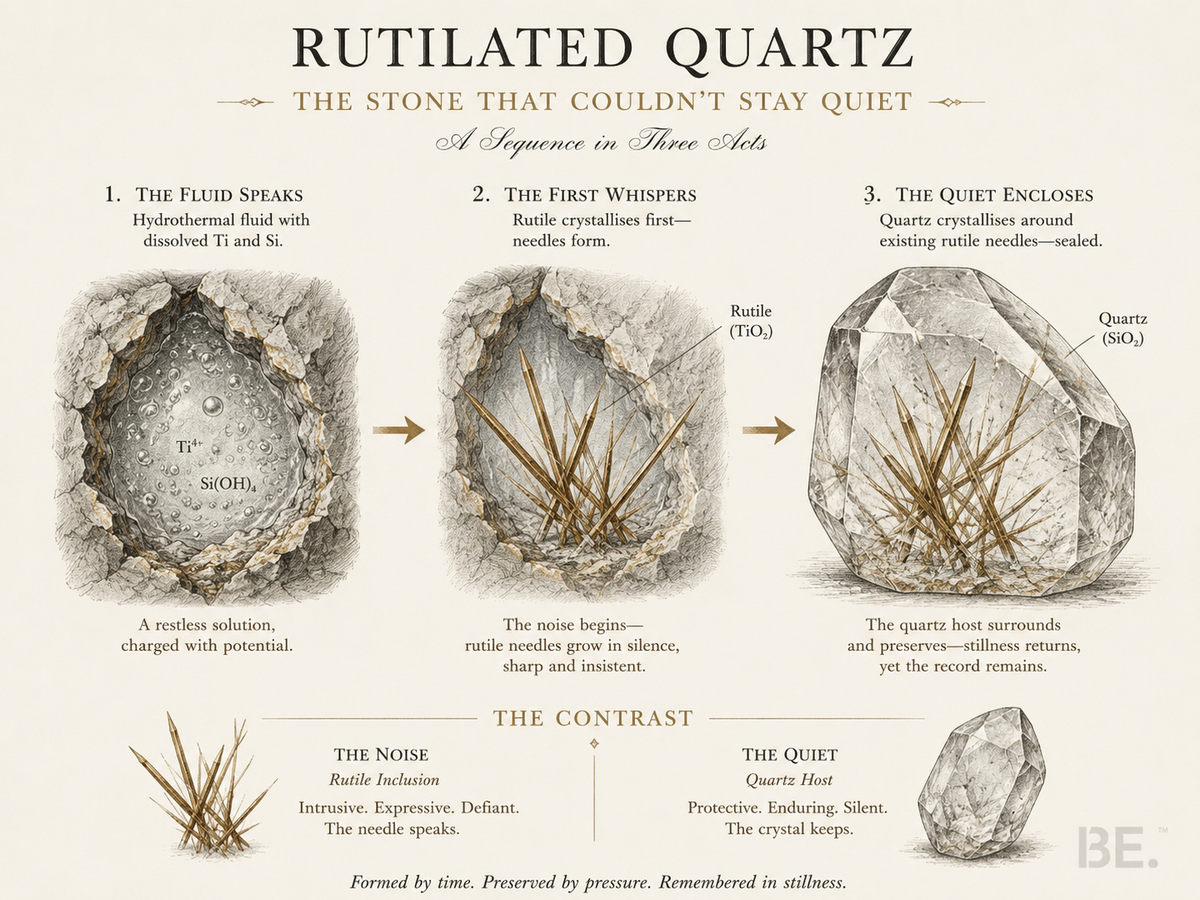
Rutile needles can be fine enough to resemble hair or dense enough to look like captured light. In hydrothermal formation environments, rutile and quartz can grow in overlapping temperature conditions, often discussed around the 400-573°C range. The two minerals do not need to take turns. Quartz can grow around rutile; rutile can remain visible as acicular inclusions inside the host.
Titanium is the ninth most abundant element in the Earth’s crust, and titanium-bearing minerals are known for persistence. In metallic form, titanium is associated with jet engines, medical implants and corrosion resistance. In rutilated quartz, that same element appears as TiO2 needles suspended in a transparent silicate host.
Sagenitic webs and readable structure
Some rutilated quartz shows ordered crossing patterns called sagenitic webs. Needles can intersect at angles that reflect crystallographic directions, sometimes creating 60-degree visual geometry. This is why strong rutilated quartz can look architectural instead of messy. The best pieces let the eye follow how the needles move across the bead.
Density matters, but density alone is not enough. If the quartz host is too cloudy, the rutile becomes visual noise. If the needles are too scattered, the stone can feel weak. When the needles are dense, lie in one direction and sit in a host clear enough to see through, you can follow each needle across the bead.
Co-formation, not surface decoration
Rutile inside quartz is often called an inclusion, but that word can make the needles sound like something added later. In geological terms, rutile and quartz belong to the same formation story. The quartz recorded another mineral growing through the same system.
That is why rutilated quartz reverses the usual gemstone logic. Many stones lose value when inclusions are visible. Rutilated quartz gains value when the inclusion is clear, beautiful, directional and structurally readable.
For how rutile needles form and how BE. grades them, read the rutilated quartz guide.
How BE. uses rutilated quartz
In BE., golden rutilated quartz belongs to The Prism: brightness, movement, internal momentum and visible structure. It is quartz with direction.
For the full buying guide, see Rutilated Quartz Meaning and Properties.
Frequently Asked Questions
What are the gold needles in rutilated quartz?
They are rutile, a titanium dioxide mineral, included within quartz as fine acicular crystals.
Is more rutile always better?
Not always. Density helps, but the best material remains readable: the needles should be visible, directional and supported by a clear enough host.
Does rutile make quartz fake?
No. Rutile is a natural mineral inclusion and the defining feature of rutilated quartz.
References
- GIA Gems & Gemology: Prismatic Rutile in Quartz. Microscopy of rutile inclusions in quartz host.
- Gemdat: Rutilated Quartz. Material profile and trade reference.
- BE. Crystal 4T Grading System. The four observable axes used to read a strand.
- BE. Geological Codex. Material-level reference for the stones in the BE. catalogue.
Field Notes.
One stone at a time: its geology, and how to read quality. The Stone Buying Checklist comes with your first email.
By subscribing you agree to receive emails from BE. Unsubscribe anytime.
Sent. Check your inbox.