
Rutilated vs Clear Quartz: Why It Costs 2-50x More
A geology-first comparison of rutilated and clear quartz — how the inclusions form, what each look offers, and how to choose between them for a strand.
In this field note
Rutilated and clear quartz are often shelved beside each other at very different prices. The host in both is quartz, but a rutilated specimen also makes a claim about its inclusions. Mohs 7 describes the quartz host’s scratch resistance; it does not guarantee equal toughness, fracture stability, drill quality or service life in every bead.
This piece compares the two as a mineralogist would and as a buyer should: how the inclusions form, what each variety looks like at strand scale, where the price gap actually comes from, and how to choose one over the other for a specific stack or season.
The shared host: what quartz actually is
The host material in both is crystalline quartz — SiO2, trigonal system, Mohs 7, with quartz refractive indices around 1.544–1.553. These properties help identify the host, but finished durability also depends on surface-reaching fractures, inclusion boundaries, bead wall thickness, drill edges, settings and impact.
Clear quartz, also called rock crystal, is the colourless variety of macrocrystalline quartz; it may still contain veils, fluid inclusions, fractures or mineral inclusions. “Rutilated quartz” is a trade and descriptive name for quartz containing needles identified or represented as rutile (TiO2). Needle shape or colour is not, by itself, a species-level identification.
How rutile ends up inside quartz
The relative timing of a needle inclusion and its quartz host must be read from the actual inclusion boundaries and growth relationships. Some rutile predates the enclosing quartz; other scenes may record overlapping growth or later fracture-related events. A finished bead removes many crystal-face clues, so formation history should be qualified rather than inferred from a retail name.
Rutile can appear golden, reddish, brown or very dark, but visible colour alone does not reveal the exact trace chemistry. Black needles in quartz may belong to rutile-group material or to another included mineral. Species-level wording should follow microscopy or analytical evidence, not a colour nickname. The broader crystal-colour guide explains why appearance and chemical cause must be kept separate.
Side by side: how they actually compare
| Property | Clear quartz | Rutilated quartz |
|---|---|---|
| Chemistry | SiO2 | SiO2 host + TiO2 needles |
| Mohs hardness | 7 | 7 (host); rutile 6–6.5 |
| Transparency | Water-clear to slightly hazy | Transparent host, opaque needles |
| Visual story | Optical purity | Internal architecture |
| Inclusion direction | Ideally none visible | Random sprays, parallel sets, or stars |
| Value factors | Host clarity, form, condition, cut, matching and construction | Host condition plus disclosed inclusion identity, pattern, cut, matching and construction |
| Origin highlights | Brazil (Minas Gerais), Arkansas, Madagascar | Brazil (Novo Horizonte, Bahia), Madagascar, Pakistan |
What changes at strand scale
At strand scale, clear quartz can read as a continuous field of transparency, while rutilated quartz breaks that field into bead-specific inclusion scenes. Each bead samples a different part of the rough: one may show a single needle, another a fan, and another several intersecting directions. The useful quality question is whether those differences look intentionally matched and whether fractures or drill edges interrupt the structure.
This is why rutilated quartz rewards close looking and clear quartz rewards stillness. Stack them together and you get both registers at once: the rutilated bead asks the eye to investigate, the clear bead lets it rest.
- Needle legibility. Judge whether the inclusions remain distinct within a usable host, rather than assuming sparse or dense is universally better.
- Needle colour and identity. Gold, copper, red-brown and dark needles create different visual effects, but colour does not identify the included species.
- Host clarity. A milky or fractured host devalues the bead regardless of needle quality.
- Intersecting patterns. Crossing needles can create a geometric burst, but that visible pattern should not be called asterism unless the stone shows a true star-like optical effect under directed light.
- Match across the strand. Premium strands are graded so the bead-to-bead variation reads as composition, not chaos.
Why the prices diverge
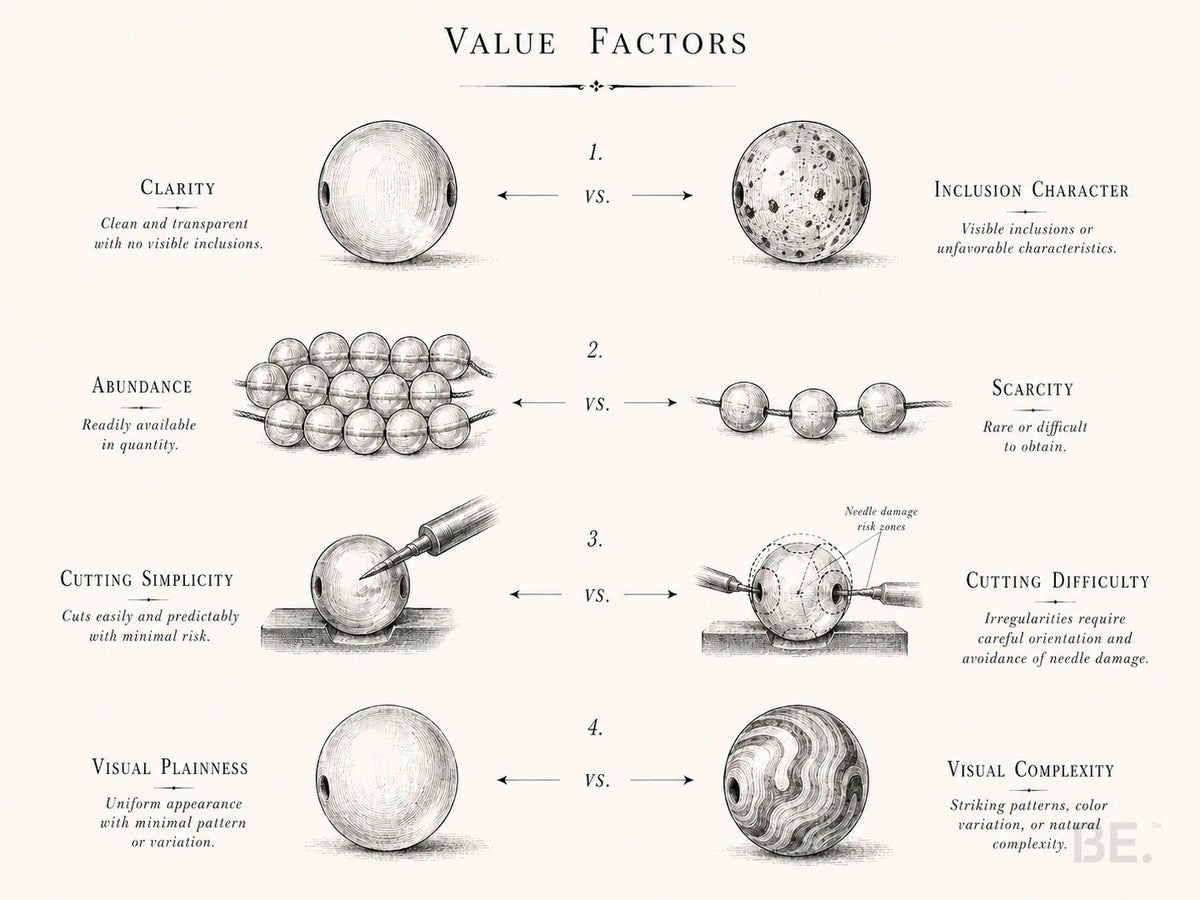
Clear quartz is paid for in clarity (no veils, no fractures), in cut precision, and in bead size — larger beads from clean crystal cores command a steeper premium because the parent material has to be both internally clean and large enough to yield big beads.
Rutilated quartz asks the cutter to preserve two visual systems at once: a usable quartz host and an inclusion pattern that remains legible after shaping. Yield can fall when fractures interrupt the host or when a cut misses the strongest needle arrangement. That can create a premium over a genuinely comparable clear-quartz object, but the difference is not a fixed multiplier. Compare the same object category, dimensions, condition, workmanship, disclosure and seller service before attributing the gap to rutile alone.
How to choose between them
The decision is rarely about which is "better" — they answer different questions. Clear quartz is the choice when the wrist already carries a lot of visual information: textured metals, coloured stones, layered strands. It reads as a neutral, an optical pause. Rutilated quartz is the choice when the strand is meant to be the focal piece — when it sits alone on a bare wrist, or anchors a stack of muted, single-tone beads.
Skin tone matters less than light. Clear quartz changes character dramatically across the day; outdoors it disappears and indoors it gathers warmth from nearby surfaces. Rutilated quartz holds its needles in any light, which makes it the more photogenic of the two and the easier to wear in low-lit environments.
For layering, equal Mohs hardness does not make bead-on-bead contact harmless: quartz beads can still chip one another at drill edges or impact points. Use spacing, a stable stringing design and a fit that limits collision. When pairing quartz with softer or cleavage-prone materials such as pearl, opal or moonstone, reduce rubbing and impact rather than relying on wrist position alone.
Frequently asked questions
Q1.Is rutilated quartz a different mineral from clear quartz?
The host in both is crystalline quartz (SiO2). Rutilated quartz additionally contains needle-like inclusions represented as rutile (TiO2), so the host identity is shared while the complete material description is not identical.
Q2.Are the rutile needles fragile?
Enclosed needles are protected by the quartz host, but durability still depends on whether inclusions or fractures reach the surface, especially near drill holes. Mohs hardness describes scratch resistance and does not by itself predict chipping or fracture growth.
Q3.Why are some rutilated quartz strands black and others gold?
Rutile and other needle-like inclusions can appear gold, copper, red-brown or dark. Trace chemistry can influence colour, but colour alone cannot establish whether a dark needle is rutile, a rutile-group phase or another included mineral.
Q4.Does clear quartz have inclusions too?
Yes — almost all natural clear quartz contains some inclusions at high magnification (fluid pockets, healed fractures, dust-line growth bands). What buyers call "clean" clear quartz simply has no inclusions visible at arm’s length.
Q5.Can I wear them together?
Yes, with normal care. Both have a quartz host, but two equally hard beads can still chip at impact points or abrade vulnerable drill edges. A stable fit and spacing matter more than treating equal Mohs numbers as a no-damage guarantee.
Q6.How do I tell premium rutilated quartz from commercial grade?
Compare like with like: disclosed host and inclusion identity, stable condition, a pattern that remains legible after cutting, clean drill edges, polish, bead-to-bead composition, construction and documentation. “Premium” has no universal rutilated-quartz grading standard, so ask the seller to define it in observable terms.
References
- Mindat — Quartz mineral data
- Mindat — Rutile mineral data
- Mindat — Quartz mineral data
- Wikipedia — Rutile
- Wikipedia — Quartz
- Webster, R. (2002). Gems: Their Sources, Descriptions and Identification, 5th ed. Butterworth-Heinemann.
- Schumann, W. (2009). Gemstones of the World, 4th ed. Sterling.
Field Notes.
One stone at a time: its geology, and how to read quality. The Stone Buying Checklist comes with your first email.
By subscribing you agree to receive emails from BE. Unsubscribe anytime.
Sent. Check your inbox.