
Prehnite: The Pale Green Stone Few Sellers Grade Well
A geology-first guide to prehnite — calcium-aluminium silicate formation, why some pieces show epidote needles, top deposits and how to read a strand.
In this field note
Prehnite is one of the few gemstones named after a person rather than a place or property, and the person was an unlikely candidate: an eighteenth-century Dutch military officer stationed at the Cape who collected minerals between troop inspections. The stone he sent to Europe was so unfamiliar that the Berlin mineralogist Abraham Werner had to invent a new name for it. Two hundred and forty years later, the original Cape locality still produces the reference material against which all other prehnite is graded.
This guide explains what prehnite is mineralogically, why colour ranges from pale lemon to deep apple green, what the dark needles inside many specimens really are, where the visible market material forms, and how to read a strand of beads with confidence. For a wider view of how prehnite sits next to the two phantom quartzes in the same colour family, see the comparison piece on green crystals.
What prehnite actually is
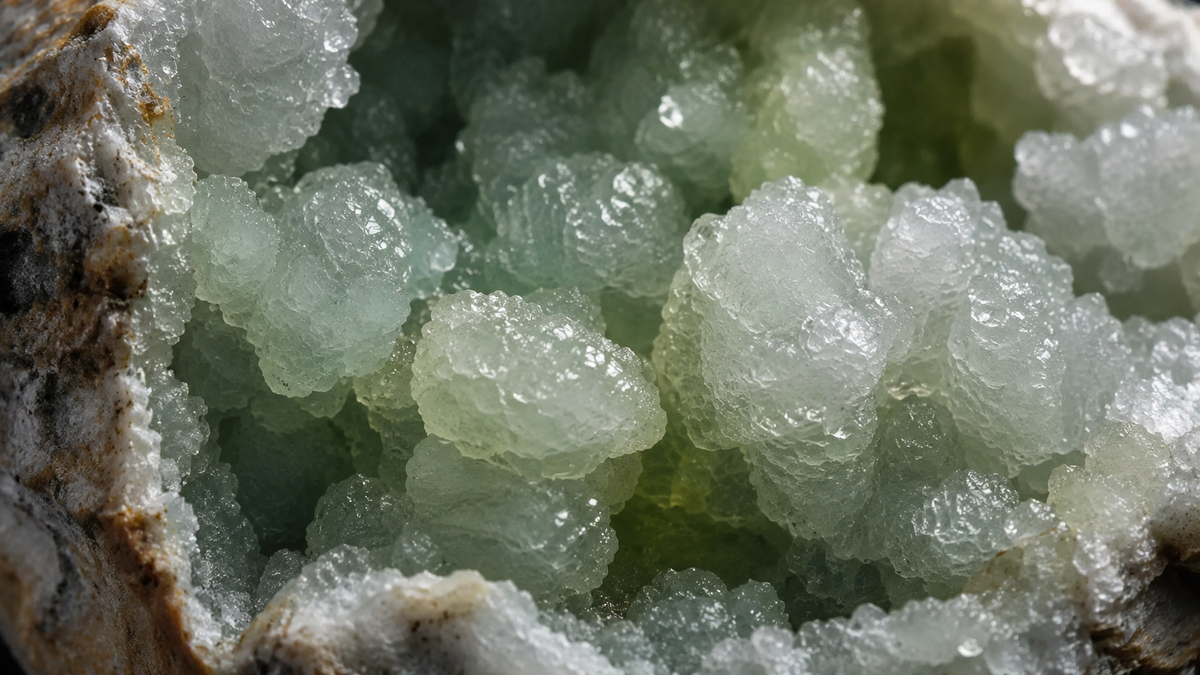
Prehnite has historically been classified as a phyllosilicate, but modern crystal-chemical work places it at the phyllosilicate / sorosilicate boundary — its (AlSi₃O₁₀) framework shows sheet-like character with tectosilicate affinities. Its formula is Ca2Al(AlSi3O10)(OH)2. It crystallises in the orthorhombic system but rarely forms textbook prismatic crystals — the standard habit is botryoidal: rounded, grape-like masses that line vugs and fractures in basalt and dolerite. Under a loupe these botryoids resolve into tight bundles of tabular sub-crystals radiating from a common base.
Prehnite forms in the prehnite-pumpellyite metamorphic facies — a low-grade regime between burial diagenesis and greenschist conditions, typically 200-300 °C and modest pressure. It is therefore associated with hydrothermal alteration of mafic volcanic rocks: ancient basalt flows whose vesicles and fractures became filled with secondary minerals over millions of years. Common cavity companions are zeolites, calcite, datolite and epidote.
Mohs hardness is 6 to 6.5 — hard enough for everyday jewellery but softer than quartz. The mineral is named after Colonel Hendrik von Prehn (1733-1785), an officer in the Dutch East India Company and an amateur mineralogist who described the stone from the Karoo region of the Cape Colony around 1773 (precise type locality is debated in older sources; Cradock in the Eastern Cape is the most commonly cited modern reference). His original specimens reached Werner in Berlin, who formalised the name prehnite in 1788 — making it one of the first minerals named after a living person.
Why the colour varies
Prehnite's signature apple green comes from minor iron substituting for aluminium in the lattice (Fe3+ for Al3+). The depth and exact hue depend on how much iron entered, plus what other minerals co-crystallised inside the cavity.
| Variety / colour | Cause | What it tells you |
|---|---|---|
| Apple green | Moderate Fe3+ substituting for Al3+ (typically 0.5-2 wt%) | The standard market colour; iron-rich hydrothermal fluid acting on basalt |
| Yellow-green to lemon | Lower iron content, sometimes with trace manganese | Australian and Malian material often falls in this range; reads cooler in daylight |
| Pale green to colourless | Very low iron, near end-member chemistry | Scottish Strontian-region material; close to the textbook pure prehnite formula |
| Apple green with dark needles | Epidote (Ca2(Al,Fe)3(SiO4)3(OH)) needles co-crystallised during cavity filling | Both minerals grew together in the same vug; the epidote provides a visible internal texture |
| Olive to brownish green | Higher iron and minor titanium substitution | Less commercially popular but mineralogically the most iron-rich variety |
Where the visible material forms
Prehnite is geographically widespread but commercial deposits are concentrated where ancient basalt provinces have been deeply weathered and exposed. Each major source has its own visual signature.
| Origin | Typical character | What to look for |
|---|---|---|
| Cape, South Africa (Karoo dolerite sills) | The historic type locality; apple green with frequent epidote needles | The reference material; dense, translucent, with classic grape-like surface texture |
| New South Wales, Australia (Wave Hill, Prospect Hill) | Yellow-green to lemon, often clean and translucent | Brighter, cooler tone than Cape material; usually free of epidote inclusions |
| Mali (Kayes region) | Lemon to apple green, frequently with epidote needles in star-burst pattern | The most striking epidote-in-prehnite combinations on the current market |
| Strontian, Scotland (historic) | Pale green to colourless, near end-member chemistry | Historic specimen material; rarely seen in bead form but scientifically important |
| Jeffrey Mine, Quebec, Canada | Pale apple green with occasional grossular garnet companions | Now-closed mine; older inventory still circulates as specimen material |
Reading a prehnite strand
Prehnite is one of the more variable stones bead-to-bead, because the original material is mined as cavity fillings of irregular size. Reading a strand is mainly about matching tone, translucency, and inclusion character.
- Translucency. Hold the strand against a window. Good prehnite glows softly, like backlit jade. Collectors often describe strong material as lit from within: jelly-like translucence matters more than a vivid green. Beads that look opaque or chalky are usually weathered surface material rather than fresh interior.
- Colour evenness. Botryoidal masses have a colour gradient from rim to centre. A well-graded strand pulls beads from similar zones; mixed strands jump from lemon to apple between beads.
- Epidote needle distribution. If the strand is marketed as epidote-in-prehnite, the needles should be visible inside the bead, not just on the surface. Surface-only needles often mean the bead was polished from an outer rind.
- Lustre. Polished prehnite shows a vitreous-to-pearly lustre. A dull, waxy surface suggests undercured polishing or tumbled rather than hand-polished beads.
- Bead shape integrity. Prehnite has a weak basal cleavage. Look for small step-fractures near the drill hole; significant chipping means the material was worked too aggressively.
Trade names, decoded
Prehnite has accumulated a handful of trade names, most of which are misleading borrowings from more famous gems.
- Cape emerald. A historic trade name for South African prehnite. Misleading — prehnite is not beryl, and the colour is yellow-green rather than the bluish-green of true emerald.
- Evening emerald. Another nineteenth-century misnomer. Avoid; the term has also been applied to peridot and is genuinely confusing in writing.
- Chiltern emerald. Old Australian dealer term for New South Wales prehnite. Again misleading on the same grounds.
- Epidote-in-prehnite. Accurate — prehnite bead with visible needle inclusions of true epidote. This is a real and desirable variety; ask for source to confirm.
- Prehnite jade. Modern Chinese-market term. Not jade (which is jadeite or nephrite); just descriptive of the soft translucent green. Should be sold as prehnite.
Caring for prehnite
At Mohs 6-6.5, prehnite is durable enough for most jewellery but softer than quartz, so it scratches if stored against harder strands. Keep it in its own pouch. Avoid ultrasonic and steam cleaners — prehnite contains structural hydroxyl groups, and sustained heat or vibration can cause micro-fracturing along the basal cleavage. Clean with lukewarm soapy water and a soft cloth. Direct prolonged sunlight is fine; the iron chromophore is photostable.
How BE. grades prehnite
Every prehnite strand is read against the Crystal 4T framework — Transparency, Tone, Texture and Treasure — and ships with a Stone Origin Record stating the source country and region (Cape, NSW and Mali are recurring sources, and where the upstream supplier has disclosed a specific deposit the locality is recorded) and naming any included minerals (epidote, datolite, calcite) at the species level. Tone is measured against BE.'s apple-green to lemon-green reference under daylight-balanced light; strands pass only if bead-to-bead tone variation stays within one reference step. Beads with surface-only epidote needles are excluded from epidote-in-prehnite strands.
Frequently asked questions
Q1.Is prehnite a type of jade?
No. Jade is either jadeite (a pyroxene) or nephrite (an amphibole). Prehnite is a calcium-aluminium silicate in a separate mineral group entirely. The visual resemblance is coincidence; the chemistry, lattice, and hardness differ.
Q2.What are the dark needles inside some prehnite beads?
They are crystals of epidote — a calcium-iron-aluminium silicate that grew alongside prehnite in the same basalt cavity. Epidote needles are a natural co-mineral, not a contaminant or a defect. Material with visible needles is often marketed as epidote-in-prehnite.
Q3.Why is prehnite often translucent rather than transparent?
Because it grows as botryoidal masses of tight sub-crystals rather than single crystals. Light entering the bead refracts between sub-crystal boundaries, producing the characteristic soft, almost backlit-jade appearance. Fully transparent prehnite is rare and usually faceted into specimen-grade gems.
Q4.Where does prehnite get its name?
From Colonel Hendrik von Prehn, a Dutch East India Company officer stationed at the Cape Colony in the 1770s, who first described the mineral to European mineralogists. Werner formalised the name in 1788 — making prehnite one of the earliest minerals named after a living person.
Q5.Can prehnite be confused with grossular garnet or peridot?
Visually, yes — all three can show a yellow-green tone. But they differ in hardness (garnet 6.5-7.5, peridot 6.5-7, prehnite 6-6.5) and refractive index, and prehnite is the only one with a botryoidal habit and pearly basal lustre. A jeweller can separate them in seconds with a refractometer.
Q6.Does prehnite fade in sunlight?
No. The iron chromophore is photostable and prehnite can be worn outdoors indefinitely without colour loss. The only environmental concern is sustained heat above about 350 °C, which can drive off structural water.
Q7.How hard is prehnite on the Mohs scale?
Prehnite is Mohs 6–6.5. It is suitable for jewellery with care, but it scratches more readily than quartz; store it away from harder stones and avoid hard knocks.
References
- Mindat — Prehnite data
- GIA Gems & Gemology — Prehnite varieties
- Wikipedia — Prehnite
- Wikipedia — Epidote (co-mineral)
- Webster, R. (2002). Gems: Their Sources, Descriptions and Identification, 5th ed. Butterworth-Heinemann.
- Schumann, W. (2009). Gemstones of the World, 4th ed. Sterling.
Field Notes.
One stone at a time: its geology, and how to read quality. The Stone Buying Checklist comes with your first email.
By subscribing you agree to receive emails from BE. Unsubscribe anytime.
Sent. Check your inbox.