
How to Measure Your Wrist for a Bracelet (3 Ways, No Tape)
Measure your bare wrist with paper or non-stretch string. Check a fitting bracelet's inner circumference. Use product size details and Find Your Size.
In this field note
A wrist measurement gives you a useful starting point for choosing a bracelet. Paper, string and an existing bracelet can all help, although they measure different things. The way a finished strand moves and feels on the wrist also matters. Bead diameter, construction and clasp design can affect the space inside the closed bracelet.
To turn a wrist measurement into a strand size, use the crystal bracelet size chart.
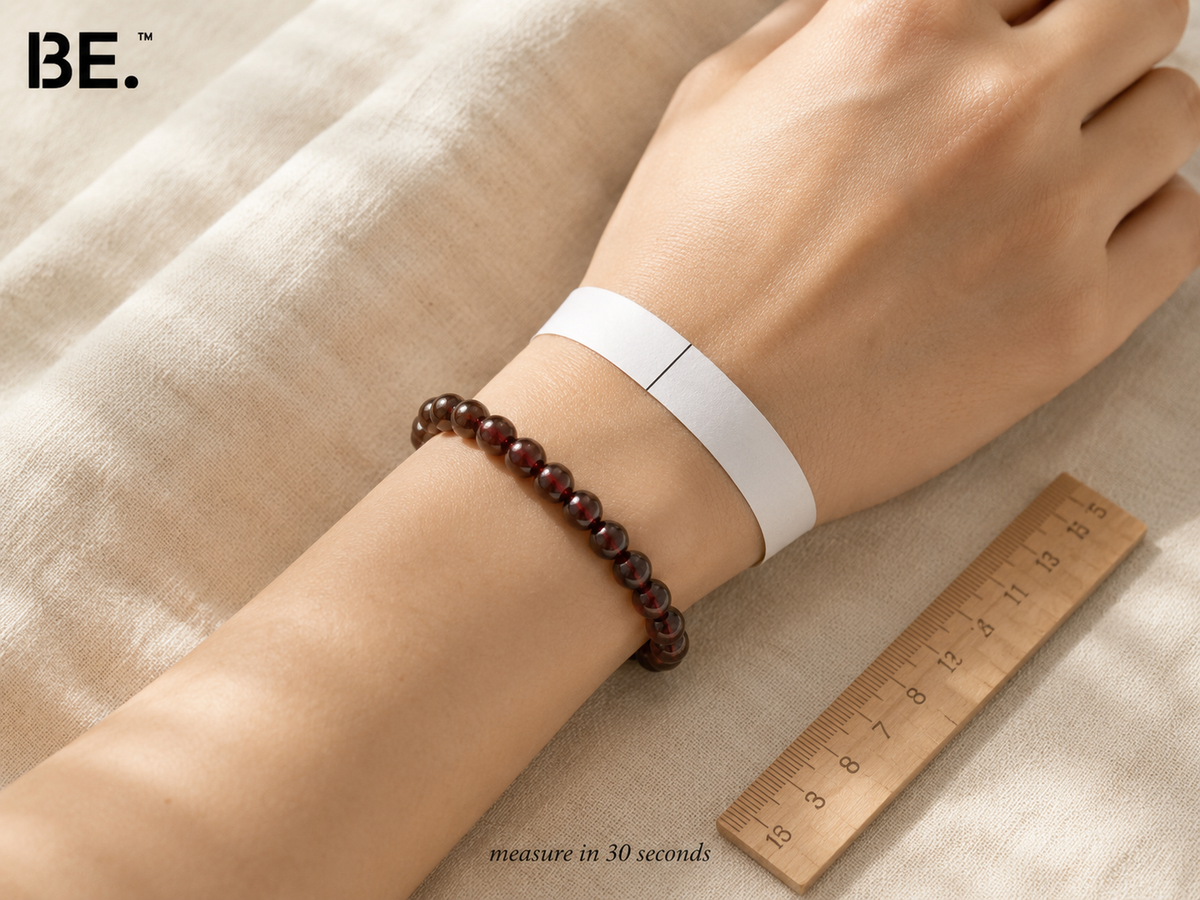
A clasped bead bracelet and a rigid bangle can require different measurements. Check the opening and the measurement basis of the design before choosing a size.
Three ways to measure your wrist
- 1. Paper strip. Cut a narrow strip of paper and wrap it around your bare wrist where the bracelet will sit, close to the wrist bone. Keep it against the skin without pulling tight. Mark the overlap, lay the strip flat and measure to the mark with a ruler.
- 2. String or ribbon. Use a material that does not stretch easily. Wrap it around the same position on your bare wrist, mark the overlap and lay it straight against a ruler. Record the measurement without adding fit allowance at this stage.
- 3. Existing bracelet. Fasten a bracelet whose fit you like. Where its shape allows, measure around the inside of the closed loop with a flexible tape and record the result as its inner circumference. A flat end-to-end measurement describes a different length. Compare this reference only with a product measurement that uses the same basis.
For the paper and string methods, measure the wrist on which you intend to wear the bracelet. Keep the material against the skin without compressing it. If you wear bracelets on both wrists, measure each one separately. An existing bracelet provides a finished-piece measurement that should be recorded separately.
Choosing a fit preference
Fit preference describes how a finished bracelet rests and moves on the wrist. The observations below help you assess the feel you prefer. They are not a length conversion. For the final size choice, check the specific product's available measurements and how they are defined, alongside BE.'s current Find Your Size guide.
| Fit preference | What to observe | Selection basis |
|---|---|---|
| Close | The bracelet rests close to the wrist with limited movement. Check for pressure or pinching when bending your wrist. | Use your bare wrist measurement and check how the selected product defines its available sizes. |
| Regular | The bracelet moves naturally with the wrist without persistent pressure or unwanted sliding toward the hand. | Compare the product's stated size options with its measurement basis and the current Find Your Size guidance. |
| Loose | The bracelet moves more freely and may sit farther toward the hand. Observe how it behaves during normal movement. | Review the available sizes and their measurement basis, using the current Find Your Size guide as a reference. |
Fit preference varies from person to person. A comfortable strand should allow natural wrist movement without persistent pressure. How much it moves depends on the bracelet's construction, bead diameter, clasp and actual inner space.
Why bead diameter affects fit
A bracelet's closed-loop inner circumference can differ from its finished centreline length. Larger beads may change the space available inside the loop because of their shape and arrangement. Two strands with similar listed finished lengths can therefore feel different. Check the measurement basis for each design and use Find Your Size to compare its available options.
Before choosing a size
- Measure under ordinary conditions. Recheck your wrist circumference if you notice a change during the day or with temperature.
- Keep the wrap gentle. The material should touch the skin without compressing it.
- Record both units. Note centimetres and inches so any size chart works.
- Consider bead diameter. Check the design's measurements and fit guidance before choosing between available lengths.
- Use the size guide. Compare the options with Find Your Size, especially when the product measurement differs from the reference you have taken.
How BE. handles sizing
BE. products display their available size options. Start with your bare wrist circumference, then read the measurement basis stated for the selected design. The inner circumference of a closed bracelet and its finished centreline length can differ. Find Your Size provides guidance for comparing the available options with your wrist measurement.
Frequently asked questions
Q1.How do I measure my wrist without a tape measure?
Wrap a narrow paper strip or non-stretch string around your bare wrist where the bracelet will sit. Mark the overlap, lay the material flat and measure to the mark with a ruler. Record this as your bare wrist circumference, without adding fit allowance.
Q2.How do I choose between a close, regular and loose fit?
A close fit has limited movement around the wrist. A regular fit allows natural movement without persistent pressure or unwanted sliding. A loose fit moves more freely and may sit farther toward the hand. These describe how you prefer a bracelet to feel and move. Check the product's stated measurement basis and consult BE.'s current Find Your Size guide when choosing a size.
Q3.Does bead size affect fit?
Yes. Bead diameter can affect the space available inside the finished bracelet. Similar listed centreline lengths do not necessarily provide the same inner clearance. Compare each product using its stated measurement basis and Find Your Size.
Q4.Which wrist should I measure?
Measure the wrist on which you intend to wear the bracelet. If you regularly switch wrists, measure both sides separately. Use each measurement for the wrist on which the bracelet will be worn.
Q5.Is there an average wrist size I should use?
A population average is not a reliable size for an individual bracelet. Measure the bare wrist on which you intend to wear it. Then compare your measurement using the basis stated for the product and BE.'s Find Your Size guide.
Q6.How do I choose a bracelet size before buying?
Measure your bare wrist at the intended wearing position. Review the available sizes and the measurement basis stated for the specific product, alongside BE.'s current Find Your Size guide. Consider whether you prefer a close, regular or loose feel. Actual fit also depends on bead diameter, construction and clasp.
References
- BE. Size Guide
- Crystal Bracelet Size Chart
- Bracelet: Wikipedia
- BE. Journal (2026). Beaded Crystal Bracelets: Materials, Stringing & What to Check.
Field Notes.
One stone at a time: its geology, and how to read quality. The Stone Buying Checklist comes with your first email.
By subscribing you agree to receive emails from BE. Unsubscribe anytime.
Sent. Check your inbox.