
Wearing Crystal Bracelets Through Pregnancy and Postpartum
A wrist changes size through pregnancy and back again afterwards. Which closure copes, which stones suit washed hands, and what changes with a newborn.
In this field note
A bracelet that went on easily in the spring stops going on in the autumn, and the first assumption is usually that something has gone wrong with the bracelet.
Nothing has. Fluid retention through the later months of pregnancy changes hands and wrists more than most people are warned about, and jewellery is where it gets noticed first. What follows is a fit problem with a fit answer.
Is it safe to wear a crystal bracelet while pregnant?
There is no known physical problem. Quartz, feldspar and garnet are inert silicates that sit against skin without reacting, dissolving or transferring anything through it. A bracelet is, materially, no different from a glass bangle.
This site makes no claims beyond that sentence, in pregnancy or otherwise. What is and is not established about stones and the body is set out honestly in Do Crystals Affect the Human Body?, and everything below is about fit, wear and practicality instead.
Why does a bracelet that fitted in month three cut in by month eight?
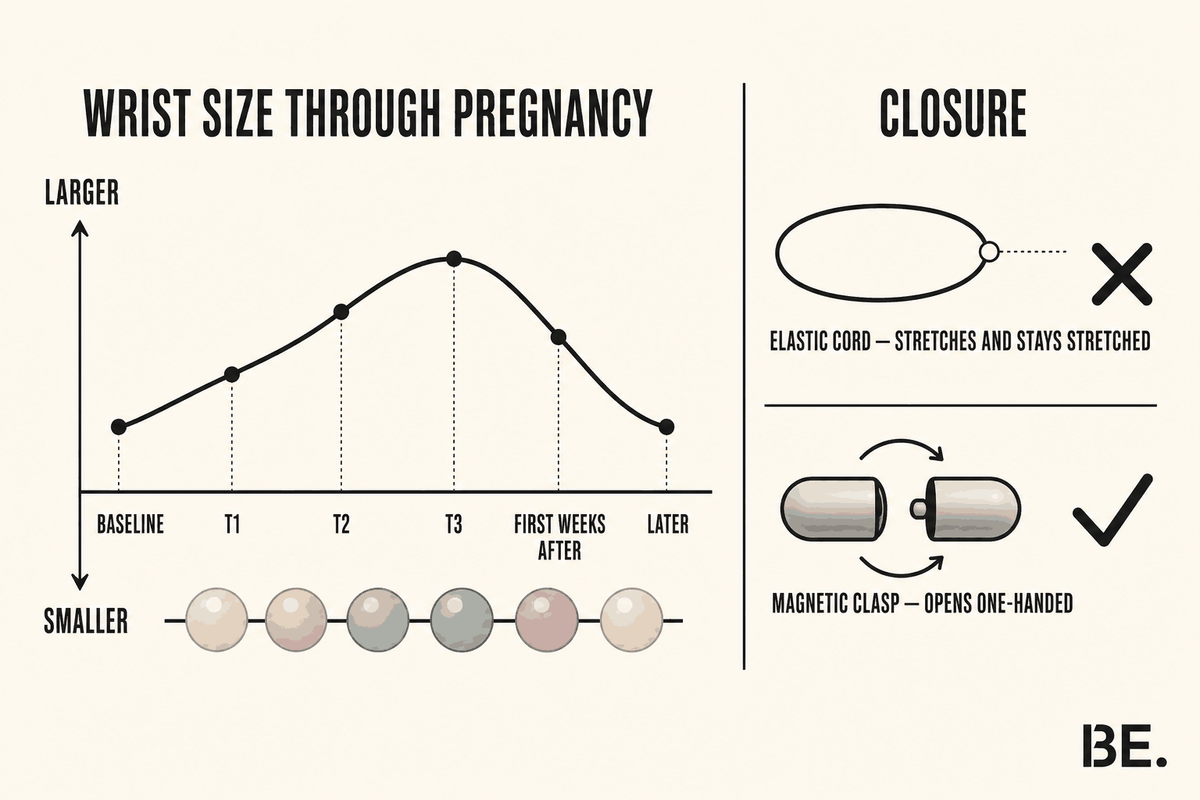
Fluid retention. Circulating blood volume rises substantially through pregnancy and fluid distributes into soft tissue, with hands, ankles and feet showing it most. Wrists follow, and the change often arrives quickly in the third trimester rather than gradually across the whole nine months.
Elastic cord handles this badly. Forced over a swollen hand it stretches beyond its recovery point, and it does not shrink back afterwards — the strand that was tight in August is loose and rolling by November. Steel wire has no give at all, which sounds worse and is actually better: it either fits or it comes off, and it never quietly deforms into the wrong size.
Which closure copes with a wrist that changes size?
One that opens. A magnetic clasp separates with a sideways twist and closes by being brought together, which means a swollen hand never has to be forced through a fixed loop. On a day when the fit is uncomfortable, the bracelet comes off in a second rather than being wrestled with.
| Stage | Wrist compared with baseline | Fit strategy | Closure that copes |
|---|---|---|---|
| Before pregnancy | Baseline | Measure once and record it | Any |
| First trimester | Usually unchanged | Wear as normal | Any |
| Second trimester | Slightly up for some | Leave a finger of slack | Opening clasp preferred |
| Third trimester | Often noticeably up | Size up, or wear intermittently | Magnetic clasp |
| First weeks after birth | Falling | Re-check the fit weekly | Magnetic clasp |
| Later postpartum | Near baseline for most | Re-measure before resizing | Any |
No centimetre figures appear in that table on purpose. The range between individuals is wide enough that a published number would be wrong for most readers. Measuring is quick and it is specific; the method is in the wrist measuring guide and the bead count that follows from it is in the size calculator.
What changes after the birth?
Two things, and they arrive at once. Swelling recedes over the following weeks, so a strand sized for the third trimester becomes loose and needs re-checking rather than being left to roll. And the other hand stops being available.
That second change is the one nobody plans for. Fastening a lobster clasp requires two hands and a mirror-image of dexterity that is hard to produce at the best of times; with a baby in one arm it is not happening. A clasp that closes by being pressed together can be managed against a table edge, one-handed, in the four seconds available. This is the least romantic argument for a magnetic clasp and the most useful one.
Which stones suit hands that are washed constantly?
The quartz family, without qualification. Clear, rose, amethyst, citrine, smoky, rutilated and hematoid quartz are all Mohs 7 with no cleavage and no water sensitivity, and brief contact with water and soap does nothing to them.
Three are worth taking off at the sink. Moonstone has two cleavage directions and a surface that dulls with repeated detergent contact. Kyanite splits easily along one plane. Obsidian is volcanic glass, and while water does not harm it, the polish shows every soap film. The stone-by-stone version of this is the shower guide, and the cleaning method for each is in the care chart.
What is worth avoiding around a newborn?
- Anything that can come apart unsupervised. A strand on steel wire with a mechanical clasp is the format that fails visibly rather than suddenly.
- Exposed metal edges or protruding fittings, which meet a baby's skin at close range constantly.
- Beads with a rough or pitted polish. A well-finished sphere passes over skin without catching; a poorly finished one does not.
- Long stacks during feeds and carrying, where several strands slide down the forearm and end up between arm and baby.
Bead finish deserves the emphasis it gets there. It is invisible in a photograph and obvious against skin, and it is the difference between a strand that can be worn while holding a baby and one that gets taken off after a week. Polish quality is one of the things the Crystal 4T texture criterion exists to describe.
Frequently asked questions
Q1.Can I wear a crystal bracelet while pregnant?
There is no known physical problem. Quartz and the other stones used in bracelets are inert silicates that sit against skin without reacting or transferring anything through it. The practical question is fit rather than safety, because wrists commonly change size.
Q2.Do wrists get bigger during pregnancy?
Often, and usually late. Fluid retention through the third trimester shows up in hands and wrists, and it can arrive over a couple of weeks rather than gradually. Jewellery is normally where it is noticed first.
Q3.Will an elastic bracelet stretch out during pregnancy?
It can, permanently. Elastic cord forced over a swollen hand stretches past its recovery point and stays loose afterwards. Steel wire has no give, so it either fits or comes off, and it never deforms into the wrong size.
Q4.Is a magnetic clasp better during pregnancy?
It copes better with a wrist that changes. A magnetic clasp opens with a sideways twist, so a swollen hand never has to be forced through a fixed loop, and the bracelet can be removed in a second on a day when it is uncomfortable.
Q5.How soon after birth does wrist size return to normal?
Swelling generally recedes over the weeks that follow, though the pace varies a great deal between individuals. Re-checking the fit weekly is more useful than waiting for a fixed date, and re-measuring before resizing avoids buying the wrong length twice.
Q6.What should I check on a bracelet before holding a newborn?
Bead finish first, because a well-polished sphere passes over skin without catching and a rough one does not. Then the fitting: no exposed edges, nothing protruding, and a clasp that fails visibly rather than suddenly.
References
- Wikipedia — Edema
- Wikipedia — Maternal physiological changes in pregnancy
- Mindat — Quartz mineral data
- GIA Gem Encyclopedia — Moonstone
- Anderson, B. W. and Jobbins, E. A. (1990). Gem Testing, 10th ed. Butterworth-Heinemann.
Field Notes.
One stone at a time: its geology, and how to read quality. The Stone Buying Checklist comes with your first email.
By subscribing you agree to receive emails from BE. Unsubscribe anytime.
Sent. Check your inbox.